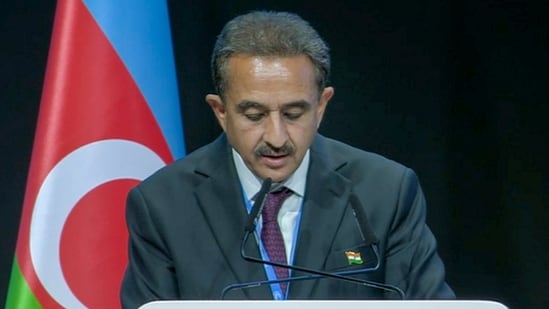
While India and the Global South are bearing huge economic burdens in mitigating climate crisis, severely limiting their capacity to meet developmental needs, it has not dampened India’s resolve on climate action, Kirti Vardhan Singh, minister of state for environment and external affairs said at COP29 on Tuesday.
Union Minister of State for Environment Kirti Vardhan Singh delivers India's national statement during the COP29 climate conference, in Baku, Azerbaijan, Tuesday. (PTI)
“The high Carbon Emission Development Pathways of the Global North in past have left very little carbon space for the Global South. However, our growth trajectories for fulfilling the primary needs of sustainable development and poverty eradication cannot be compromised,” he said as he presented India’s national statement.
“Despite not contributing to the problem, we in the Global South are bearing huge financial burden on account of climate actions for mitigation on the one hand, and losses and damages caused by climate change on the other, thus severely limiting our capacity to meet our developmental needs,” he said, while clarifying that “these have not dampened India’s resolve and commitment to take ambitious climate actions”.
Global South is bearing huge financial burden on account of climate actions for mitigation on the one hand, and losses and damages caused by climate change on the other, thus severely limiting our capacity to meet our developmental needs, he said.
“What we decide here, will enable all of us, particularly those in the Global South, to not only take ambitious mitigation action but also adapt to Climate Change. This CoP is historic in this context,” Singh said, cautioning that decisions at COP29 should be guided by the core principles of Equity, Climate justice and Common but Differentiated Responsibilities and Respective Capabilities provided in the UNFCCC and its Paris Agreement.
The context of different national circumstances, sustainable development goals and poverty eradication, particularly in respect of the Global South should not be lost sight of.
The next round of Nationally Determined Contributions is due for submission the next year. The breach of carbon space seems imminent towards the end of this critical decade, Singh underlined.
“It is imperative, therefore, that the developed countries show leadership in mitigation actions, as required under Paris Agreement, by not just advancing their net zero targets but providing enough carbon space for developing countries like ours to develop,” he said.
Developed countries need to appreciate that huge costs are being imposed on a developing country like ours for undertaking the climate actions, Singh said.
“What we decide here on NCQG must be founded on the principle of climate justice. The decisions must be ambitious and unambiguous, taking into consideration the evolving needs and priorities of the developing countries, and their commitment to sustainable development and eradication of poverty,” India’s statement added.
Singh added that India achieved its 2015 NDC targets on emission intensity reduction and non-fossil based installed electricity generation capacity much earlier than 2030 and have further enhanced ambition. India’s Renewable Energy Capacity has nearly tripled from its 2014 levels and it’s on the course to achieve the 500 GW target by 2030. India has launched the Mission LiFE- Lifestyle for Environment to encourage the sustainable lifestyle practices at the global level. Mission LiFE inspires individuals, communities and societies to exercise choices and behaviours that focus on mindful utilisation of resources.

 E-Paper