
 E-Paper



India rushes 62-tonne aid to Nepal as it walks the talk on ‘first responder’ role
HT has accessed details of the aid, funds and other assistance being mobilised for disaster-hit Nepal.

 Prefer HTon Google


India has rushed 62 tonnes of emergency aid to Nepal since deadly flash floods struck on Wednesday, emerging as the first major country to physically deliver humanitarian assistance to the Himalayan nation. Track updates on Nepal floods here
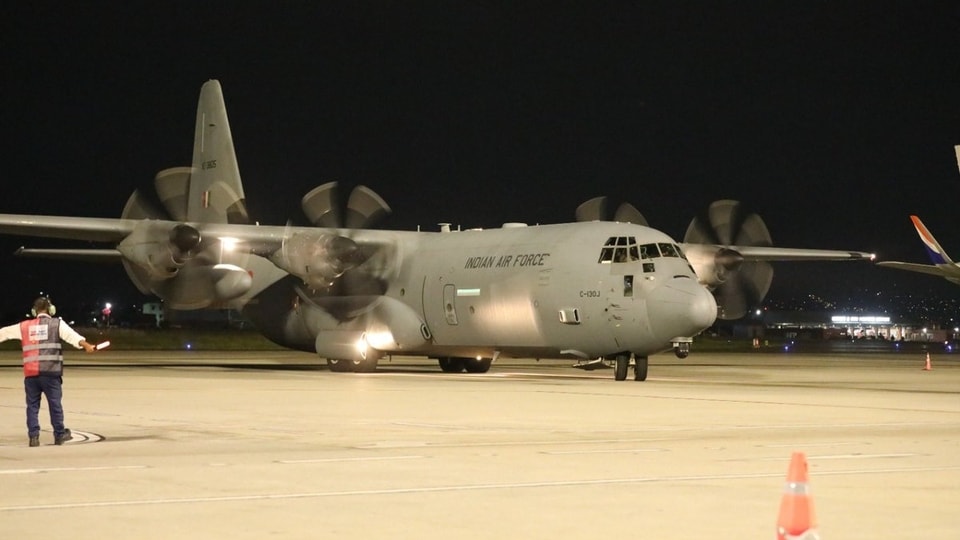
HT reported on Friday that India was the first country to physically deliver aid to Nepal after the disaster. The prompt response reinforces India's "first responder" tag, reflecting its growing record of delivering aid and assistance to disaster-hit countries, from Türkiye and Syria to Myanmar, Sri Lanka and Venezuela.
Deep Dive

By Friday evening, India had sent 62 tonnes of aid in three airlifts, while several other countries and international organisations—including the United States and China—were still mobilising assistance.
Follow Nepal-Tibet flash flood LIVE Updates
Prime Minister Narendra Modi spoke to Nepal's Prime Minister Balendra Shah within hours of the disaster, conveyed his condolences and said India was ready to provide all possible humanitarian assistance. He also said Indian teams were coordinating closely on rescue and relief efforts.
Other countries and international organisations have also pledged or begun providing assistance to Nepal. HT has accessed details of how governments and global organisations are rallying around the disaster-hit country.
Nepal: The Nepali government has said it can mobilise up to $229 million for disaster relief. The figure includes resources from the Prime Minister's Natural Disaster Relief Fund and the Prime Minister's Relief Fund, along with up to $164 million in emergency assistance that the World Bank has indicated could be mobilised.
India: India has sent 62 tonnes of emergency relief supplies in three airlifts. The first, an IAF C-130J aircraft, carried 10 tonnes of temporary shelters, blankets, hygiene kits, solar lamps and medicines. The second, a C-17 aircraft, carried 37.5 tonnes comprising 28.5 tonnes of relief items such as tents, blankets, hygiene kits, solar lamps, dewatering pumps, kitchen sets and generator sets; eight tonnes of medicines; and one tonne of food items. A third flight carrying another 10 tonnes of humanitarian assistance left for Kathmandu on Friday.
India's contribution has been announced primarily in physical relief supplies rather than as a cash commitment.
ALSO READ: Nepal floods: 140 tourists from Maha on their way back; over 60 untraceable
China: China has committed emergency supplies and cash assistance to Nepal. Chinese Ambassador Zhang Maoming said coordination for the assistance had been completed, although the mechanism for transferring the cash and delivering physical supplies was still being worked out. Nepal has declined offers of foreign search-and-rescue contingents as a general policy, saying its own security agencies are capable of handling the operation.
UAE: The UAE has allocated $10 million through the UAE Aid Agency for urgent humanitarian assistance. The agency is coordinating with local authorities and international organisations to deliver the aid.
UK: The United Kingdom has pledged £5 million ($6.8 million) in humanitarian assistance for relief and recovery. It has also deployed a Rapid Deployment Team to Nepal to provide consular support to British nationals and their families.
Australia: Australia has announced a $5 million humanitarian assistance package. Of this, $2 million will go to the World Food Programme, $2 million to Australian NGOs through the Australian Humanitarian Partnership, and $1 million to the Emergency Action Alliance for locally led recovery and rehabilitation. Australia is also sending an initial team of three humanitarian response specialists within 48 hours, while additional consular personnel are being deployed.
South Korea: South Korea has pledged $1 million in humanitarian assistance through international organisations. Seoul has also sent a rapid response team and was seeking Nepal's cooperation in the search for nine missing South Korean nationals.
Sri Lanka: Sri Lanka has pledged $1 million in financial assistance to support Nepal's immediate relief and humanitarian efforts.
US: The US State Department has committed $500,000 in immediate assistance for flood-affected communities, covering emergency shelter, relief supplies, clean water and hygiene needs. Washington is also deploying a disaster-response adviser.
ALSO READ: 11 Nashik college students escape Nepal flood by two hours, stranded in Kathmandu
World Bank: The World Bank has indicated it could provide up to ₹25 billion ($163.55 million) in emergency assistance to support Nepal's response and recovery.
UN Central Emergency Response Fund (CERF): The UN has released $2.5 million in emergency funding to support the Nepal-led response.
International Federation of Red Cross and Red Crescent Societies (IFRC): The IFRC has released nearly CHF 1 million in emergency funding to support the Nepal Red Cross Society's immediate response and has launched a larger CHF 25 million Emergency Appeal to sustain relief operations.
Welthungerhilfe (Germany): The German humanitarian organisation is providing €100,000 from its emergency relief fund.
World Health Organization (WHO): WHO has mobilised and dispatched essential emergency medical supplies, including medicines, an emergency health kit and multipurpose tents. It has also mobilised $150,000 through its South-East Asia Regional Health Emergency Fund.
Médecins Sans Frontières (MSF): An MSF emergency-response team has arrived in Nepal to assess immediate needs and is coordinating with health facilities. The organisation has said it stands ready to provide urgent humanitarian and medical assistance.
The August 26 disaster in the Nepal-China border region is believed to have been triggered by a glacial collapse—some reports point to an avalanche of ice and rocks—that sent a torrent of water, mud and debris down Himalayan river systems, destroying villages and sweeping away roads, bridges and other infrastructure. Officials and scientists are continuing to assess the precise sequence of events.
As of Saturday morning, at least 579 people had died in Nepal and seven in Tibet. Over 1,900 people, including at least 320 Indians and 100 Indian-origin people, were reported missing in Nepal, while 554 remained unaccounted for in Tibet.


