
 E-Paper



India on side of peace, says Jaishankar on Ukraine war
India strongly condemns the killings in Bucha and wants an immediate end to the conflict in Ukraine, which has had significant consequences for the national economy, external affairs ministers S Jaishankar said.

 Prefer HTon Google


India strongly condemns the killings in Bucha and wants an immediate end to the conflict in Ukraine, which has had significant consequences for the national economy, external affairs minister S Jaishankar said on Wednesday.
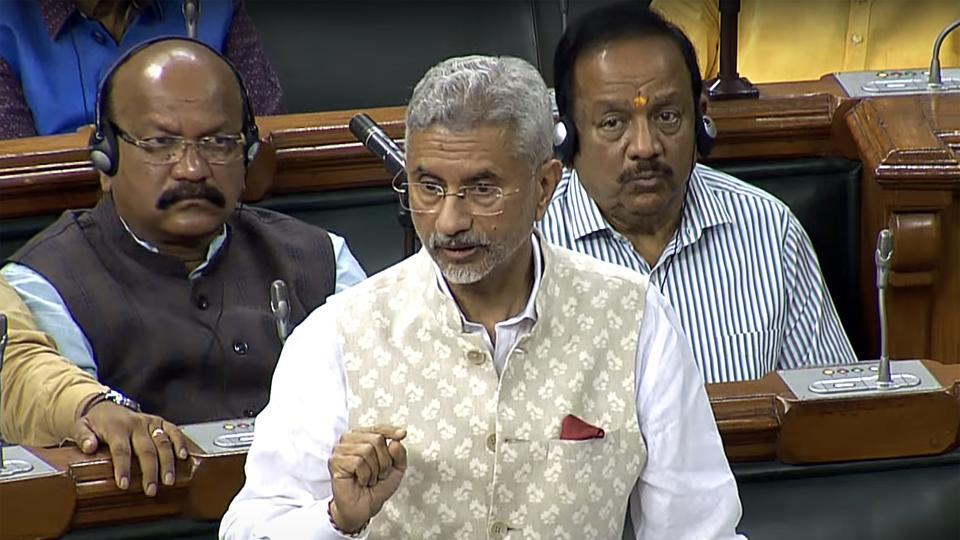
Responding to a debate on the situation in Ukraine in the Lok Sabha, Jaishankar said the government is focused on stabilising economic transactions with Russia, a “very important partner”. He said India has had “very candid, very direct” conversations with all partners regarding its position on the Ukraine crisis.
Referring to several MPs raising the happenings at Bucha town in Ukraine, Jaishankar said: “I want to say that we are deeply disturbed by the reports. We strongly condemn the killings which have taken place there. This is an extremely serious matter and we support the call for an independent investigation.”
Images have emerged of mass graves and dozens of bodies of civilians, some with hands tied behind their back, in the town of Bucha outside the capital Kyiv after it was reclaimed from Russian forces. India first condemned the killings during a discussion at the UN Security Council on Tuesday.
Jaishankar reiterated India’s call for an end to hostilities, respect for sovereignty and territorial integrity of all states, and a return to dialogue and diplomacy. “If India has chosen a side, it is the side of peace and it is for an immediate end to violence. This...has consistently guided our position in international forums and debates, including in the UN,” he said.
Speaking about Operation Ganga – India’s effort to pull its citizens out of war-torn Ukraine – the minister said India has never evacuated citizens in this number in such a situation.
“As an evacuation, we were the first. If individual citizens left? Yes, many of them did. Many of them left as part of the larger political plan their particular countries had,” he said.
“In our case, there was nobody else who had done an evacuation before we did an evacuation. When the fighting started, many countries said there is nothing we can do about it... you are stuck. When we evacuated, we served as an inspiration,” Jaishankar said.
In an apparent reference to the impact of US and Western sanctions on Russia, he said the government is working to “stabilise economic transactions between India and Russia because this is very important for us”. An inter-ministerial group led by the finance ministry is examining “how the payments issue can be best addressed”. While India has experience in handling such issues, the finance minister will have to take a call, he added.
Responding to Congress leader Manish Tewari’s comments about India speaking honestly to friends such as Russia, Jaishankar said that “all our conversations with everybody on this matter have been very candid, very direct”. He added: “Positions stated in the House have been communicated with as much directness to all our partners, nobody has any doubt where we stand on this matter.”
Jaishankar noted that energy flows from Russia to Europe were continuing despite the tensions, and there were other measures in different domains, including financial and payment carve-outs. He hinted that India’s decisions regarding the purchase of oil and other commodities from Russia shouldn’t be politicised. “Attributing a political colouring to it is uncalled for, it is unfair,” he said.
The minister has previously pointed out that India buys less than 1% of its oil requirement from Russia and that this proportion was unlikely to change significantly.
The Ukraine conflict has had significant consequences for the global economy, and India is deciding what is best in its national interest. “At a time when energy costs have spiked, clearly we need to ensure that the common person in India is not subject to an additional and unavoidable burden. Fertiliser prices have a direct implication on the livelihood of a majority of our population and for food prices. Even the security of the nation is at stake as we maintain our defence posture in the manner that the current security challenges warrant,” he said.
Later in the day, Prime Minister Narendra Modi appreciated the discussion that took place in Parliament on the Ukraine situation, saying the rich level of debate illustrates there is bipartisanship on the matters of foreign policy which augurs well for India at the world stage.
“Over the last few days, Parliament has witnessed a healthy discussion on the situation in Ukraine and India’s efforts to bring back our citizens through operation Ganga. I am grateful to all MP colleagues who enriched this discussion with their views,” he posted on Twitter.



