
 E-Paper



India rejects new claim linking its officials to Khalistani separatist’s killing in Canada
Kumaran said sensitive matters under judicial considerations were best allowed to proceed through established legal processes without public commentary

 Prefer HTon Google


India on Monday rejected a Canadian media report linking two Indian officials to the 2023 killing of Khalistani separatist Hardeep Singh Nijjar and called for such sensitive matters to be handled through “legal processes without public commentary”.
The Globe and Mail, citing two unidentified sources, one in national security and the other in law enforcement, reported on Sunday that two officials who were earlier posted in India’s consulate general in Vancouver were allegedly involved in the killing of Nijjar in June 2023.
P Kumaran, secretary (East) in the external affairs ministry, told a media briefing that India “categorically rejects allegations of involvement in trans-national violence or organised crime”.
Such claims are “baseless, politically motivated and unsupported by credible evidence despite repeated requests”, Kumaran said. “India believes that concerns of this nature must be addressed through credible law enforcement and judicial processes and not through public or politicised narratives,” he added.
The criminal investigation in the case of Nijjar is proceeding according to established legal procedures, and proceedings have entered the pre-trial phase, following which it will move to the full jury trial stage, Kumaran said.
“Canadians have an established legal procedure and it will proceed as per that procedure. India consistently maintained its commitment to the judicial process,” he said.
“We believe that sensitive matters under judicial considerations are best allowed to proceed through established legal processes without public commentary,” he added.
The Globe and Mail report named former visa officer Kanwaljit Singh, who gathered information about Nijjar from the diaspora by using his role to facilitate the process. The report said he was monitored by the Canadian Security Intelligence Service (CSIS) as an undercover agent of the Research and Analysis Wing (RAW).
The other official named in the report was Manish, who was the consul general in Vancouver and is now the envoy to Cyprus.
Singh was among six Indian officials and diplomats expelled by the Canadian government in October 2024 for alleged involvement in violence.
The information gathered by the two officials was allegedly transmitted to former RAW operative Vikash Yadav,, and he communicated it to the Lawrence Bishnoi gang which allegedly organised the killing, the report said.
Yadav, a former CRPF officer deputed to the external intelligence agency, was removed from his post after the US department of justice named him in the case against Indian national Nikhil Gupta, who recently pled guilty to charges related to a plot to kill Sikhs for Justice leader Gurpatwant Pannun in New York.
Both Nijjar and Pannun have been designated as terrorists by India. Pannun is the organiser of the so-called Khalistan Referendum and Nijjar was, at the time of his death, its Canadian coordinator.
India and Canada have an ongoing security and law and order dialogue, and National Security Advisor Ajit Doval visited Ottawa last month for talks. India’s high commissioner Dinesh Patnaik told Hindustan Times last month: “We have nothing to worry about on this account. We want to work with the Canadians to bring the perpetrators to justice.”
Noting that the criminal case involving four Indian nationals accused in Nijjar’s murder is in progress and no evidence of an Indian link has been presented till date, Patnaik said, “If there is any evidence that the Americans want to provide to the Canadians, fine. If the Canadians have evidence, fine. Like I have always maintained, if we find there are elements within the Indian establishment who have done something wrong, we will ourselves take action.”
Relations between India and Canada cratered after former Canadian PM Justin Trudeau alleged in September 2023 that there were “credible allegations” of a potential link between Indian agents and Nijjar’s killing. India dismissed the accusations as “absurd” and “motivated”.
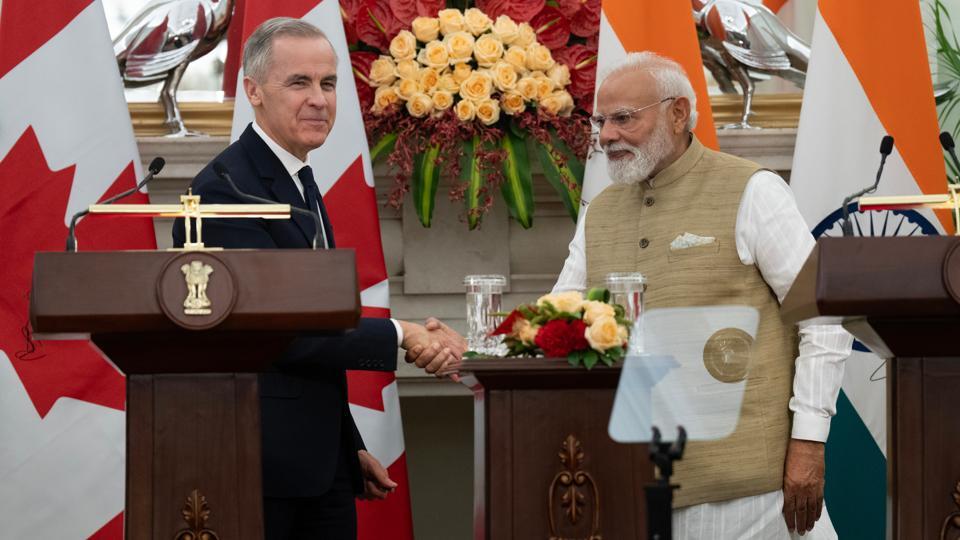
A statement issued by the Canadian Prime Minister’s Office following PM Mark Carney’s meeting with Prime Minister Narendra Modi said the leaders agreed to “advance bilateral cooperation on security and law enforcement”, including issues of mutual concern such as the illegal flow of drugs and trans-national organised criminal networks.
Carney also “underscored that Canada will continue to take measures to combat transnational repression”, the statement said.
Kumaran also said both PMs had reaffirmed their commitment to “rebuild strategic trust, strengthen institutional cooperation and anchor the relationship in mutual respect, sovereignty and democratic values”.
Senior officials of India and Canada are discussing security and law enforcement cooperation, and a meeting held in February had resulted in the framing of a work plan for cooperation on national security and law enforcement issues, Kumaran said.



