
 E-Paper



India waits for Pakistan to end terror before resumption of dialogue
Fact is that the Indian retaliation in the form of surgical strikes in occupied Kashmir and air strikes at Balakot in Manshera came only as a response to terror attacks by Pakistan based proscribed groups after the complicity of Rawalpindi GHQ was established by Indian security agencies.


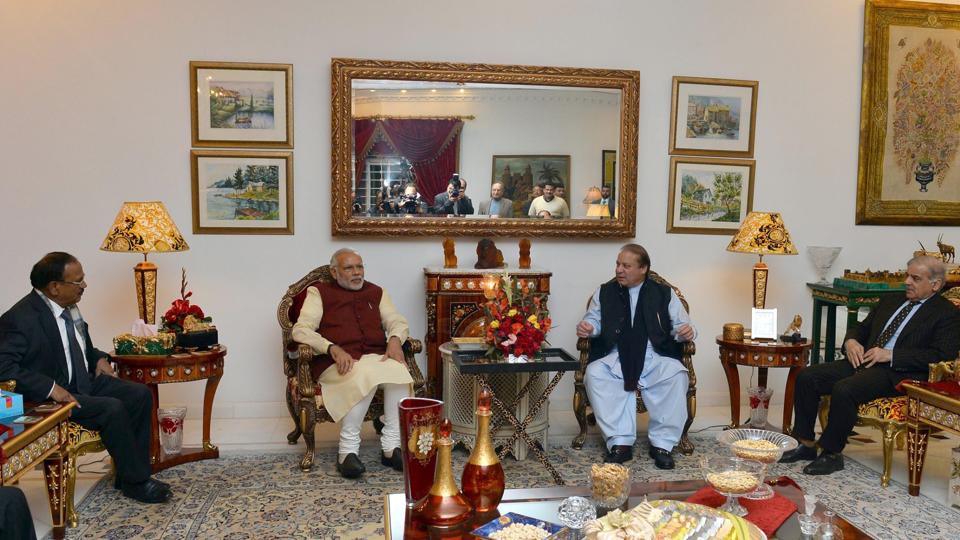
When Prime Minister Narendra Modi made an impromptu landing at the Lahore airport on December 25, 2015, he hugged his then counterpart Nawaz Sharif who had come to receive him. During his four-hour visit, Sharif recalled that his mother Begum Shamin Akhtar had told him that Modi was a good man after she saw the Indian PM on Indian television news channels taking the blessings of his mother Heeraben by touching her feet. PM Modi met Sharif’s mother at a family function in Raiwind near Lahore and exchanged notes with her. Sharif sent an embroidered shawl for Heeraben, which was duly reciprocated by PM Modi for the then Pakistan PM’s mother with Indian High Commission scouring the entire security locked Lahore to secure a gift.
It was this gesture of warmth that stuck with PM Modi who condoled the demise of Sharif’s mother Shamim Akhtar on November 22, 2020, by writing a letter to the former PM. The letter was conveyed to Nawaz Sharif through his politician daughter Maryam Nawaz by an Indian diplomat based in Pakistan. “I recall my interaction with her during my brief visit to Lahore in 2015. Her simplicity and warmth were indeed very touching,” wrote PM Modi in his condolence message.
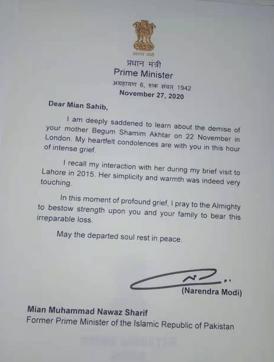
Although political detractors of PM Modi accuse him of reaping electoral benefits for blaming Islamabad time and again, the condolence letter shows that India has no ill-will towards the civilian, democratically elected leadership in Pakistan.
At a launch of a book on Friday, external affairs minister S Jaishankar made it clear that for India to engage in a dialogue with Pakistan, the neighbouring country must put an end to cross-border terrorism. “As far as PM Modi is concerned, we have shown a lot of clarity that they (Pakistan) can’t continue with terrorism and then expect diplomacy to carry on,” he said at the function. This is no different from the message conveyed by National Security Advisor Ajit Doval to his then Pakistan counterpart Nasser Janjua in Bangkok before PM Modi visited Lahore on December 25, 2015.
Also read | 4 out of every 5 Pak citizens believe country headed in wrong direction: Report
Doval told Janjua that India will deal with terror but Pakistan must give a commitment that there would be no state protection to the proscribed anti-India terrorist groups in that country. However, the entire bold Indian diplomacy of December 2015 came to a nought with Pakistan based Jaish-e-Mohammed group targeting the Pathankot airbase within a week of PM Modi’s Lahore visit. Documents recovered from the terrorists revealed that the foiled terror attack was planned on the day PM Modi landed at Lahore, showing that the Pakistan deep state was totally opposed to any détente with India and was using Islamists to scuttle any rapprochement.
Today, with the Pakistani deep state and army controlling the levers of political power in Islamabad, the Indian establishment is at a loss of a committed and credible interlocutor in the Islamic Republic who has the power to defang the terrorist groups. It is quite evident to the Indian leadership that Pakistan army will not allow any civilian leader to have a dialogue with New Delhi to normalise bilateral relations. Nawaz Sharif tried it twice and failed. His daughter Maryam is now being painted as an Indian agent and there is clearly a threat to her life.
Also read | Nearly half of China’s investments in India’s neighbourhood went to Pakistan
Instead, the Pakistani leadership time and again cries wolf over non-existent impending surgical strikes by the Indian Army in an effort to defame India as an aggressor and reiterate the tired nuclear flashpoint theory. Statement to this effect by Pakistan’s foreign minister in the UAE, duly tweeted by National Security Advisor, on Friday is a case in point.
Fact is that the Indian retaliation in the form of surgical strikes in occupied Kashmir and air strikes at Balakot in Manshera came only as a response to terror attacks by Pakistan based proscribed groups after the complicity of Rawalpindi GHQ was established by Indian security agencies.
The Pakistani alarm from a non-existent surgical strike came after India was totally unfazed by a Sino-Pak air combat exercise across the Gujarat border in Sindh province earlier this month. The two iron brothers also signed a defence MoU during the visit of Chinese defence minister and State Councillor General Wei Fenghe to Islamabad.
Given that Pakistan under PM Imran Khan Niazi is behaving like a tributary state to the Middle Kingdom and proscribed terrorist groups continue to spew poison against India, New Delhi’s desire to have normal ties with all its neighbours will remain an unfulfilled dream.


