
 E-Paper



Indian Navy takes delivery of ₹20,000-cr indigenous aircraft carrier ‘Vikrant’
Vikrant will be the fourth aircraft carrier to be operated by the Indian Navy — the first Vikrant (British-origin) from 1961-1997, INS Viraat (British-origin) from 1987-2016 and INS Vikramaditya (Russian-origin) 2013 onwards

 Prefer HTon Google


The Cochin Shipyard Ltd on Thursday handed over the country’s first indigenous aircraft carrier – Vikrant, the largest warship to be built at home – to the Indian Navy ahead of its planned induction into service next month, marking the end of a long journey after the construction of the vessel began in 2009.
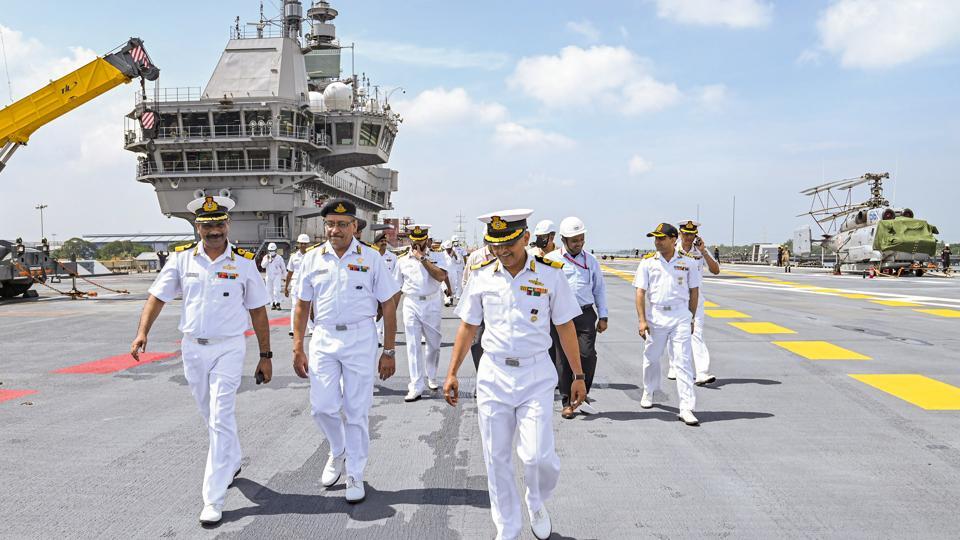
Vikrant, built at a cost of around ₹20,000 crore, will significantly boost the country’s naval presence and its reach, navy officials said. The warship was delivered after rigorous user acceptance trials, carried out between August 2021 and July 2022.
“With the delivery of Vikrant, India has joined a select group of nations having the niche capability to design and build an aircraft carrier,” the navy said in a statement.
Vikrant has put India in a select league – only the United States, the United Kingdom, Russia, France and China have the capability to build aircraft carriers. The 262-metre-long vessel has a full displacement of 45,000 tonne. It has been named after the aircraft carrier INS Vikrant, operated by the navy from 1961-1997.
It has an indigenous content of 76%, is a “perfect example of the nation’s quest for Aatmanirbhar Bharat and provides thrust to the government’s Make in India initiative,” the navy said in a statement. Vikrant will operate an air wing consisting of 30 aircraft, including MiG-29K fighter jets, Kamov-31 choppers, MH-60R multi-role helicopters, advanced light helicopters and light combat aircraft (navy).
Also Read:Collaboration with foreign companies intrinsic to self-reliance goal: Army chief
The fighters on board the aircraft carrier will use the ski-jump to take off and will be recovered by arrestor wires, or STOBAR (short takeoff but arrested recovery) in navy parlance. Vikrant is also expected to operate a new deck-based fighter that the navy is planning to buy; it has already tested Boeing’s F/A-18E Super Hornet and Dassault Aviation’s Rafale-M.
The carrier, designed by the Directorate of Naval Design, has 14 decks, including five in the superstructure, 2,300 compartments, and can accommodate a crew of 1,700, including specialised cabins for women.
India currently operates a solitary aircraft carrier – INS Vikramaditya – bought second-hand from Russia for $2.33 billion, but the navy has been arguing it needs three such floating airfields given its vast maritime territory.
Vikrant will be commissioned into the navy barely two months after China launched its third aircraft carrier – the first designed and built entirely in the country.
The launch of the new carrier named ‘Fujian’ on June 17 came against the backdrop of China’s push for greater maritime influence in the far seas and as its warships’ attempts to leave their mark in the Pacific and Indian Ocean regions. A warship’s launch marks a significant milestone in its construction and refers to the vessel entering the water for the first time.
China currently operates two aircraft carriers — CV-16 Liaoning and CV-17 Shandong.
Vikrant will be the fourth aircraft carrier to be operated by the Indian Navy — the first Vikrant (British-origin) from 1961-1997, INS Viraat (British-origin) from 1987-2016 and INS Vikramaditya (Russian-origin) 2013 onwards.


