
 E-Paper



Indian Navy to seek green light for expansion of nuke, diesel submarine fleet
India’s strategic ally France is open to jointly design and develop nuke-powered submarines India, a partnership that will assume importance when PM Modi meets President Macron in Paris next month

 Prefer HTon Google


The Indian Navy intends to approach the government for authorised force levels of nuclear-powered and diesel-electric attack submarines in addition to the ballistic missile submarines with Strategic Force Command (SFC), people familiar with the matter said on Wednesday.
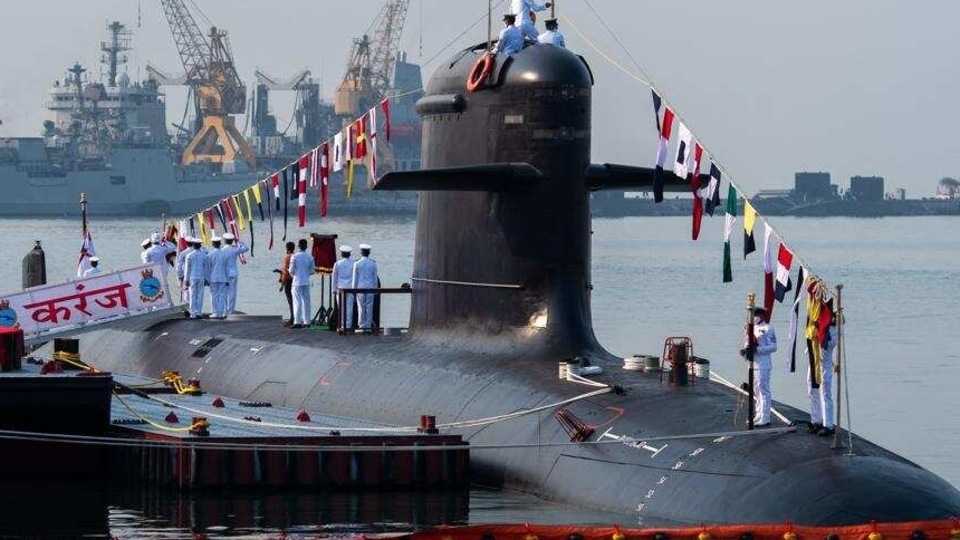
The navy’s new plan, inspired by a similar cabinet authorisation for 42 squadrons of the Indian Air Force, will seek approvals for 6 nuclear-powered attack submarines and 18 diesel attack submarines, a South Block official said. The authorisation for the diesel subs would include those with an air-independent propulsion system, or AIP, which ensures these submarines can remain under surface for a longer period and are quieter than the nuclear-powered submarine.
The proposed move comes at a time the navy is finalising plans to seek approval from the Defence Acquisition Committee to build six nuclear-powered attack submarines, or SSNs, as part of the defence establishment’s continuing focus on expanding the navy’s capabilities to counter the rise of China’s navy in the Indian Ocean Region and beyond.
India currently has only one Akula class SSN on lease from Russia, Akula-II nuclear-powered attack boat INS Chakra, and 15 diesel-electric submarines including the Scorpene-class submarine INS Kalvari. While three of the Kalvari class submarines have been commissioned, the remaining three will be fitted with the AIP system that makes the submarine more lethal than SSNs because its low radar signature minimizes the possibility of detection.
The SSNs play a huge role in sea denial to the adversary and have the capability to remain under the sea without surfacing except for replenishing food stocks and other logistics.
The Indian Strategic Forces Command, which is part of the Nuclear Command Authority and is responsible for the management of the country’s strategic nuclear weapons stockpile, has one 6,000 tonnes nuclear-powered ballistic missile submarine (SSBN) INS Arihant. The next SSBN, INS Arighat, is set to be commissioned in 2022, the 75th year of Independence and will have K-15 and K-4 nuclear-capable submarine-launched intermediate-range ballistic missiles on board. The K-15 is expected to have a range of up to 1,500 km while the K-4 is likely to have a maximum range of 3,500 km.
Both missiles are being developed by the Defence Research and Development Organisation, or DRDO.
The DRDO also has long-term plans to develop and test-fire the K5 missile, which will have a range of 5,000 km, the same range as the Agni-5 surface-to-surface missile.
The SSBN is the most potent of the nuclear triad due to its survival capabilities and forms the backbone of India’s second-strike capability due to its no-first-use (NFU) policy as spelt out in the draft nuclear doctrine.
India’s strategic ally France is willing to jointly design and develop SSNs with India, a partnership that will assume importance when Prime Minister Narendra Modi goes to Paris to hold a bilateral summit with President Emmanuel Macron after the completion of the India-EU summit at Lisbon on May 8. The French SSNs are based in Toulon in southern France, and its ballistic missiles submarines in the port city of Brest in northwestern France.
India’s national security establishment is already in touch with its French counterparts to ensure that the Indian Navy builds up enough deterrence in the Indo-Pacific in the face of the rapidly expanding PLA Navy. The Indian Navy expects the PLA Navy to start sending carrier strike force patrols to the Indian Ocean by 2023.


