
 E-Paper



Indian-origin Ajay Banga of World Bank on Trump's team to oversee Gaza governance
World Bank president and an alumnus of St Stephen’s, Delhi, and IIM Ahmedabad, Ajay Banga has a career spanning over three decades

 Prefer HTon Google


World Bank president Ajay Banga has been appointed to a newly formed Board of Peace designed to supervise the temporary governance and reconstruction of the Palestinian territory of Gaza.
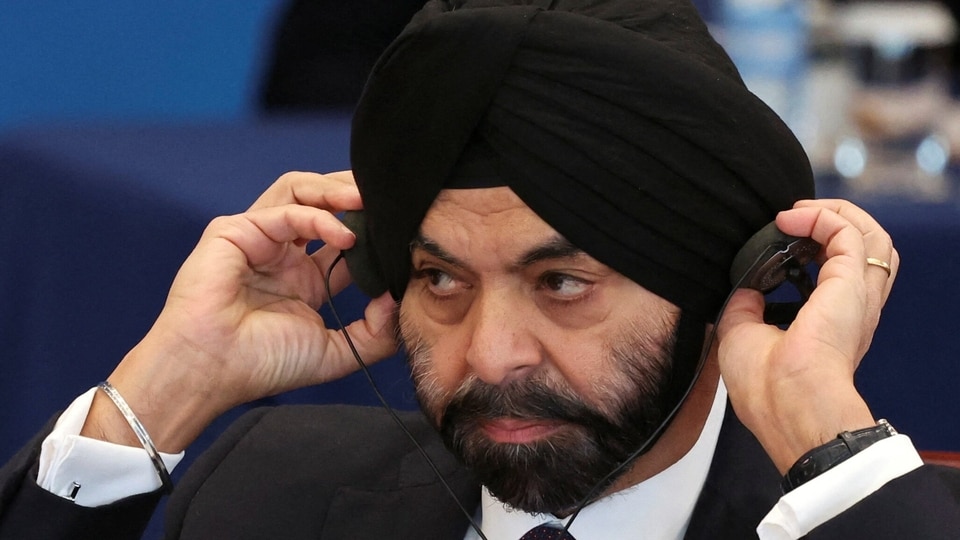
The appointment, announced by the White House on Friday, places the Indian-American finance veteran among technocrats at the centre of a controversial 20-point roadmap spearheaded by President Donald Trump to end the devastating conflict in the region after Israel’s military action killed around 70,000 people.
Ajay Banga, 63, brings a formidable track record of corporate and international leadership to the board.
An alumnus of the elite St Stephen’s College of Delhi University, and the Indian Institute of Management, Ahmedabad (IIM-A), Punjabi-origin Banga’s career spans over three decades.
Before his 2023 appointment to head the World Bank, he served as the president and CEO of Mastercard for 10 years.
He may be new to moves towards claimed regional stabilisation, but is no stranger to high-level advisory roles, particularly within US administrations. Under Barack Obama, he served on the President’s Commission on Enhancing National Cybersecurity and the Advisory Committee for Trade Policy and Negotiations. Banga became a US citizen around two decades ago.
His nomination to lead the World Bank by President Joe Biden was seen as a move to equip the institution for major reforms, specifically to better respond to climate change and the financial challenges facing developing nations.
Now, under Trump, Banga is tasked with applying this expertise possibly to capital mobilisation to rebuild a shattered Gaza.
What’s the ‘Board of Peace’ that Ajay Banga is on?
The Board of Peace — to which Banga has been appointed along with other senior and renowned leaders from across the spectrum — is the central body overseeing Phase 2 of Trump’s 20-Point Peace Plan.
Chaired by Donald Trump himself, the board’s primary function is to supervise a "Palestinian technocratic body" — the National Committee for the Administration of Gaza (NCAG) — which will handle the day-to-day restoration of public services and civil institutions.
Trump has invited Egypt's President Abdel Fattah El-Sisi also to join the board, news agency AFP reported citing the country's foreign ministry.
The White House has defined the board's portfolio as "critical to Gaza’s stabilization”, which statedly includes governance capacity-building, regional relations, reconstruction, and investment attraction. While Banga handles the financial and institutional aspects, other high-profile figures will manage diplomatic and security portfolios.
The board includes:
- Political and diplomatic leaders: US Secretary of State Marco Rubio, President Trump’s special envoy Steve Witkoff, and former British Prime Minister Tony Blair.
- More Trump’s men: Jared Kushner, Trump’s son-in-law, and Robert Gabriel, a Trump adviser, are also on the panel.
- For financial expertise, alongside Banga is Marc Rowan, a billionaire private equity executive and CEO of Apollo Global Management.
- For on-ground representation, Nickolay Mladenov, a former UN Middle East envoy, will serve as the High Representative for Gaza, acting as the link between the board and the local NCAG.
To head the local government, the White House has named little-known former Palestinian Authority bureaucrat Dr Ali Sha’ath. The PA rules parts of the West Bank while Hamas has been in charge of the Gaza Strip.
Sha’ath will report to the Trump-chaired Board of Peace.
What the Gaza governance structure looks like
Apart from this overseer panel, an 11-member Gaza Executive Board has been formed to support these efforts, featuring international voices such as Turkish foreign minister Hakan Fidan, UAE minister Reem Al-Hashimy, and Qatari diplomat Ali Al Thawadi.
The appointments come at a moment of extreme volatility. Despite a fragile ceasefire in place since October, the region remains a site of violence. Reports indicate that even during the truce, more than 450 Palestinians, including over 100 children; and three Israeli soldiers have been killed.
The immediate conflict, which began in October 2023 following a Hamas-led attack that killed 1,200 people in Israel, has resulted in the deaths of tens of thousands and the internal displacement of Gaza’s entire population.
How analysts, global bodies see Gaza situation
Multiple rights experts and a UN inquiry have characterized the situation as a "hunger crisis" and have even raised allegations of genocide, while Israel maintains its actions are essential for self-defence.
Trump at one point saw Gaza as a real estate opportunity, but later played the “man of peace” for a technocrat-heavy governance solution. The plan includes the deployment of an International Stabilization Force (ISF), authorized by a UN Security Council resolution in mid-November. That is led by US Army Major General Jasper Jeffers.
But rights advocates and experts have criticised the system, noting that it resembles a "colonial structure" because it allows an international board to supervise a foreign territory’s governance.
A significant point of contention is the absence of any Palestinians on the founding Executive Board. Plus, the involvement of Tony Blair has drawn fire due to his controversial role in the Iraq War and the historical legacy of British imperialism in the Middle East.


