
 E-Paper



India’s auto sector reflects nation’s aspirations: Modi
PM Modi highlighted India's bright auto sector future, driven by a young population, expanding middle class, and 'Make in India' initiatives at the Bharat Mobility Expo.


Prime Minister Narendra Modi said on Friday that India, with its large aspiring middle-class base and young demography, and where ease of travel is one of the top priorities, can ensure a bright future for the automobile sector .
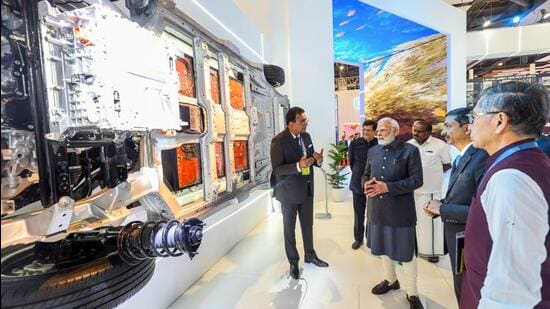
Addressing a gathering after inaugurating the Bharat Mobility Global Expo 2025 at Bharat Mandapam in Delhi, the Prime Minister also emphasised that India remained an outstanding destination for every investor looking to shape the future of the mobility sector.
“Friends, today’s Bharat is full of aspirations and youth energy. I see this aspiration in India’s automotive industry. Last year, Bharat’s auto industry grew by about 12%. Exports (of automobiles) are also growing with the mantra of ‘Make in India, Make for the World’. The number of cars sold every year in Bharat is far more than the population of many countries,” he said.
India exports approximately 25 million cars in a year. In 2024 (calendar year), car sales in India rose 4.2% to 4.27 units million and two-wheeler sales by 14.5% to 19.5 million units.
Recalling the contributions of industry legends Ratan Tata (of the Tata group, which runs Tata Motors and JLR) and Osamu Suzuki (of Suzuki Motor Corp, whose subsidiary Maruti Suzuki is India’s largest car maker) in fulfilling the mobility aspirations of Indian middle class, Modi said that their legacy will inspire the mobility sector.
“At the auto sector’s largest event, I also remember Ratan Tata and Osamu Suzuki. In growing India’s auto sector and in fulfilling the dreams of its middle class, these two noble personalities have made great contributions. Their legacy will continue to inspire India’s entire mobility sector,” he added. Both Tata and Suzuki died in 2024.
After visiting the exhibition, PM said the future for mobility in India was bright and positive. “India’s automotive industry is fantastic and also future ready,” he said.
The Bharat Mobility Global Expo 2025 is being held between January 17 and 22 at three separate venues -- Bharat Mandapam and Yashobhoomi in New Delhi and India Expo Centre in Greater Noida.
India is the world’s fifth-largest economy and the third-largest passenger vehicle market, the PM said.
“Imagine, the position of our auto market when Bharat is placed among the top-three global economies,” he said, emphasising the growth potential of the mobility sector at a time India has embarked on becoming a developed country by 2047. The Modi government has resolved to become world’s third largest economy during its third-term (Modi 3.0) and a developed economy by 2047.
He said several factors are driving the growth of the mobility sector -- the country’s young population, expanding middle class, rapid urbanisation, ongoing construction of modern infrastructure, and affordable vehicles because of ‘Make in India’. The median age of India’s population was around 28 years in 2024.
“All these factors push the growth of Bharat’s auto sector and give new strength to it...Needs and aspirations are required for the growth of automobile sector and fortunately, both are present in India,” Modi said.
India will remain the world’s youngest country for several decades, with the youth being the largest customer base, creating significant demand. Similarly, the aspiring middle class is another major consumer base that has emerged over the past decade, he said.
“In the last 10 years, 25 crore [250 million] Indians came out of poverty. This neo-middle class is purchasing their first vehicle. They would upgrade their vehicles as they prosper. Auto sector is certain to get its benefit,” the PM added.
The construction of good and wide roads have encouraged people to buy vehicles, he said, citing the government’s huge capital expenditure on infrastructure creation. The capex in the budget for FY25 has a provision for ₹11.11 lakh crore. The government is also taking several policy measures to reduce average cost of logistics and promote ease of travel, he said.
“We are now moving towards smart mobility,” Modi said, adding that the ‘Make in India’ initiative with production-linked incentive (PLI) scheme has played a major role in enhancing growth potential for the auto sector.
“PLI scheme has helped in sales of over ₹2.25 lakh crore. This scheme has created over 1.5 lakh direct jobs in the sector,” the PM said, emphasising its cascading effect on multiple sectors such as micro, small and medium enterprises, component industry, logistics and tourism. The potential attracted over $36 billion foreign direct investment (FDI) in the sector in last four years and this figure would multiply in the coming years, he said.
The PM reiterated the government’s commitment to developing a complete ecosystem for auto manufacturing within India. Recollecting his vision of the “Seven Cs” for mobility solutions -- Common, Connected, Convenient, Congestion-free, Charged, Clean, and Cutting-edge -- he said the focus on green mobility is part of this vision to support both the economy and ecology while reducing the import of fossil fuels.
Union commerce and industry minister Piyush Goyal said Bharat Mobility Global Expo was the world’s second largest event spread in over 200,000 square metres. “I think, this is in a way, exemplifies the whole-of-industry, whole-of-government, and whole-of-the-nation event,” he said.
The expo is one of the instruments to attract investments in the sector and boost exports, he said, adding that the country has already become the top global manufacturer for three-wheelers and tractors.
Union minister for heavy industry and steel HD Kumaraswamy said the expo exhibited India’s strength in auto sector and its commitment for clean transportation solutions. “By embracing sustainable transport options, we can improve public health, reduce our carbon footprints and create cleaner, greener future for generations to come,” he said.
India’s automobile industry is one of the most vital contributors to the economy and it is the third-largest automobile market globally, generating approximately 7% of the national gross domestic product (GDP) and employing 3.7 crore (37 million) people, he added. In 2023-24, the industry produced over 23 million vehicles across various segments.


