
 E-Paper



Keeping India out of UNSC will cast doubt on its credibility: Jaishankar
Keeping India out of the permanent membership of the UNSC will cast doubts on the credibility of the international organisation, external affairs minister S Jaishankar on Thursday said.

 Prefer HTon Google


Keeping India out of the permanent membership of the United Nations Security Council (UNSC) will cast doubts on the credibility of the international organisation, external affairs minister (EAM) S Jaishankar on Thursday said, adding that the country has demonstrated its “capability of helping” other nations through its G20 presidency.
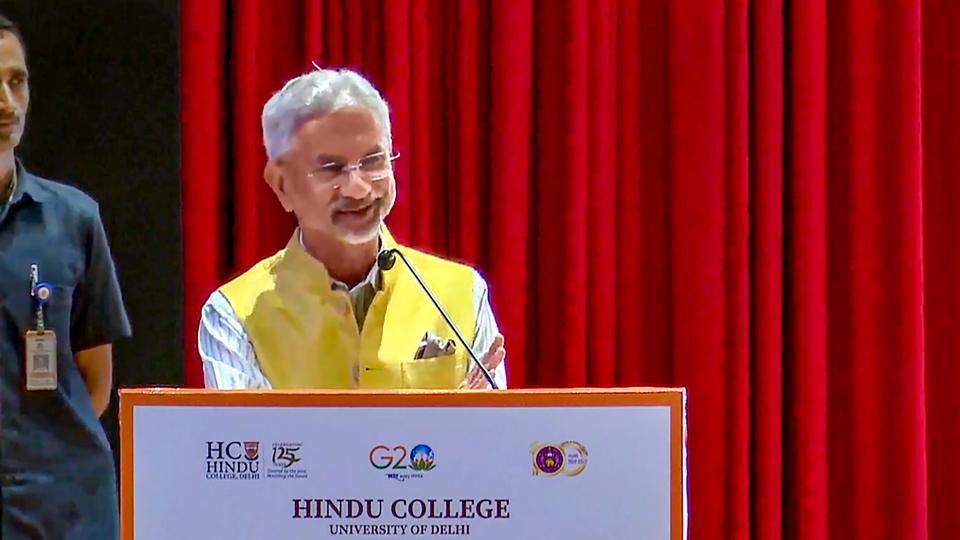
Speaking at an event titled ‘G20 Presidency & its Global Impact’ at Delhi University’s Hindu College, Jaishankar said that India assumed the G20 presidency at a time when the country started mattering more to the world, and today, the nation is recognised as essential to the global workplace and the global talent pool.
India last year wrapped up its two-year stint as a non-permanent member of the UNSC, where it has been one of the leading voices calling for reforms in the council. India’s bid for a permanent seat at the council has been backed by four of its five permanent members, including France. Besides France, the council’s permanent members are China, Russia, UK, and the US.
“There is not an equal representation in UNSC as there is no African country, Latin America and the world’s largest country in terms of population and the fifth-largest economy cannot be kept out of this, and if it is kept out, there will be questions raised on the credibility of the United Nations,” Jaishankar said.
“BRICS first time said that UNSC memberships should undergo a change. History is on our side, and the UN will change. Forces who are blocking it will keep trying but eventually, it will happen,” he added, in an apparent reference to China that has been blocking efforts for reforms at the United Nations.
The foreign minister said the United Nations was formed in 1940 during the Second World War and had only 50 member countries at the time. However, the number of members has increased four times, with about 200 countries as members now, he said.
“The present United Nations architecture was formed in the 1940s. There were 50 member countries of the UN back then, and now there are more than 200 countries. So there will be changes,” he said.
He compared the five permanent members, who are vested with the veto power, with passengers sitting on the first row of a bus and not leaving their places.
Jaishankar said that India assumed the presidency of G20 at a time the country is “mattering more and more to the world”.
“India has assumed the G20 presidency at a time when India is starting to matter more and more to the world. This is partly because of our economic achievements as we are now the fifth-largest economy in the world,” he said.
India, today, is recognised as essential to the global workplace and the global talent pool, he added.
The minister said that India’s over the grouping matters because it has “demonstrated a capability of helping other countries”. “Therefore, India’s presidency of the G20 has expectations and responsibilities, which are exceptional,” he said.
India formally took over the presidency of the grouping on December 1 and will hold the chair till November 30. It is also slated to hold a two-day summit, in the national capital on September 9 and 10, which will be a culmination of all the G20 processes and meetings held throughout the year among ministers, senior officials, and civil societies.


