E-Paper



After 24% surge, India is now home to 75% of tigers in the world
The increase shows the success of the country’s 20-year-old science- based tiger conservation programme, experts said.

 Prefer HTon Google


India recorded a 23.5% increase in tiger population between 2018 and 2022, taking the number of big cats in the wild to 3,682, more than the initially estimated 3,167 and accounting for 75%of the tigers in the world. In April, Prime Minister Narendra Modi had released an interim estimation of 3,167 tigers. India had 2,197 tigers in 2018, up from 1,411 tigers in 2006.
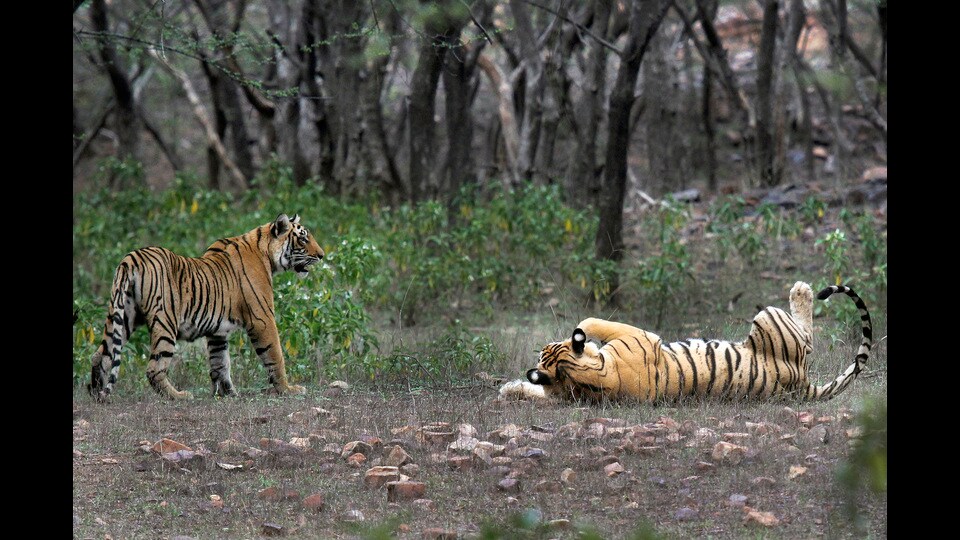
The increase shows the success of the country’s 20-year-old science- based tiger conservation programme, experts said.
Around 80% of the tigers (2,885) now reside in eight of the 18 tiger states, including Madhya Pradesh, Karnataka, Uttarakhand, Maharashtra, Tamil Nadu and Assam. Madhya Pradesh has the highest tiger population of 785, followed by 563 in Karnataka and 444 in Maharashtra.
The central Indian and Western Ghats landscapes have contributed 2,526 tigers to the total number, making them the most dense tiger regions in the world, according to state-wise estimation reported on Saturday.
On the individual score, Corbett National Park in Uttarakhand and Kaziranga National Park in Assam continue to be most densely populated tiger reserves, with 260 and 104 tiger, respectively, with Bandhavgarh in Madhya Pradesh and Bandipur in Karnataka in close pursuit.
Globally, the number of tigers increased from 3,890 in 2016 to 5,575 in 2023, with India and Nepal doubling the numbers, said a statement from the Global Tiger Forum on Saturday. The GTF counts vary slightly for the overall global figure, due to which India’s share according to this total does not amount to the share released by the government.
Rajesh Gopal, GTF secretary general and former member secretary of National Tiger Conservation Authority, attributed the increase in tiger population in India and range countries to the philosophy of Project Tiger aimed at protecting the feline in “core-critical” parts of tiger habitats.
“The protection of tiger in core-critical parts has been complimented equally by multi-stakeholder peripheral management of buffer and beyond to address interference problem with NTCA feedback taken positively for projects in and around tiger habitats. This has worked well,” he said.
In a paradigm shift on considering projects in and around tiger habitats, the government takes inputs from NTCA and tries to include the NTCA recommendations in the final approval conditions for projects. In some cases on the basis of NTCA recommendation, projects have either been altered or not allowed in and around tiger habitats, most of which are mineral- rich areas.
The rise in tiger numbers, especially in states like Uttarakhand, Madhya Pradesh and Maharashtra reflects good health of the tiger habitats, fruition of incentivised scheme for relocation of villagers from core areas and comparatively less poaching activities, unlike in areas like northeastern states, where the tiger population has not risen like the rest of the country, said YV Jhala, former dean of Wildlife Institute of India (WII).
“Overall, northern states have shown good progress, but many southern states like Andhra Pradesh and Telangana have shown declining trends, which is worrying,” Jhala said.
The reason for the increase in tiger population in Madhya Pradesh and Maharashtra was an increase in the area surveyed in 2022 compared to 2018, but that is not a bad thing, said Anish Andheria, chief executive officer of Wildlife Conservation Trust. The healthy number of tigers in the two states was found outside the reserves, indicating that the corridors linking one tiger reserve to another that enables excess tiger population to move to a new habitat was working, he said.
In Madhya Pradesh, 137 of the 785 tigers were found outside the six reserves. In Maharashtra, of the 444 tigers, at least 80 were found to be outside the six notified tiger habitats. In Karnataka, 136 of the 563 tigers were found outside the five tiger reserves. Similarly, in Uttarakhand, 73 tigers were found outside the two reserves --- Corbett and Rajaji National Park --- of the total 560.
That was not the case in Odisha, Andhra Pradesh, Bihar, Telangana and Chhattisgarh, where either the tigers’ numbers have declined or have not increased substantially. In Rajasthan, which is famous for Ranthambore and Sariska tiger reserves, the big cats outside the reserves were not found to be many.
“The number of tigers outside the reserve is an indicator of the health of the corridors. For instance, the green connectivity between Kanha and Pench tiger reserves is very good and therefore the entire landscape has seen a good rise in tiger population,” said Andheria.
The reserves, where the tiger number has improved, have minimised human conflict by shifting villages out the reserve. Jhala said the Central government pays ₹ 15 lakh as an incentive to a family (husband-wife unit) for relocation. “India is the only country in the world with such a scheme. This has lessened human intervention and man-tiger conflicts in the core areas,” said Jhala, who is credited with introducing the modern tiger estimation methodology.
VB Mathur, former director Wildlife Institute, said the report reflects three things. “First, it is a reflection of better wildlife management in tiger reserves. Second, it is a reflection of the good health of the prey base and tiger habitats, which is helping tigers to flourish. Third, it shows that poaching activities have been checked compared to the past. All these factors combined have led to a surge in tiger numbers,” he said.
Parag Madhukar Dhakate, chief conservator of forests in Uttarakhand, said the good forest cover in the state supports the growth of tigers. “Overall, 12 % of the state’s total geographical area is directly under protected areas, including six national parks, seven wildlife sanctuaries and four conservation reserves. This has allowed tigers to thrive and move around”, he said.