E-Paper



India’s total health expediture dips, some markers up
Out of pocket expenditure on health, which pushes lakhs of people below poverty line each year, declined by 16 percentage points, from 64.2% to 48.2% between 2013-14 and 2018-19.

 Prefer HTon Google


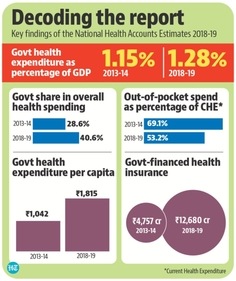
India’s total health expenditure (THE) dropped to 3.2% of GDP in 2018-19 from 4% in 2013-14, according to the estimates of National Health Accounts 2018-19 that the government released on Monday, although out of pocket expenditure on health, which pushes lakhs of people below poverty line each year, declined by 16 percentage points, from 64.2% to 48.2% in the same period. There was also an increase in the social security expenditure on health, including government-financed health insurance and reimbursement to employees, from 6 to 9.6% of THE.
The report shows there has been a continuous decline in health spending over the years even though government health expenditure as percentage of GDP went up marginally, to 1.28% in 2018-19 from 1.15% in 2013-14. But it is lower than 1.35% that was reported in 2017-18.
Total health expenditure per capita at constant prices was ₹3,314 in 2018-19, not very different from 2013-14, when it was ₹3,174.
At current prices, THE per Capita amount in 2018-19 was ₹4,470 compared to 2013-14’s ₹3,638.
A public health expert said the government needs to spend “usefully”.
“The real challenge is to create absorptive capacity because it is commonly said that the Centre releases funds but the states are not able to spend. The government needs to spend usefully; while creating infrastructure is good but that is the easiest thing to do, what is needed is creating the work force. For instance, the government can easily double the number of ASHAs/ANMs, which will create jobs and also help strengthen primary health care. We need to address the weak points,” said Dr K Srinath Reddy, senior public health expert, and founder, Public Health Foundation of India.
That’s already happening, the government indicated in a statement. “There is a significant shift in the nature of government expenditure. The increased focus on primary health care reinforces government’s decision to prioritize primary healthcare in the country. The report captures that 55.2% of the government expenditure currently has been on primary health. This not only ensures quality services at the grassroots level but also reduces the chances of ailments requiring secondary or tertiary health care services,” said Rajesh Bhushan, health secretary, in a statement.
The government also pointed to the increase in social security expenditure, and said it reflects the impact of efforts undertaken in achieving universal health coverage in the country.
National Health Accounts is a tool to describe health expenditures and the flow of funds in both Government and private sector in the country.
For the year 2018-19, total health expenditure for India was estimated at ₹5,96,440 crores (3.16% of GDP and ₹4,470 per capita)..
Referring to the reduction in out of pocket expenditure on health, VK Paul, member (health), Niti Aayog said: “The guiding principle of government from last few years has been to reduce out-of-pocket expenditure on health by citizens, which pushes individuals and families into poverty.”