
 E-Paper



‘Inertia, policy paralysis’: SC’s rebuke on air crisis
The court’s comments came as the S-G urged the bench not to issue “harsher directives”, such as making it mandatory even for the central government employees to work from home or imposing a complete lockdown in Delhi and the adjoining areas in the national capital region (NCR).

 Prefer HTon Google


The Supreme Court on Wednesday said that the executive in the country is suffering from a “policy paralysis” and “inertia”, waiting for the top court to step in for bringing down the rising levels of air pollution in Delhi-NCR.
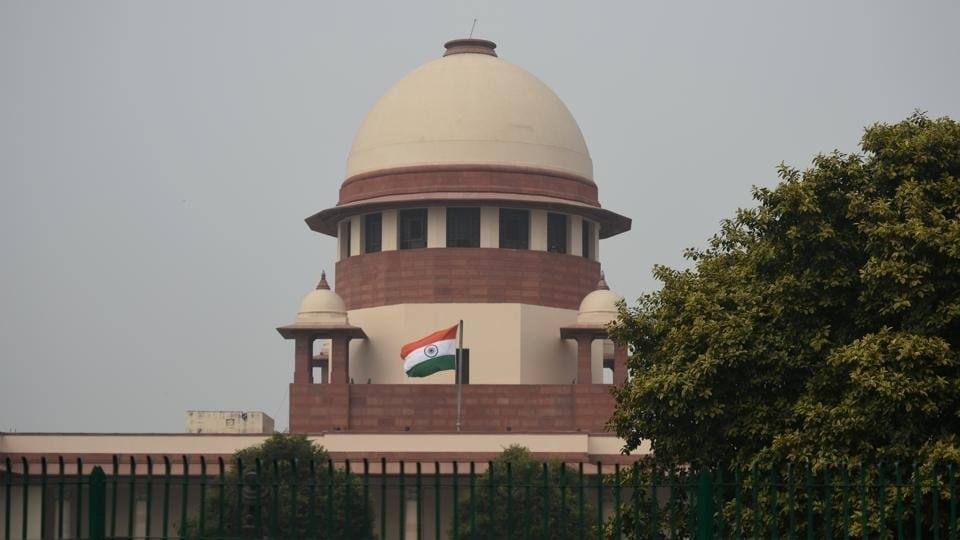
Expressing dissatisfaction over the steps taken by the Centre and state governments of Delhi, Haryana and Punjab to address the air pollution in the Capital, a bench headed by Chief Justice of India (CJI) NV Ramana added that it expected the authorities to do much more than calling upon the court to issue directions on issues such as work-from-home, carpooling, and the use of sprinklers.
“What I have been observing as a judge that bureaucracy has developed an inertia... a policy paralysis where they want this court to do everything. As if we should give directions take a bucket, put out fire, use sprinkler and all. We have to do everything,” the CJI told solicitor general Tushar Mehta, who appeared for the Union government.
The bench, which also comprised justices Dhananjaya Y Chandrachud and Surya Kant, added: “This is an unfortunate situation to which the bureaucracy has come down to. They say ‘we won’t do anything. Let the court pass directions and we will simply put signatures saying the court has directed it’... This is the attitude developed by the executive.”
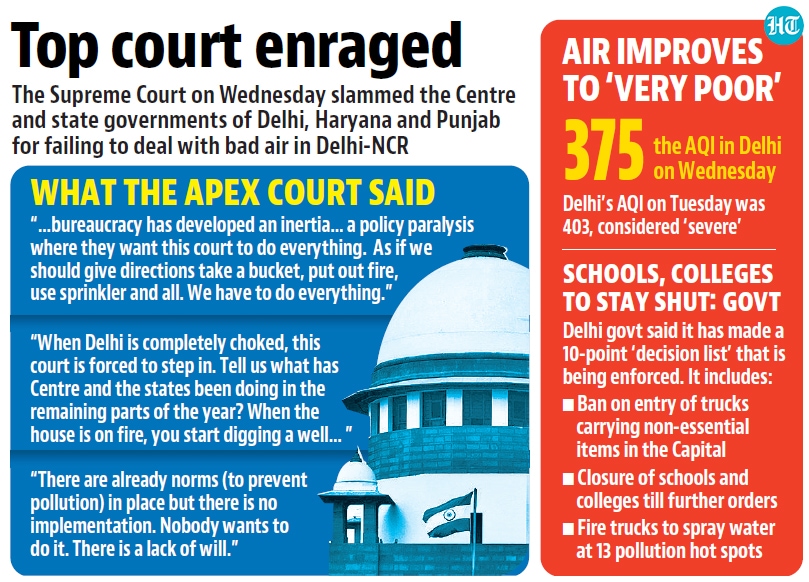
“When Delhi is completely choked, this court is forced to step in. Tell us what has Centre and the states been doing in the remaining parts of the year? When the house is on fire, you start digging a well... Just because Delhi and some adjoining areas in UP, Haryana and Punjab are involved, we have to intervene. Otherwise, this is something a high court could look at,” remarked the bench.
The court’s comments came as the S-G urged the bench not to issue “harsher directives”, such as making it mandatory even for the central government employees to work from home or imposing a complete lockdown in Delhi and the adjoining areas in the national capital region (NCR).
Mehta requested the court to put off any directive on such measures till November 21 in view of statements by officials from the metrological department in the emergency meeting of Centre and states on Tuesday that the situation could improve after Sunday due to a change in wind directions.
The bench reluctantly agreed to defer its orders but not before it pointed out severe deficiencies by all the authorities concerned in implementing statutory and regulatory norms regarding industrial and construction activities.
In the last hearing, the bench gave the Centre and states with portions within NCR -- including Haryana, Uttar Pradesh and Punjab -- 24 hours to come up with urgent steps to mitigate the crisis. The Commission for Air Quality Management (CAQM) headed the meeting on Tuesday, and late in the night widened bans on construction work and in-person classes at schools and colleges to the larger NCR outside of Delhi.
The move, which came 12 days after hazardous air pollution first set in, also included a ban on the entry of trucks in the Capital unless they were carrying essential supplies and the shutting of six thermal power plants within a 300km radius of Delhi.
Forecasts that the weather will turn unfavourable for air quality began in late October, a period when satellites also began to record a late but expected spike in farm fires. On November 5, a day after Diwali, the air quality index (AQI) shot up to 462 in the severe category -- it has stayed in the severe and the very poor category since.
The bench agreed with senior counsel Vikas Singh, who appeared for the 17-year-old petitioner, Aditya Dubey, that the rules are already there to control emissions from power plants; dust and other pollutants from industrial and construction activities; BS-VI norms for vehicles, but there is no oversight and implementation.
“These are activities that take place throughout the year. There are already norms in place but there is no implementation. Nobody wants to do it. There is a lack of will,” rued the bench, while adjourning the case to Wednesday next week.
“We will take it up after 21st November. But, in the meantime, don’t think you can lower your guard just because we are not issuing any direction,” the bench told Mehta while adding that the central government should also “contribute more” in terms of reducing strength of its employees in offices as well as by providing common transport instead of letting its employees use private vehicles to travel to offices.
“All of you are saying transportation is a major source. All guzzlers including high-end cars are on the road. You say you will encourage people to carpool but who will implement it? This will be left to the mercy of the car owners,” the bench told Mehta.
The S-G had earlier submitted that the number of vehicles being used by the central government employees were miniscule as compared to other vehicles and that stopping them would do “more harm” because they deal with pan-India issues.
“We have resorted to a graded response mechanism. We cannot bring the entire capital to a standstill,” Mehta emphasised while requesting the bench to not issue any further directives in the wake of variety of directions already issued by CAQM on Tuesday.
The S-G read out the directions issued by the CAQM on Tuesday to the bench, requesting it to defer any further order until November 21.
Senior counsel Abhishek Manu Singhvi, representing the Delhi government, sought to highlight that the court must also address the issue of stubble burning since it is a chief contributor of rising levels of pollution in the months of October and November.
As he implored the bench to have hearings on pollution every year in October instead of “firefighting at the last moment”, Singhvi also said that 90% of the measures, mandated by the commission on Tuesday, have already been in place in the national capital.
At this point, the bench emphasised on the need to have adequate number of mechanised machines for road cleaning in the city to tackle the dust which is a major source of pollution.
Singhvi said the Delhi government has spoken to the municipal corporations about their requirements and the government shall provide complete financial assistance for whatever number of machines are required.
The court suggested that the Delhi government should augment its fleet of CNG buses and should encourage its employees to use public transport.
About removing old vehicles from the road, the bench said that the exercise of identifying old vehicles will take long and that the city government should instead take some urgent measures to bring down the number of vehicles plying in the city.
Singhvi maintained that such an exercise can be successful only if vehicles are stopped in entire NCR and not just in Delhi.
Haryana’s additional advocate general Anil Grover was also asked by the court about curtailing the number of vehicles on roads, suggesting that some inspection and enforcement measures must be taken to bring down unnecessary and casual traffic in Delhi’s adjoining districts of Gurugram, Faridabad and Jhajjar.
“We want you to take steps within a day or two? Why don’t you stop unnecessary vehicles? Don’t leave it to the mercy of others,” the bench told Grover, who further informed the bench that work-from-home orders have also been issued for the areas falling in the NCR, and the schools are shut.
While the counsel for UP said that they are complying with the directions issued by the commission, Punjab government’s counsel pointed out that the state does not have any district in the NCR and that its submissions are confined to the issue of stubble burning.
During the last hearing on Monday, the top court lamented that it was being “forced to set the agenda” on the pollution crisis in NCR.



