
 E-Paper



INS Karanj, third indigenous submarine, commissioned into Indian navy
The submarine was launched in January 2018 for sea trials and will increase the strength and capability of the Indian navy, said chief of naval staff admiral Karambir Singh


A third Scorpene class submarine INS Karanj of Project-75 was on Wednesday commissioned into the Indian navy, after two years of rigorous sea trials.
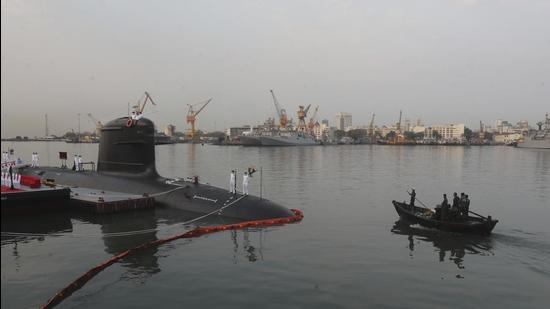
The submarine was launched in January 2018 for sea trials and will increase the strength and capability of the Indian navy, said chief of naval staff (CNS) admiral Karambir Singh.
Singh and retired admiral VS Shekhawat were present during the occasion. Shekhawat, who was part of the commissioning crew of the old Karanj and was also its commanding officer during the 1971 India-Pakistan war, was the chief guest.
Shekhawat, the 14th CNS who served as navy chief from September 30, 1993 to September 30, 1996, said, “We live in India and launch numerous satellites, building nuclear submarines, manufacturing vaccines for the world. The new Karanj is another example of Make in India”.
Also Read | SC notice to Centre, NDA on denying women entry into defence, naval academies
He said between the first world war and second world war submarines were hardly evolved, but after the second world war when electronic revolution began, development and engineering took place and the nature of the submarine substantially changed. “There is huge difference between the old Karanj and the new one, but one thing will never change, that is the sea and the danger from the sea,” he added.
Shekhawat quoted a British navy officer who insisted that “the hazard of the sea must always be given priority over the violence of the enemy, the enemy you might have to get away from, but from sea you can never escape if there is a dangerous situation.”
“This Project-75 submarine is motivation to indigenisation, and Aatmanirbhar Bharat is a fundamental tenet of Indian navy’s growth story and future operational capabilities,” Singh said while speaking at the occasion.
The trials of the Air Independent Propulsion (AIP) system, recently developed by Defence Research and Development Organisation, have been just completed. “The system will be ready in 2023 and after that when the first submarine will go for refit, the AIP will be installed in her. AIP plug will increase the capability of submarines to remain underwater for longer,” added Singh.
INS Karanj, India’s third of six Scorpene class submarines, has superior stealth and several major combat capabilities. It is a diesel-electric attack submarine built under the Project-75 programme at Mazagon Docks Limited in Mumbai in collaboration with Naval Group (formerly DCNS), the French submarine builder.
India’s first indigenous submarine INS Kalvari was launched in October 2015 and was commissioned in December 2017, five years behind schedule. The second one, INS Khanderi was launched in January 2017 for sea trials and commissioned in September 2019. INS Karanj is the third. The fourth submarine INS Vela was launched in May, 2019 and is undergoing sea trials, and the fifth submarine INS Vagir was launched in November 2020 and is also undergoing sea trials. The sixth submarine INS Vagsheer is in various stages of outfitting.
Scorpene submarines can undertake multifarious types of missions; they are designed to operate in all theatres, with means to ensure interoperability with other components of a Naval Task Force. It is a strong platform, marking a generational shift in submarine operations.
The state-of-the-art technology utilised for construction of the Scorpene class submarines has ensured superior stealth features such as advanced acoustic silencing techniques, low radiated noise levels, hydrodynamically optimised shape and the ability to attack the enemy using precision guided weapons. The attack can be launched with both torpedoes and tube launched anti-ship missiles, at the same time as underwater or on surface. The stealth of this strong platform is enhanced by the special attention given to various signatures. These stealth features make them invulnerable, unmatched by most submarines.
The old INS Karanj was commissioned on September 4, 1969 at Riga in the erstwhile USSR, (United States of Soviet Russian) also took active part in the conflict under the Command of then commander VS Shekhawat and was decommissioned in 2003.


