
 E-Paper



J&K, Ladakh officially Union Territories; historic, says PM
The event was hailed by PM Modi and home minister Shah, with the former saying the decision to nullify Article 370 and bifurcate J-K will bring political stability and end corruption in the region.

 Prefer HTon Google


Jammu and Kashmir (J&K) was formally bifurcated into two Union territories with the swearing in of lieutenant governors in Srinagar and Leh on Thursday, in a historic move that was celebrated in Ladakh, cautiously welcomed in Jammu, but drew a muted response in the Kashmir valley.
Girish Chandra Murmu took oath as the first LG of J&K in a low-key ceremony at Srinagar’s Raj Bhavan at around 12.30pm that was televised across India, bringing the curtain down on the formerly princely state that enjoyed special provisions and constitutional protections for 72 years. Earlier in the day, RK Mathur was sworn in as the first LG of Ladakh in Leh. Chief justice of the J&K high court, Gita Mittal, administered the oath of office to both LGs.
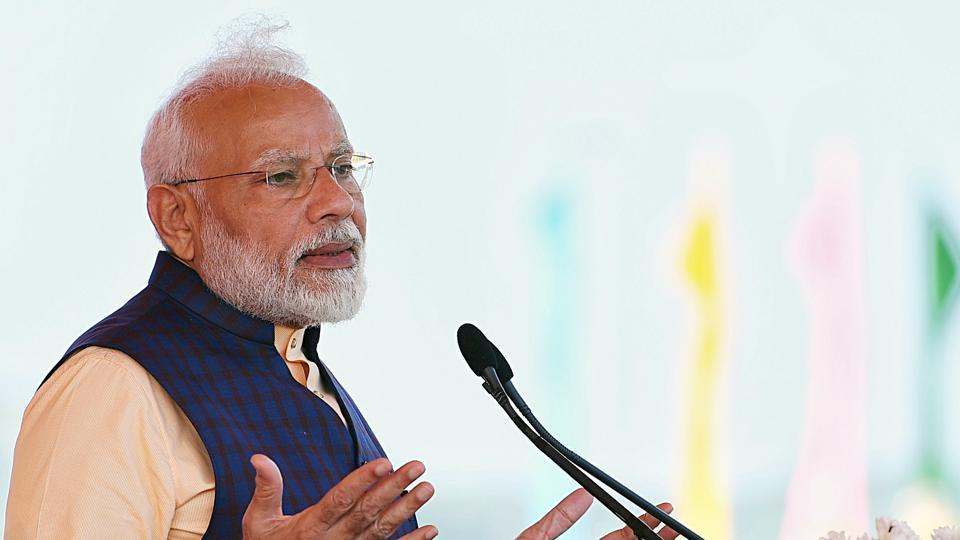
The event was hailed by Prime Minister Narendra Modi and home minister Amit Shah, with the former saying the decision to nullify Article 370 and bifurcate the state will bring political stability and end corruption in the region. “The new system in Jammu & Kashmir and Ladakh is not meant to draw a line on the land but to build a strong link of trust,” Modi said at a ceremony in Gujarat to mark the birth anniversary of Vallabhbhai Patel, the first home minister of India.
Modi said Patel inspired him to effectively revoke Article 370 and added that unity in diversity was India’s strength. “The country took the decision to scrap Article 370, which had only given separatism and terrorism to that state,” he added.
Shah said that Article 370, which gave special status to J&K, and 35A, which gave special privileges to its residents, were gateways of terrorism that had now been closed.
The Jammu & Kashmir Reorganisation Act, passed in Parliament in early August, says J&K will be a UT with an elected legislative assembly and a chief minister, while Ladakh will be governed by the LG and have two hill development councils.
The ceremony in Srinagar came close on the heels of two days of unrest during the visit of a group of European lawmakers. The event was held at the heavily secured Raj Bhavan lawns and attended by about 300 invitees, many of them from the bureaucracy, judicial services, and academia.
Most opposition leaders in the Valley did not attend the event, citing the detention of prominent leaders such as former chief ministers Farooq and Omar Abdullah and Mehbooba Mufti. Only two MPs attended the event — the Bharatiya Janata Party’s (BJP) Jugal Kishore and the Peoples Democratic Party’s Nazir Ahmed Laway. The BJP’s Nirmal Singh, a former deputy CM, and state unit president Ravinder Raina were also present.
Laway told HT that he accepted the invitation to attend the swearing in ceremony since he did not want to disrespect the LG’s position and the constitutional provisions.
National Conference MPs Hasnain Masoodi and Akbar Lone did not attend the ceremony. “How could we have attended the ceremony, when my party president and Vice President are in jail just metres away from the venue of the oath ceremony?” Masoodi asked.
Congress party unit chief Ghulam Ahmad Mir said no leaders from the state unit were invited. “They didn’t invite us because the government is carrying out the whole exercise undemocratically,” he said.
Most offices of political parties in the Valley were deserted on Thursday with only the BJP celebrating the occasion. Manzoor Bhatt, BJP’s spokesperson in the state, said the formalisation of the UT status for Kashmir will end 70 years of discrimination faced by the people. “There has been a lot of oppression and corruption here and we are hopeful of a new beginning being made,” Bhatt said.
On his first day in office, Murmu hit the ground running, said officials aware of developments. The new LG attended a review meeting at the secretariat, taking stock of the situation in the state. The meeting lasted for over two hours and officials apprised Murmu of various problems. He is learnt to have assured the officials that their concerns will be addressed.
Meanwhile, radio stations in the region too have been renamed. While the radio station situated in Jammu has been renamed as All India Radio (AIR) Jammu, stations in Srinagar (Radio Kashmir) and Leh have been renamed as All India Radio, Srinagar and All India Radio Leh, respectively.
The formal bifurcation marks the end of a period of political turmoil in the state that began with the collapse of the BJP-PDP coalition government in 2018. But parts of the state have been under lockdown since the government moved to nullify Article 370 on August 5. Though restrictions on movement have been gradually relaxed, residents report marked resentment and anger on the ground.
“We were a full state with special provisions. Now we know that our powers will be curtailed. It is not like we want to go with any other country but we are deeply hurt,” said Asrar Ahmad Bhat, a resident of Srinagar.
In Jammu, though people welcomed the move, some said they were cautious about the future. “I wake up to the new status of Union Territory with a tinge of sadness. To see the vast state built with the blood and sweat of my people to be reduced thus causes pain…I am deeply conscious that there was no other way to correct the wrongs being done to us for decades under Kashmiri hegemony,” said Manu Khajuria Singh, an activist in Jammu.
The mood was more upbeat in Ladakh, with many people expressing hope that the new status and direct control of the central government will usher in development. “We are happy with the UT as we enter a new era. We have a lot of hope and expectation from the Centre but there are apprehensions about the unique culture and identity of Ladakh,” said Morup Stanzin, a resident of Ladakh.
Noor Ahmad Baba, a retired professor of political science at the Central University of Kashmir, said a feeling of disappointment and humiliation continued to dog the people of Kashmir. “The locals are also not convinced about the claims of development and jobs,” he added.


