
 E-Paper



Jabs for 12-15, boosters for all 60+ from Mar 16
The government said the vaccine it planned to administer to the children aged between 12 and 15 years — there are 71.4 million such people in the country — was Biological E’s Corbevax.


India will begin administering the first coronavirus vaccine doses to children between the ages of 12 and 15, and booster doses to all above the age of 60 from March 16, an expansion in the immunisation drive aimed at fighting new variants and minimising the effect of the infectious disease on normal life.
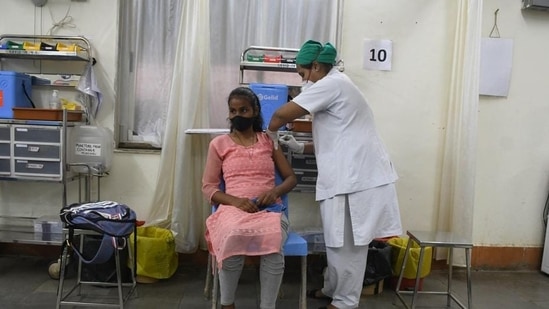
The government said the vaccine it planned to administer to the children aged between 12 and 15 years — there are 71.4 million such people in the country — was Biological E’s Corbevax. It has placed an order of 50 million doses of the vaccine, and supplies have started coming in, according to people aware of the matter.
“If children are safe, then the country is safe. I am happy to announce that from March 16, Covid vaccination will start for children belonging to the age group of 12 to 13 and 13 to 14 years. Also, all 60 years and above will now be able to take the precaution dose. I request guardians of all children and persons in the 60 and above age group to come forward and take the vaccine shot,” Union health minister Mansukh Mandaviya said.
The move comes after calls from experts to expand the vaccine drive, especially booster doses, to fight new variants such as Omicron, which showed a substantial drop in vaccine efficacy against symptomatic disease.

India last expanded its immunisation drive in January, opening it up to children aged 15 years and above, and administering booster doses to health care and frontline workers and people above the age of 60 with certain health conditions. Prime Minister Narendra Modi announced the first use of “precautionary doses” in December last year, referring to what has commonly been called boosters. Several countries have started using the additional doses since September 2021.
“Union Government after due deliberations with scientific bodies has decided to start Covid-19 vaccination for 12-13 yr and 13-14 yr age groups (those born in 2008, 2009 and 2010. i.e those who are already above 12 years of age) of population from 16th March 2022. The Covid-19 vaccine to be administered would be Corbevax manufactured by Biological Evans, Hyderabad,” the Union health ministry said in a statement.
Corbevax, a Covid-19 vaccine developed by Hyderabad-based Biological E, has received emergency use authorisation for children between 12 and 18 years of age from India’s drug regulator. The approval was based on interim results of the ongoing Phase-2 and Phase-3 clinical trials. The Drugs Controller General of India already previously approved the use of Corbevax among adults on December 28 last year.
Corbevax is manufactured by Biological E after a no-strings-attached tech transfer from its developers, Texas Children’s Hospital Center for Vaccine Development at Baylor College of Medicine.
Children between ages 15 and 18 are already being administered Bharat Biotech’s Covaxin.
On average, the government currently gets vaccine supplies of around 300 million Covaxin and Covishield doses a month; both these vaccines have been the mainstay of India’s Covid-19 vaccination programme.
Paediatricians are happy with the development.
“More they add, the better it is as children may have mild or asymptomatic manifestation of the disease, but they can pass it on to other; therefore, to break the chain we need to vaccinate them as well. We don’t know what we will be dealing with in future, so it’s good to equip kids as well. Plus, their peer group system works well; it will fly in this age group,” said Dr Anupam Sibal, senior paediatrician, and group medical director, Apollo Hospitals.
The opening up of the drive comes at a time when the country appears to have ample amount of doses at hand and the daily cases of Covid-19 are well under control.
India recorded 2,503 new cases in the last 24 hours, with currently 36,168 active cases. The daily data and weekly positivity rate has dropped to 0.47%
Studies have shown that an initial course of Covid-19 vaccines — typically given in two doses — may not be enough to halt infection from Omicron, but a booster shot may help.
The World Health Organization (WHO) recently said it strongly supported “urgent and broad access” to booster doses of Covid-19 vaccines, capping a reversal of the UN agency’s repeated insistence last year that boosters weren’t necessary for healthy people and contributed to vaccine inequity.
“Government has also decided that the condition of co-morbidity for Covid-19 precaution dose for population over 60 years of age will be removed forthwith. Hence, from 16th March 2022 onwards, the entire population above 60 years of age will be eligible for Precaution Dose of COVID19 vaccine,” the health ministry said.
The need to accelerate vaccine coverage has been underscored by the rapid spread of the Omicron variant in several countries, where scientists have also found it to be significantly resistant to immunity created by vaccines or a past infection.
China’s seven-day average of Covid-19 cases shot up to 1,584 on March 13, according to the NYT database, an increase of 452% over two weeks, as the country sees its worst outbreak in two years, and after Wuhan, where it all began in 2019. Germany has said the impact of Covid-19 in the country has reached a “critical” level after the number of infections rose to a record high this week.
In the case of some vaccines, such as the AstraZeneca dose (produced and used in India as Covishield), the vaccine efficacy against symptomatic disease dropped to near-zero when infections were with Omicron, prompting health experts as well as governments in countries such as the US and UK to appeal to people to take booster shots.
“It is a good idea to provide additional doses to those with low or compromised immunity as they would need assistance in fighting the virus such as elderly, especially those with co-morbidities, and those who suffer from some chronic health condition because of which their immunity is compromised. For other groups, we need to have more data,” said Gagandeep Kang, senior vaccine expert, and faculty, Christian Medical College, Vellore.
To be sure, studies and ground reporting showed that the Omicron variant was significantly less likely to lead to hospitalisation, partly because vaccine efficacy in preventing serious illness was more durable.
According to the government’s daily update on vaccine stock availability, 173.8 million balance and unutilised doses of coronavirus vaccines were available with states or were in the pipeline.


