
 E-Paper



Kashmir records 7 years’ highest July rainfall
June and July were exceptionally wet in Kashmir though the Valley witnessed relatively drier and hotter months of March and April this year


Kashmir recorded seven years’ highest rainfall in July this year compensating the deficit in precipitation in the Himalayan valley, which witnessed relatively drier and hotter months of March and April this year.
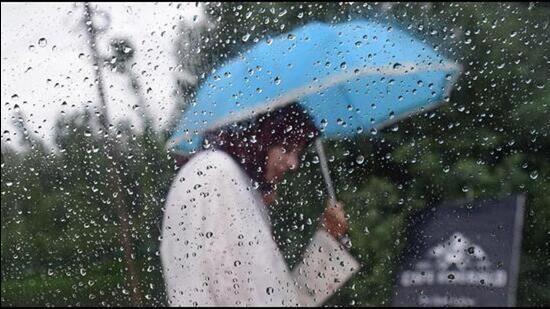
Weather experts said that June and July were exceptionally wet in Kashmir this year with summer capital Srinagar recording 230.2mm rainfall cumulatively, comparable to the year 2015, which also witnessed good rainfall in the two months amounting to 226.8 mm cumulatively.
“In Kashmir, despite the monsoons, the months of June and July are usually warmer and drier. However, this year was an exception with stronger monsoon currents than the previous years,” said meteorologist Farooq Ahmad Bhat of the Srinagar centre of the Indian Meteorological Department.
“In June this year, Srinagar recorded 107 mm rains which were slightly higher than our recent baseline year of 2015 when it was 87.5mm. However, July saw 122.3 mm rains in Srinagar, just less than 139.3 mm in the year of 2015,” he said.
“This is after years that we saw continuous rainfall in July due to monsoon. Only in 2015 we saw such type of rains in July. In rest of the years we have mostly seen around 50 mm rains in the month,” Bhat added.
Another meteorologist Mohammad Hussain Mir said that it was in rare cases that there was rainfall in the whole month of July. “Usually monsoon would not behave like this. There used to be breaks but this year there was no break in the month,” said Mir.
Kashmir gets 70% of its precipitation owing to Western Disturbances – moisture laden winds from Mediterranean – with normally January and February as snow months and March and April (receiving above 100 mm each) as the wettest rain months. But this year, the valley residents struggled due to hot and dry weather with temperatures hovering 8-10 degrees above normal in March and April.
The deficiency was due to the absence of any strong western disturbance and hence the cities of Jammu and Srinagar largely remained dry.
“We witnessed 70-80% deficit precipitation with March and April comparatively dry, getting just 57 mm rains in the two months in Srinagar. But that deficit has now been compensated by monsoon in June and July,” said Bhat.
The average rainfall annually is usually between 700-750 mm in J&K. “This year we have already reached 546 mm of which 230 mm have been recorded in June and July in Srinagar. We can now say that we have normal rainfall this year,” he added.
Not only the rains, the two monsoon months also saw some massive cloudbursts with one taking lives of 16 pilgrims near the Amarnath cave shrine in early July.
“The phenomenon happens in some specific locations where the intensity of rainfall is high mostly 100 mm per hour in a short period of time. These phenomenons keep happening in the pre-monsoon or monsoon seasons. There is nothing unusual about it,” said Bhat.
“The only thing we are witnessing now is that the happenings are reported more often now owing to easy communication from previously inaccessible areas,” he said.


