
 E-Paper



KCR-led TRS faces a tall task as Telangana turns 8
In the last three-and-a-half years, KCR-led TRS has started feeling the heat of the growing anti-incumbency built on unrest among unemployed youth, problems in paddy procurement and a failure to fulfil promises like three acres of land for Dalits and the building of double-bedroom houses for the poor in Telangana


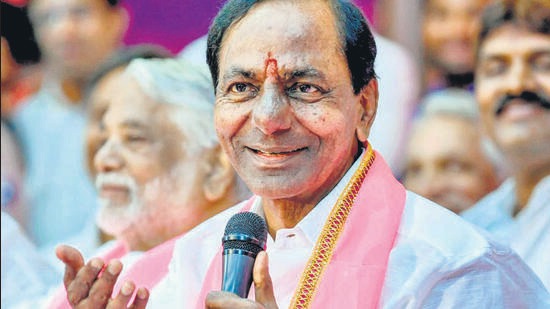
On Thursday, Telangana, the youngest state of India, will be completing eight years of its formation; and Telangana Rashtra Samithi (TRS) president and chief minister K Chandrasekhar Rao, also known as KCR, his eight years in the office.
The struggle towards the formation of Telangana spanned over five decades, making it one of the longest socio-political movements witnessed in independent India that witnessed several ups and downs, suppressions by the successive governments and betrayal by political leaders who led the movements.
While most violent movement for separate Telangana was witnessed in 1969-70 which claimed over 400 lives, the last phase of the movement between 2001 and 2013 was relatively peaceful, but most strategic.
Almost every section of the Telangana society — students, youth, workers, employees, medical professionals, farmers, women, weaker sections and minorities — took part in the agitation, bringing the entire administration in the region to a standstill.
The movement, which picked up pace with the fast-unto-death launched by KCR, in November 2009, turned aggressive after a spate of suicides in the next three years. Post Telangana’s formation, during the first assembly session, KCR had claimed that nearly 1200 people died in the last phase of the agitation.
With pressure mounting from TRS and also the Bharatiya Janata Party in Parliament, the then United Progressive Alliance (UPA) government at the Centre decided to carve out separate Telangana state.
Amid stiff resistance from public representatives from Andhra and Rayalaseema regions, the Telangana was finally formed on June 2, 2014, after the passage of Andhra Pradesh Reorganisation Act in Parliament under the most turbulent conditions on February 20, 2014.
Eight years of Telangana
Though it was the Congress-led UPA government that formed the separate Telangana state, however, it was the TRS led by KCR which walked away with all the credit as it spearheaded the political movement for the statehood. Naturally, the people voted the TRS to power in June 2014.
Within no time, KCR proved to be the shrewdest politician and emerged as an undaunted leader. Though the TRS had won just 63 out of 119 assembly seats — only three seats more than the absolute majority mark — KCR virtually decimated the entire opposition, by poaching 12 out of 15 Telugu Desam Party MLAs and nine out of 21 Congress MLAs, besides all the three MLAs of YSR Congress Party, two of Bahujan Samaj Party and an independent MLA.
Administratively, the chief minister adopted an aggressive approach in addressing the basic needs of Telangana – primarily power crisis, irrigation and drinking water supply. Thanks to the abundant availability of coal in Singareni Coal mines and an established hydel power station at Srisailam Left Bank, the state overcame power crisis within no time and became one of the power surplus states in the country.
On the irrigation front, the KCR government took up Mission Kakatiya, aimed at restoring all defunct irrigation tanks and lakes. The biggest achievement of the TRS government was the completion of Kaleshwaram Lift Irrigation Scheme on Godavari river, aimed at irrigating nearly one crore acres of parched lands in north Telangana.
Similarly, another scheme Mission Bhagiratha, aimed at supplying tap water to every door step across the state at the cost of ₹40,000 crore, was also a major achievement of the Telangana government. The scheme, which was replicated at the national level as Har Ghar Jal Yojana, won laurels from the Centre.
The establishment of over 300 residential schools for SCs, BCs and minorities, besides a slew of welfare schemes, including Kalyan Lakshmi, Shadi Mubarak, increased pensions, Arogyasri and financial assistance to various sections of people marked KCR’s first tenure.
The launch of Rythu Bandhu scheme which envisages a payment of ₹10,000 per year per acre to each farmer towards input cost and Rythu Bima paying ₹5 lakh to each of the families of the farmers who die in distress also fetched huge mileage to the TRS.
Though the TRS government has not kept up its promise of filling up the government jobs, which was one of the major issues for which the movement for separate state was launched, the Telangana has witnessed massive employment generation in industrial, information technology and IT-enabled services sectors.
“In the last eight years, as many as 4.54 lakh youth have got jobs in the IT and ITES sectors, taking the total employment in the IT sector to 7.78 lakh,” Telangana IT minister K T Rama Rao said in the latest report on IT sector released on Wednesday.
Political analyst S Rama Krishna said the state had limited its recruitments to a few areas like police and health department but there were no massive recruitments in the last eight years. “Only recently, the government started issuing notifications for 80,000 new jobs,” he pointed out.
Tough road ahead for TRS
KCR took the opposition parties by surprise by going in for early elections in December 2018 and returned to power for a second successive term with a massive mandate 88 out of 119 seats in the assembly. Within no time, the number swelled to 103 with the defection of 12 Congress MLAs and three TDP MLAs.
In the last three-and-a-half years, the TRS has started feeling the heat of the growing anti-incumbency built on unrest among unemployed youth, problems in paddy procurement and a failure to fulfil promises like three acres of land for Dalits and the building of over 2.5 lakh double-bedroom houses for the poor.
The resurgence of the opposition parties, beginning with the 2019 Lok Sabha elections, is now posing a big threat to the TRS. While the Congress under the leadership of newly-appointed PCC chief A Revanth Reddy appears to be growing stronger, the BJP, fresh from the victories in by-elections in Dubbak and Huzurabad and impressive show in Greater Hyderabad Municipal Corporation elections is also posing a big challenge to the TRS.
Despite the tall claims by KCR of turning around Telangana into one of the richest states in the country, the crippling financial position is evident due to delay in payment of salaries, pending arrears to contractors, depriving the local bodies of their funds and mounting public borrowings.
While implementation of welfare schemes has become a tough task for the KCR government, he launched a new scheme – Dalit Bandhu – in August 2021, to attract Dalit voters ahead of the Huzurabad by-elections by offering to pay ₹10 lakh to each eligible Dalit family for self-employment scheme. But the scheme is yet to be implemented in full scale due to paucity of funds.
In an obvious bid to counter the BJP’s growth as a potential rival in the state, KCR launched a no-holds-barred attack on the BJP, both at the state and national level.
While his attempt to stitch up a federal front of regional parties before 2019 elections failed with lack of response from other regional parties, the TRS chief revived his “national mission” recently by meeting several leaders, including Akhilesh Yadav of Samajwadi Party, Hemant Soren of Jharkhand Mukti Morcha, Arvind Kejriwal of Aam Aadmi Party, Sharad Pawar of Nationalist Congress Party, Uddhav Thackeray of Shiv Sena and H D Deve Gowda of Janata Dal (S).
Indications are that KCR might anoint his son K T Rama Rao as his successor in the party and the government before moving to the national politics. How and when he does is a million-dollar question.
Telangana BJP official spokesman N V Subhash said the last eight years of the TRS rule was a wasted opportunity. “KCR, who claims to be an intellectual, has totally bungled in managing the state finances and pushed the state into a huge debt-trap so much that now he is unable to pay even salaries and pensions,” he said.
Telangana Congress Legislature Party leader Mallu Bhatti Vikramarka said the people of Telangana, including government employees and farmers are very much frustrated with the TRS government. “They have lost their confidence in KCR who promised to make the state a “Bangaru Telangana” (Golden Telangana), but made it a debt-ridden state,” he said.


