
 E-Paper



Keeping up with UP | The silence of Mayawati
BSP leaders believe that the four-time ex-chief minister is not only paranoid about her own security, but also concerned with actions like her brother being summoned by the Enforcement Directorate several times.

 Prefer HTon Google


Mayawati, the daughter of Prabhudas, a clerk in the Post and Telegraph Department and Ramrati, a housewife, once dreamt of becoming a bureaucrat. Soon those personal ambitions were to change, around the time she met a man named Kanshi Ram. At the time, Kanshi Ram was struggling to unite the ‘Bahujan Samaj’ under the banner of All India Backward (SC, ST and OBCs) and Minorities Communities Employees' Federation (BAMCEF) he had floated in 1973.
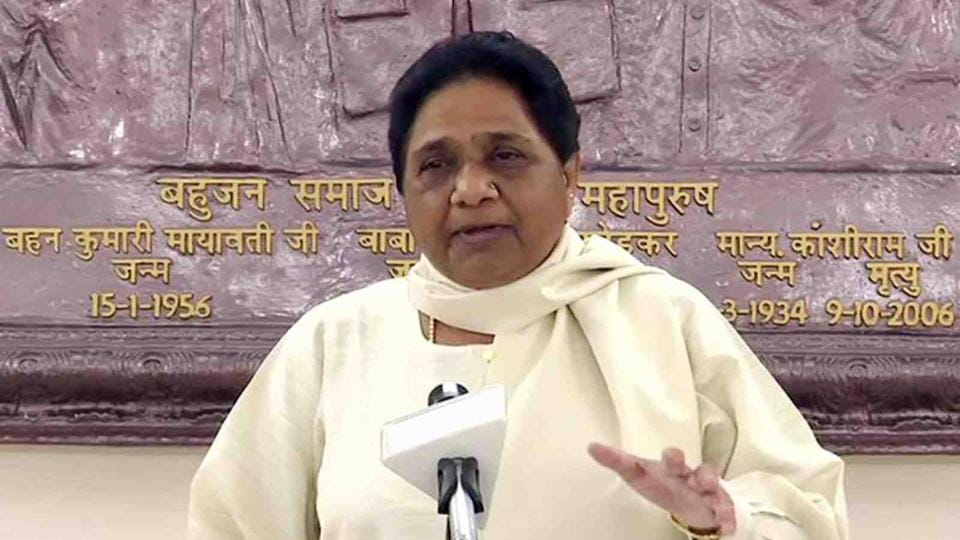
In 1977, much to the chagrin of her father, Mayawati joined his mission in 1977. For years thereafter, Mayawati worked across Uttar Pradesh mobilizing Dalits, forming the political foundation that took her from a non-descript Patparganj home in New Delhi to eventually the chief minister’s bungalow at Kalidas Marg in Lucknow.
In her, Kanshi Kanshi Ram found a firebrand leader and they together launched the Bahujan Samaj Party in 1984, capturing large segments of the Dalits in the state, around 21%, finding particular support among the Jatavs, Mayawati’s own sub caste. This electoral strength gave her the power to bargain in Uttar Pradesh’s coalition era between 1993 and 2007, catapulting her to the Chief Ministers chair four times. Thus when Mayawati recently told media persons that Yogi Adityanath and Akhilesh Yadav were political pygmies for someone who had made giants like Atal Bihari Vajpayee, Kalyan Singh, PV Narasimha Rao and Mulayam Singh Yadav dance to her tunes, she was not completely off the mark.
Cut to the 2022 election season though, and Mayawati, who once gave voice to Dalits, seems to have gone quiet. Barring tweets and press meets, she has been confined to her home in Lucknow. BSP leaders believe that the four-time ex-chief minister is not only paranoid about her own security, but also concerned with actions like her brother being summoned by the Enforcement Directorate several times.
Even then though, when elections to 403 assembly constituencies are right around the corner, her conspicuous absence from the cut and thrust of the elections is indeed incongruous. While her party has given a “behenji aa rahi hai” call, some argue that she expects a hung house, where she could bargain herself to a position of power again. After all, in her political history, no party is untouchable.
That said, BSP leaders are worried that with Omicron now spreading like wildfire, Mayawati may be wary of travelling at all, addressing rallies or meeting the public. Comparatively, the BJP has already campaigned across the state with its Jan Vishwas Yatra covering almost all constituencies as part of their feedback mechanism. The Samajwadi Party too has seen party national president Akhilesh Yadav continuously on the move, emerging the biggest challenge to the BJP. Akhilesh Yadav has sealed alliances and his ‘Vijay Rath Yatras’ have been drawing huge crowds. Some though dismiss Mayawati’s absence from the poll scene this early as not new, and as her style of functioning. Even in 2017, Mayawati held her first political rally much after the notification by the Election Commission.
Mayawati, however, has another explanation for her absence in the electoral field. “My party is poor. It does not have funds like the BJP or others. If I hold rallies like them, then it will incur a financial burden on us,” she told the media recently. Her other contention is that both the SP and the BJP are exhorting ticket seekers in every constituency to bring crowds while on the other hand, the BSP is busy finalising candidates for all the 403 seats in the state. Unlike the BJP and the SP, the BSP is going it alone.
Mayawati’s ‘style of functioning’ is a little different from others. A couple of sector in-charges in every constituency short-list candidates. Those shortlisted are now being interviewed by Mayawati herself and over 150 names have been cleared thus far. The declared candidates, described as assembly in-charges, have been introduced to the core team of workers and have begun campaigning.
Notwithstanding these behind the scenes moves, her intriguing silence troubles her voters more than her opponents. There were signs of cracks in her support base even in the 2012 assembly elections, where many supporters in Meerut’s Baoli village for instance had said that while Mayawati had empowered them enough that upper castes could no longer ban their ‘hukka-paani’, they were resentful of her going soft on ‘manuvadis’.
On the other hand, the BJP has been wooing Dalits by the distribution of free ration and other doles. This has started paying them dividends as a weak Congress is no longer an option. Indeed, an inactive Mayawati is advantage-BJP as Dalits, especially Jatavs, will likely not vote for the Yadav-led SP. Many sections of the community had not voted done so even in the 2019 Lok Sabha elections when the two parties were poll partners. Socially, as well as politically, Yadavs and Dalits have always been antagonistic.
Also, contrary to the earlier perception that an active Mayawati would bring about a multi-cornered contest in the state and thus divide the opposition votes, the BJP is now eyeing her vulnerable core votes with the RSS (Rashtriya Swayamsewak Sangh) working at the Dalit vote for years.
Interestingly, while the BJP is eying Dalits, the BSP is trying to win over disgruntled Brahmins. Party general secretary Satish Chand Mishra and his family have been touring the 86 reserved constituencies to win upper caste support and form a Brahmin-Dalit alliance. “The social engineering formula that brought the BSP to power in 2007 will ensure its victory in the 2022 assembly election as well,” said SC Mishra.
Ironical then that a quest for power has changed the fundamental politics of the BSP, with Kanshi Ram wanting to end upper caste hegemony, but Mayawati seems happy to harness them for her political ambition. On a plaque installed on the front wall of the Prerna Kendra, built by Mayawati in Lucknow are inscribed the following words by Kanshi Ram: “I wish that Km Mayawati should have a long life devoted for the mission she is committed to, but every person has to die one day and she will die too someday. I wish after her death, her bones should not be immersed in the rivers of Ganga or Yamuna but be laid beside my bones in the Prerna Kendra in Delhi and Lucknow. This wish of mine will go against the Manuvadi system of the society.”
Mayawati may have inherited Kanshi Ram’s mission, but it has since been lost in the melee for political position. But even for that, she will have to step out of the shadows, and take on challengers as she once did.


