
 E-Paper



Lakhimpur Kheri violence: SC appoints retired HC judge to monitor probe
The Supreme Court underscored that the appointment of a former judge from outside Uttar Pradesh to oversee the probe into Lakhimpur Kheri violence would “ensure transparency, fairness and absolute impartiality in the outcome of the investigation”.


The Supreme Court on Wednesday appointed retired Punjab and Haryana high court judge Rakesh Kumar Jain to monitor the probe into the Lakhimpur Kheri violence, in which eight people, including four farmers, were killed on October 3.
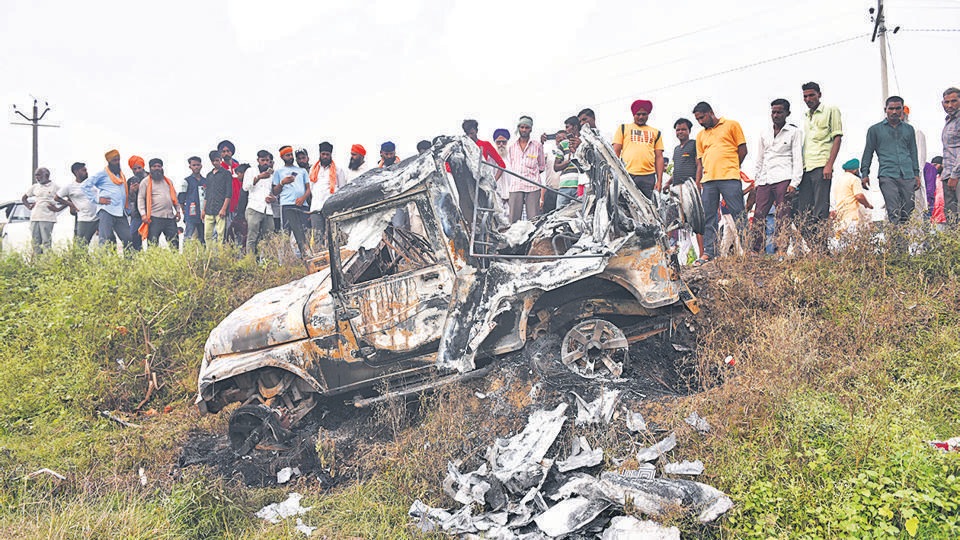
The court underscored that the appointment of a former judge from outside Uttar Pradesh to oversee the probe would “ensure transparency, fairness and absolute impartiality in the outcome of the investigation”.
“This Court is equally concerned about guaranteeing an impartial, fair, just and thorough investigation into the incident which has resulted in such a tragic loss of lives of protesters as well as some other persons,” said a bench, headed by Chief Justice of India NV Ramana, asking the former high court judge to monitor the probe and submit a report in the court after the charge sheet is filed in the case.
The bench, which also comprised justices Surya Kant and Hima Kohli, further underlined that constitutional courts must ensure “the rule of law and constitutional guarantees of a fair and impartial investigation into alleged criminality” as it pointed out how it had previously disapproved of “slow pace, manner and outcome of the investigation conducted so far”.
The court, thus, ordered a new special investigation team (SIT) to probe the violence and inducted three Indian Police Service (IPS) officers in the team, asking them to complete the investigation “expeditiously” and in a time-bound manner, and by using latest forensic investigative methods “to reach the truth”.
“While investigating such offences, justice must not only be done, but also be seen and perceived to be done. We thus deem it appropriate to reconstitute the SIT hereinafter to preserve the faith and trust of people in the criminal administration of the justice system,” said the bench.
The court said that 1993-batch IPS officer SB Shiradkar will head the three member-SIT and will also include IPS officers Padmaja Chauhan and Preetinder Singh. All three officers are currently serving in Uttar Pradesh but are directly recruited IPS officers and belong to other states.
It took note of the fact that at present, the SIT predominantly consisted of middle-level or subordinate-level police officers posted in Lakhimpur Kheri district.
“It appears to us that in spite of their perceived commitment and sincerity in carrying out the investigation, there may still be a lurking suspicion in respect of the fairness and independence of such an investigation. We, therefore, deem it appropriate to direct reconstitution of the SIT infused with directly recruited IPS officers who do not hail from the State of Uttar Pradesh though are allocated to the UP Cadre,” recorded the court in its order.
The bench passed its directive in the case registered by the top court on its own motion (suo motu) after the UP government on Monday said that it has no objection to the appointment of a former high court judge to oversee the probe into the incident.
It had also asked senior counsel Harish Salve, who appeared for the state government, to give names of some high-ranking and senior police officers who could be inducted in the SIT since most of the current police officers were inspector-level and were posted in Lakhimpur.
A day ago, the state government submitted names of some senior police officers, following which the court named the new members of the SIT.
Over the last few hearings, the top court has been critical of the manner in which the state police have so far conducted the investigation in the case.
On November 8, the bench pulled up the UP police, commenting that the investigation into the Lakhimpur Kheri incident appeared to be favouring the “main accused” in the case. The remarks continued the trend of the top court’s dissatisfaction with the probe in the case where a convoy, in which at least one vehicle belonging to Union minister Ajay Mishra ‘Teni’, ran over farmers protesting three controversial agricultural laws, leading them to run amok and lynch some of the occupants of the vehicles. Four farmers, three Bharatiya Janata Party (BJP) workers, and a journalist were killed in the incident.
Ashish Mishra, the son of the minister, is one of the accused in one of the two cases (the convoy running over farmers) being investigated. His arrest came only after the bench, on October 9, criticised the lenient treatment he seemed to be receiving from the police in the murder FIR.
The other case being investigated by the police relates to the lynching of some of the occupants of vehicles in the convoy. In the last hearing, the court was perturbed that some of the evidence being collected in this case was aimed at protecting the “main accused”
The state maintained that it has “clinching evidence” of Mishra’s presence at the scene (something he and his father have consistently denied), but that forensic reports on this are awaited.
The bench had then underscored the need for appointing a retired high court judge from outside the state to monitor the probe after noticing that the investigation in the farmers’ murder case (FIR no. 219) could be adversely impacted by the manner in which the UP police were recording evidence in the case relating to the murder of three BJP workers (FIR no. 220).
It added that the court does not have confidence in the judicial commission appointed by the UP government. On October 7, the UP government set up a judicial commission, headed by retired Allahabad high court judge PK Srivastava, to probe the incident


