
 E-Paper



Landslide risk not enough reason to halt Char Dham project: Centre to SC
At SC, the Centre presented the concerns of the Indian Army, the reason why the government sought modification of road width, and the steps taken to mitigate the risk of landslides in the stretches where the expansion under Char Dham project is sought.


he risk of landslides cannot deter the army from giving up on the construction of border roads, the Centre told the Supreme Court on Thursday, defending its application to construct all-weather roads with 10 metre width as part of its Char Dham project in Uttarakhand. Some of these roads, the Centre has said, are strategically important ones leading to the Indo-China border.
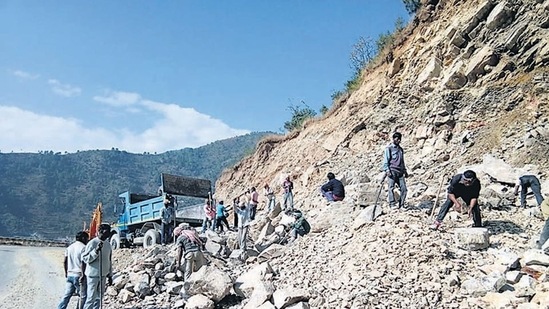
The Court was hearing two applications by separate departments of the Union government, the Ministry of Defence (MoD) and the Ministry of Road, Transport and Highways (MoRTH) for modifying an earlier top court order of September 2020 that did not allow roads with a width higher than 5.5 metre as part of the Char Dham project. That order relied on a 2018 circular of MoRTH providing for roads in hilly regions to be 5.5m wide. However, another MoRTH circular in December 2020 allowed 7m width for feeder roads on the India-China border.
Appearing for the Centre in the matter on which orders were reserved by the Court on Thursday, Attorney General KK Venugopal presented the concerns of the Indian Army, the reason why the Centre sought modification of road width, and the steps taken by government to mitigate the risk of landslides in the stretches where the expansion is sought.
“Landslides are a reality across the country and we have to live with it. The question is will the army drop its hands and say landslides will take place and so will give up on developing mountain roads. No army in the world will say that. If we have to live with it, we have to use all the technology at our command to mitigate it,” Venugopal said.
Parts of Uttarakhand witnessed landslides caused by extreme rainfall last month. With the Intergovernmental Panel on Climate Change saying in a recent report that instances of extreme weather events will increase as a result of the climate crisis, and with rampant development in the hill state cutting hill sides and removing original vegetation, experts say the risk of landslides has increased.
The Centre’s submissions came a day after the Court enquired about steps taken by the Union government to address the risk posed due to landslides in landslide prone zones on the three strategic roads under consideration of the court.
Informing the court of the mitigation measures undertaken by the Centre, the country’s top law officer said that on September 15, 2020, a week after the order on maintaining 5.5m width, the government signed a memorandum of understanding (MoU) with Geological Survey of India (GSI) for carrying out geological studies in the region on which work had commenced. He further stated that in January, another MoU was entered with Defence Geo-Informatics Research Establishment, a premier lab of DRDO, for preparing sustainable landslide mitigation measures for the national highways. In addition, the Tehri Hydroelectric Development Corporation (THDC) has been hired as project consultant to cater to needs of slope restoration during the expansion.
The bench of Justices Dhananjaya Y Chandrachud, Surya Kant and Vikram Nath found these MoUs to be recent and said, “Your MoUs with GSI, THDC and DRDO are as late as January while the work on the project started much earlier. Perhaps now that the government is undertaking this study to identify vulnerable spots, it should precede construction.”
The plea of the Centre was opposed by NGO Citizens for Green Doon on whose plea the road width was restricted to 5.5m. Senior advocate Colin Gonsalves reiterated that the fragile ecosystem of Himalayas cannot tolerate such wide roads and there are consequences that come with such expansion, landslides being one of them.
The Court directed Gonsalves to submit suggestions on what precautions are to be observed by Centre, in the event the court agrees to accept the stand of the Centre.


