
 E-Paper



Litigant asks for right to pray at disputed site
Devotee Gopal Singh Visharad, who had filed a lawsuit in a lower court in 1950 seeking the right to pray at the disputed site, died in 1986. His son Rajendra Singh now represents him. Chief Justice Ranjan Gogoi-led five-judge Constitution bench heard the arguments on the 10th day.

 Prefer HTon Google


A Hindu litigant on Thursday told the Supreme Court that the Babri Masjid was built after demolishing a Ram temple at the disputed site in Ayodhya and Hindus kept worshipping there without giving up its possession while seeking enforcement of the right to worship there.
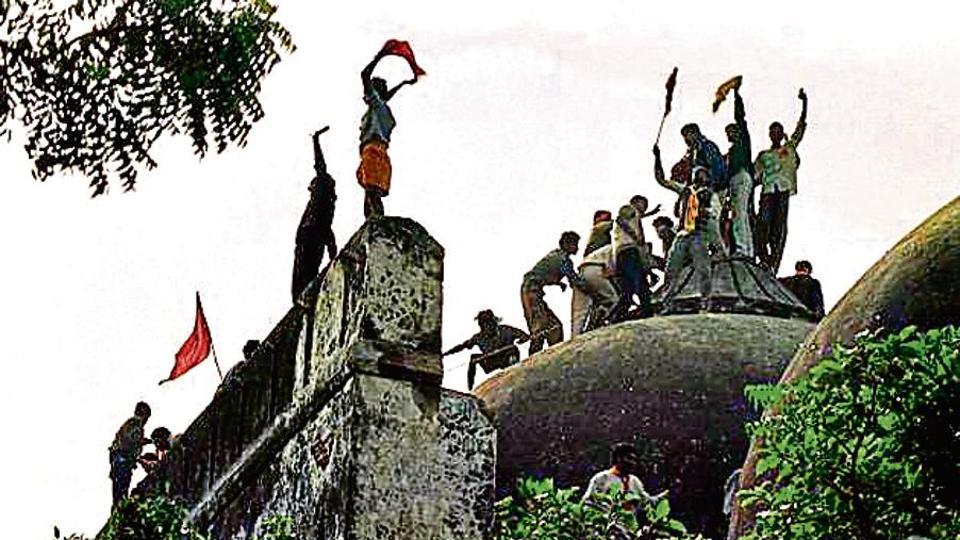
Devotee Gopal Singh Visharad, who had filed a lawsuit in a lower court in 1950 seeking the right to pray at the disputed site, died in 1986. His son Rajendra Singh now represents him.
Chief Justice Ranjan Gogoi-led five-judge Constitution bench heard the arguments on the 10th day in the decades-old land dispute case.
“The mosque was built after demolishing the Ram temple, and despite that Hindus continued worshipping there and did not give up possession...Moreover, Muslims were never in possession of the site,” senior advocate Ranjit Kumar told the bench comprising Justices S A Bobde, D Y Chandrachud, Ashok Bhushan and S A Nazeer.
“I am making my submissions with reference to Parasaran’s and Vaidyanathan’s submissions [lawyers who represented the deity] that the place is itself a divine site and that I being the worshipper, my right to worship, which is a civil right, should not be curtailed,” he said.
He referred to records and said magistrate Markandey Singh on December 29, 1949, initiated proceedings to attach the disputed structure under the Code of Criminal Procedure following communal disturbances. The magistrate sought responses from Hindu and Muslim parties in support of their claim and counterclaim over the property.
People from both sides filed 20 affidavits in 1950 before the magistrate and they are also part of the judicial records of the Allahabad High Court.
“Filing affidavits, per se, is not enough to prove them. The deponents will have to appear to prove them... No court can say that the facts of these affidavits are proved,” the bench said.
These affidavits were filed in 1950 and the trial on lawsuits took place “much much later”, the lawyer said. He added the high court did not accept the affidavits saying that the deponents were not available for cross-examination.
The lawyer added that they are part of the judicial records and be accepted as the magistrate had verified the statements and identity of the deponents.
He read the affidavit of one Abdul Gani and said he stated that the Babri Masjid was built after demolishing the temple, the birthplace of Lord Ram, where Hindus continued to worship and never gave up the possession.
Gani had further said that while Muslims were reading ‘namaz’ only on Fridays, Hindus had been offering ‘puja’ on the site regularly and the offering of ‘namaz’ at the site was “against the Sharia” of Muslims.
Kumar, who adopted the submissions of lawyers of the deity to lay claim over the entire 2.77 acres of the disputed land, said the certified copies of affidavits of 20 people were brought into records of the high court during the hearing of the land dispute.
“These affidavits have been exhibited in the [law] suits by Visharad,” he said.
(With PTI inputs)


