
 E-Paper



Lockdown spells cleaner air with stubble burning at lowest in 5 yrs
Although the National Capital Region gets engulfed in smoke from stubble burning during the winter season, particularly in the villages of Haryana and Punjab, rabi crop residues are also burnt during this time of the year across north India.

 Prefer HTon Google


The heavily polluted Indo-Gangetic plains have recorded the lowest agriculture residue burning this year since 2016, satellite images from US space agency NASA have shown.
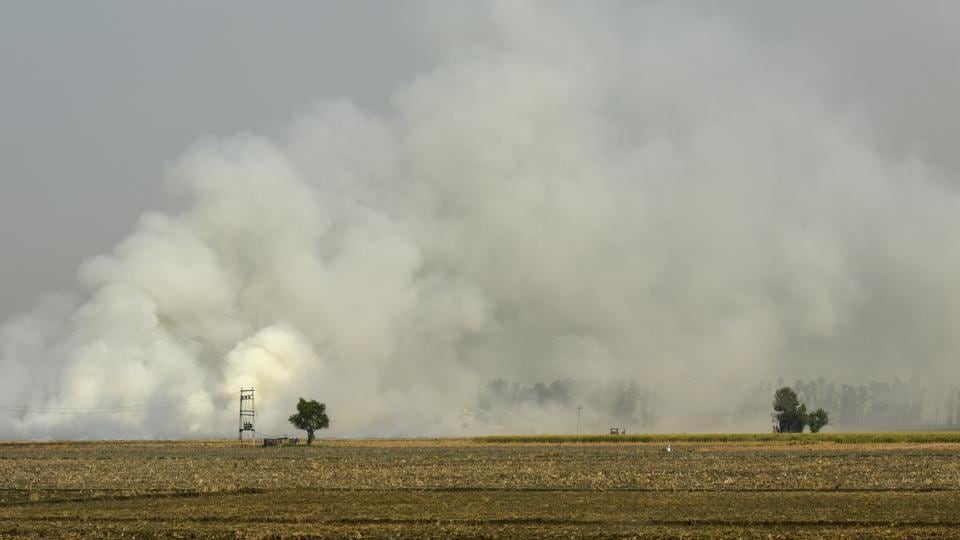
Researchers and government officials said of the several reasons behind the decline in the springtime farm fire count could be the nationwide lockdown after the outbreak of Covid-19.
“Springtime fire activities (mostly agricultural) over the Indo-Gangetic Plain have been the lowest this year in comparison to the last five years during the Covid-19-led lockdown period,” Hiren Jethva, a researcher from Universities Space Research Association at the NASA Goddard Space Flight Center, tweeted on Saturday.
Although the National Capital Region gets engulfed in smoke from stubble burning during the winter season, particularly in the villages of Haryana and Punjab, rabi crop residues are also burnt during this time of the year across north India. Air pollution is, however, much lower during summer because of favourable meteorological conditions such as strong winds.
Graphs and data tweeted by Jethva showed that while in 2016 the cumulative fire count between April 15 and May 15 was around 70,000, in 2020 the figure has come down to around 10,000 during the same period across various north and central Indian states located in the plains. In 2019, the fire count registered a rise, the data shows.
Top officials from the state pollution control boards of Punjab and Haryana confirmed that there has been a sharp drop in stubble burning incidents this year till date.
“In 2019 there were around 5,768 such incidents in Haryana till May 15. In 2020 we have recorded around 2,430 incidents. The lockdown effect could be one reason. A clearer picture will emerge when the harvest is completed by the end of May and we take the final survey,” said S Narayanan, member secretary of the Haryana Pollution Control Board.
“We have seen the NASA maps and analysed fire counts in the National Capital Region. There is definitely a decline in such incidents. The restrictions during the all-India lockdown and the shortage of labour could be the reasons,” said Anumita Roy Chowdhury executive director (research and advocacy) at the Centre for Science and Environment in New Delhi.
Though Jethva suggested lower crop volumes could be an additional factor for the decline in stubble burning, government officials said the harvest has been good this year.
The reasons notwithstanding, the fall in air pollution levels should come as welcome news. As HT has reported earlier, SARS-CoV-2, the virus that causes Covid-19, can cling to air pollutants. Tests conducted in Italy have found the same. Also, air pollution is likely to be a major risk factor for coronavirus disease mortality, scientists have concluded.
“There has been a definite decline in the number of fire incidents. The reasons behind this need to be verified -- whether it is because of the shortage of labour, whether crop yield is low this time or some other reason. This could provide some vital inputs for future planning,” said Sagnik Dey, coordinator of the Center of Excellence for Research on Clean Air (CERCA) and associate professor at the Centre for Atmospheric Sciences (CAS) at the Indian Institute of Technology in Delhi.


