
 E-Paper



Lord Murugan at core of BJP’s strategy in Tamil Nadu
Murugan Devotees’ Conference held in Madurai on June 22 is a precursor of the shift and changing gears applied by the BJP in Tamil Nadu politics

 Prefer HTon Google


Lord Murugan is the beloved and one of the most celebrated Gods in Tamil culture and tradition, transcending the boundaries of caste and religion. Lord Murugan is part of the folklore of love, bravery and literature. The familiar dialogues between the grand old lady of Tamil literature, Avvaiyar and Lord Murugan is reflective of the cultural, linguistic and spiritual genius of the Tamils. There is therefore no doubt that Bharatiya Janata Party (BJP) can hardly resist or overlook the influence and impact of Lord Murugan on Tamil culture. But the paradox is that the BJP now wants to save and champion the cause of Lord Murugan in Tamil Nadu. Strange are the ways and means of power in politics. It is increasingly becoming difficult for the Dravidha Munnetra Kazhagam (DMK) to deny or ignore the growing presence of BJP and the agenda of Hindutva politics. The trappings are there for everyone to see with the changing ethos of politics in Tamil Nadu and difficult decisions to make.
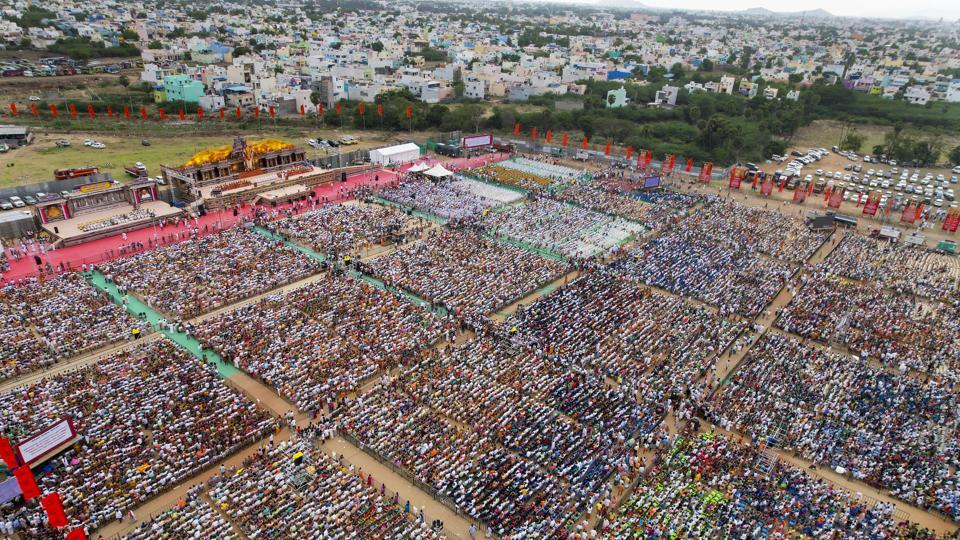
In many ways, the Murugan Devotees’ Conference (Murugan Bhakthargal Aanmeega Maanadu) held in Madurai on June 22 is a precursor of the shift and changing gears applied by the BJP in Tamil Nadu politics. It may be recalled that a similar attempt in 2020 in organising the Vel (Spear) Yatra failed without a trace.
Though it was announced that the conference was organised by the Madurai wing of the Hindu Munnani (Hindu Front), the spiritual design and political craft executed meticulously by the BJP. In a way, BJP has launched its bare-all strategy of Hindutva politics in Tamil Nadu by its make-believe exhibition of devotion and celebration of the Tamil God Murugan.
The devotional chants, joined by the ambitious politicians and the recreation of the Arupadai veedu shrines (six holy abodes) of Lord Murugan in Tamil Nadu built in the style of Durga Puja pandals in West Bengal to draw the pious and religious public as an innocuous witness to the spectacle was an act of politics with religious fervour.
This conference as a preview before the assembly elections next year was launched by the Union home minister Amit Shah and was attended by Maharashtra governor, CP Radhakrishnan, Union minister of state for the parliamentary affairs L Murugan, current BJP state president Nayanar Nagendran, former party president Annamalai and the office bearers of the BJP from other states including deputy chief minister of Andhra Pradesh Pawan Kalyan was more than a political statement informing the tools and depth of BJP’s strategy underway in Tamil Nadu politics for the days to come.
The eight resolutions passed at the conference left no doubt about the political nature of the conference and the course of politics projected by the RSS-BJP in Tamil Nadu.
Thirupparankundram appears to be the short-term strategy before the assembly elections to keep the Tamil Nadu government on back foot while the demand for the removal of Hindu Religious and Charitable Endowments (HR & CE) Department from temple administration will remain an ideological challenge for the Dravidian movement.
The appeal to Hindus to vote en bloc and chant Kandha Shasti Kavasam (a popular Tamil hymn in praise of Lord Murugan) are replicas of north-centric communal politics. There were scenes of parody against Periyar, Anna and Karunanidhi displayed on the stage as part of narrative about the Hindu Munnani through an audio visual in the presence of senior leaders from the AIADMK who attended the conference on behalf of the party. This was not only a violation of the court order of permitting the conference on the ground that it was a religious event, not a political meet.
How different is the Murugan Devotees’ Conference from the DMK organised conference last year in Palani, though hosted and conducted by the Hindu Religious and Charitable Endowments Department, Government of Tamil Nadu? The DMK government organised conference was a preemptive move to counter the BJP’s design and politics of religion in Tamil Nadu with less than moderate response from the public and criticism of its own allies concerned about the secular government hosting religious event. People at large neither consider DMK as an atheist party any longer nor believe that DMK is interested in Lord Murugan or the Hindu religion except as a critic of the caste system and an advocate for social justice.
This perception is more advantageous to the DMK in terms of its myth and reality yet the party cannot abandon its struggle and resistance against the BJP’s Hindutva politics. This is a major dilemma for the DMK party and government in Tamil Nadu. Neither Lord Murugan nor the people of Tamil Nadu require BJP or DMK to engage in the spread of the glory and celebration of Lord Murugan. A similar mistake committed by the Congress and government in responding to the BJP’s Ram Temple in Ayodhiya by adopting a strategy of appeasing the Hindu voters through neither here nor there approach.
AIADMK has not only come under attack from the DMK but also faced with the brutal realities of courting BJP and the potential fallout for the party in the future. This is the critical moment for the AIADMK leaders and cadres to glance and reflect upon the lost path of the party. It appears at this stage that AIADMK is on a suicidal path of ignoring its own identity and ideological history of the party and movement.
This leaves the battleground clear and open for the BJP to emerge as a major contestant to the DMK and challenger to the Dravidian ideology and politics in Tamil Nadu. It is now left to the DMK to remain unassailable by the strategy it may adopt — to be or not to be. The key is to remain grounded and stay focused with its ideological roots and development framework.
(Prof.Ramu Manivannan is a scholar-social activist in areas of education, human rights and sustainable development through an initiative “Multiversity.”)


