E-Paper



Madhya Pradesh tops in wheat stubble burning; ₹25 lakh fined, 50 FIRs filed
Prohibitory orders were issued under Section 19(5) of the Air (Prevention and Control of Pollution) Act, 1981 in Madhya Pradesh

 Prefer HTon Google


Bhopal: Madhya Pradesh has reported the highest number of wheat residue burning cases in India during the first fortnight of April, prompting the state government to take action — imposing fines worth ₹25 lakh and registering over 50 FIRs against farmers involved in stubble burning.
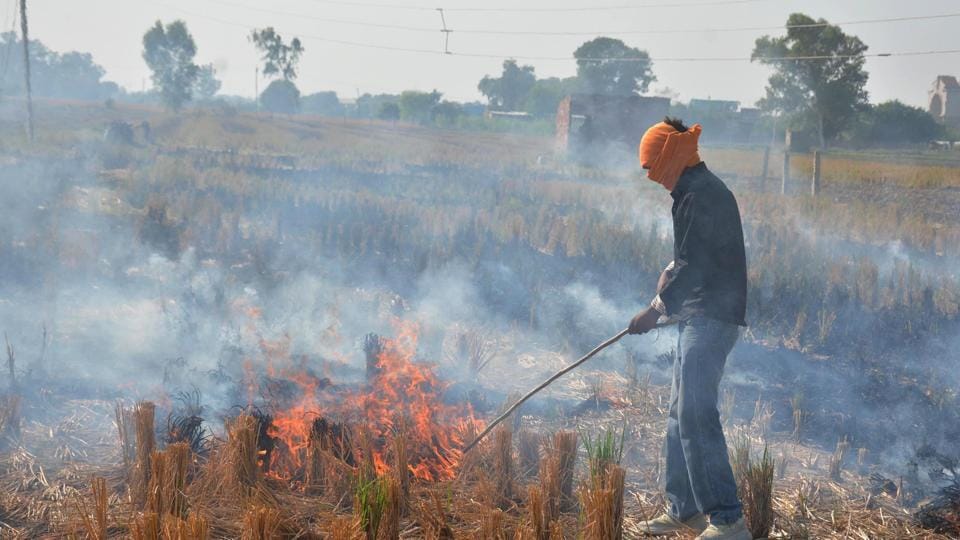
According to a report by the Indian Agricultural Research Institute, more than 15,830 cases were reported in Madhya Pradesh from April 1 to April 18 this year, while Punjab recorded 14 cases, Haryana had 47 cases, and Uttar Pradesh registered 3,607 cases.
The Pollution Control Board and the state’s district administration have issued prohibitory orders and initiated action under Section 19(5) of the Air (Prevention and Control of Pollution) Act, 1981, banning the burning of agricultural residue in the state.
The department of Agriculture and Farmers’ Welfare has imposed a fine of ₹25 lakh on farmers, and more than 50 FIRs have been registered. “In case of violation, small landholders with less than 2 acres shall pay environmental compensation of ₹2,500 per incident; those with land between 2 and 5 acres shall pay ₹5,000 per incident; and landholders with more than 5 acres shall pay ₹15,000 per incident,” an official said.
Farmers protesting against the state administration’s move called it a “punishment for poor policy implemented by the BJP-led state government.”
“The main reason for burning the crop residue is the less availability of machines and delay in sowing of crops. Due to unavailability of fertilizers, wheat sowing delays significantly, then farmers got a very short span of time for sowing moong and others as third crop. Farmers left with only one option i.e., burning the residue to clear their farms. But now, they are being penalised and being booked for violation of prohibitory orders,” farm leader Rahul Raj said.
Also Read: Punjab: Jump in PUSA-44 acreage can lead to spike in farm fires, warn experts
Blaming the government further, farm leader Anil Yadav said, “In Indore, three farmers have been booked for crop residue burning. How can administration blame farmers for this. They should first check the availability of machines for the farmers. In the absence of any option, burning crop residue is a compulsion not convenience.”
A report submitted at National Green Tribunal (NGT) in January this year said that farm power availability in the Madhya Pradesh state was 3.01 Kw/Ha in the year 2023-24. In comparison, Punjab boasts a farm power availability of more than 4.00 Kw/Ha, and the national average stands at 2.75 Kw/Ha. This indicates that the level of mechanization in the state is relatively lower compared to Punjab. In MP, 31284 Crop Residue Management (CRM) machines have been distributed to farmers, and CHCs were strengthened by 7007 CRM machines since 2017. The state has more than 23000 village panchayats but only 4000 have CHCs.
“In wheat production, MP competes with Punjab but in terms of availability of mechnisation and establishment of Custom Hiring Centres (CHC), it is yet to take up. The farmers and experts claimed that subsidy on purchase of machines for crop residue management in MP is upto 40% but in Punjab it is up to 80%, said Pramajeet Singh, an expert of farm issue.
Also read: Crop shift to alleviate stubble fires: CAQM tells Supreme Court
Singh added, “The state government in MP providing subsidy upto 40% for establishing the centre but in Punjab, subsidy is being provided to 50% to individual farmers and 80% to cooperative societies for crop residue management. Even, now the state government is focusing on punishing farmers than taking concrete steps to resolve the matter by addressing root cause.”
Madhya Pradesh agriculture and farmer welfare department Secretary M. Silvendran said, “We are very serious about this issue. We have directed all district administrations to check the availability of machines and create awareness about the ill effects of crop residue burning before taking action against farmers.”
The state government has recently approved the Anna Data Mission, a major reform initiative aimed at addressing farm-related issues, including crop residue management.