
 E-Paper



Maldives joins India in Colombo Security Conclave, Dhaka stays away
The CSC will strengthen coordination for countering transnational organized crime including narcotics trafficking, arms trafficking, human trafficking,.

 Prefer HTon Google


New Delhi: In a strategic U-turn, Mohamed Muizzu led Maldives has joined hands with Mauritius, Sri Lanka and India for a regional maritime security architecture at the national security advisor level on September 30 to counter a range of threats in the Indian Ocean Region (IOR).
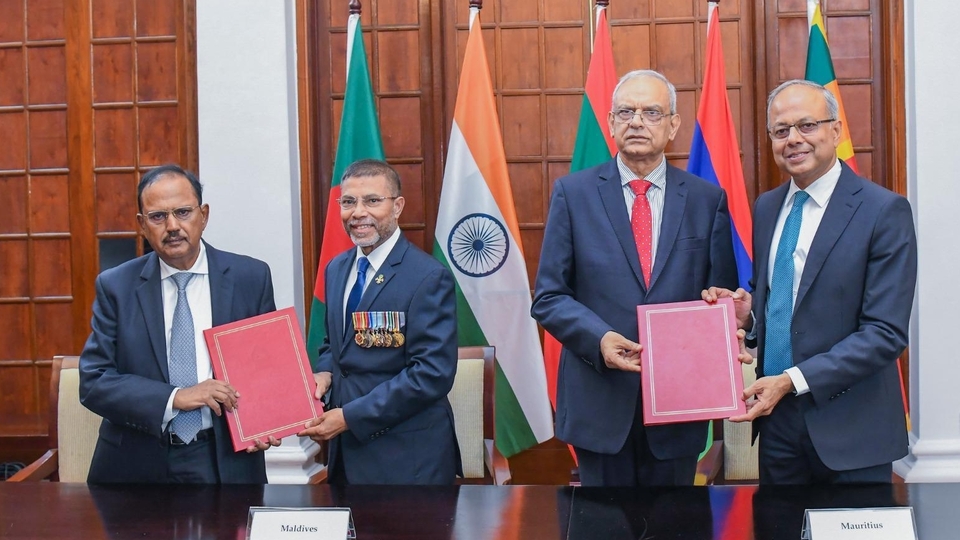
The Charter of Colombo Security Conclave (CSC) and the Memorandum of Understanding (MoU) was signed by Sagala Ratnayaka, NSA to President of Sri Lanka, Ibrahim Latheef, NSA of Maldives, Haymandoyal Dillim, High Commissioner of Mauritius to Sri Lanka and Ajit Doval, NSA to PM of India. Observer Bangladesh did not attend the conclave but Seychelles did.
The agreed ‘Pillars of Cooperation’ for the CSC are: maritime safety and security; countering terror and radicalization; combating trafficking and organized crime, cyber security, protection of critical infrastructure, humanitarian assistance; and disaster relief.
Also read: How Five Eyes Bloc is trying to defang India’s counter-terror & intel apparatus
Besides, the CSC will strengthen coordination for countering transnational organized crime including narcotics trafficking, arms trafficking, human trafficking,. The key IOR states will share information relating to counter-terrorism, radicalization, violent extremism, cyber security threats and transnational criminal networks and applicability of national and international law.
The CSC will also strengthen capacity building among partners through training courses, joint exercises, workshops and skill development programs. The member states will also engage in close cooperation in the fields of oceanography, hydrography, maritime security, marine pollution, maritime law, marine archeology and protection of marine resources.
Also read: View: L-1, mediocrity, processes and poor skills behind Shivaji Maharaj statue collapse
It is understood that the CSC architecture calls for consensus on all future moves and members as well as a dialogue between NSAs and Deputy NSAs through institutionalized mechanisms and working groups. The CSC secretariat will be based in Colombo with a secretary general acting as the convener of the important security grouping.
Also read: Revolution over, Dhaka seeks $8 billion from IMF, World Bank and ADB
While the CSC has key members of the Indian Ocean region, it will also enhance maritime security among member states with the Narendra Modi government committed to support the other three countries in capacity building without any political interference. With Maldives joining the security initiative, President Mohamed Muizzu has sent a signal that he is seeking cooperation with India rather than any power outside the IOR.


