
 E-Paper



Meghalaya illegal mine blast toll rises to 25, two arrested
Teams from the NDRF, the SDRF, and a special rescue unit are continuing rescue and search operations at the site.

 Prefer HTon Google


The death toll from the explosion at the illegal coal mine in Meghalaya’s East Jaiñtia Hills rose to 25 on Friday following the recovery of seven more bodies, even as rescue teams continued to comb the remote site. Meanwhile, police have arrested two people in connection with the incident.
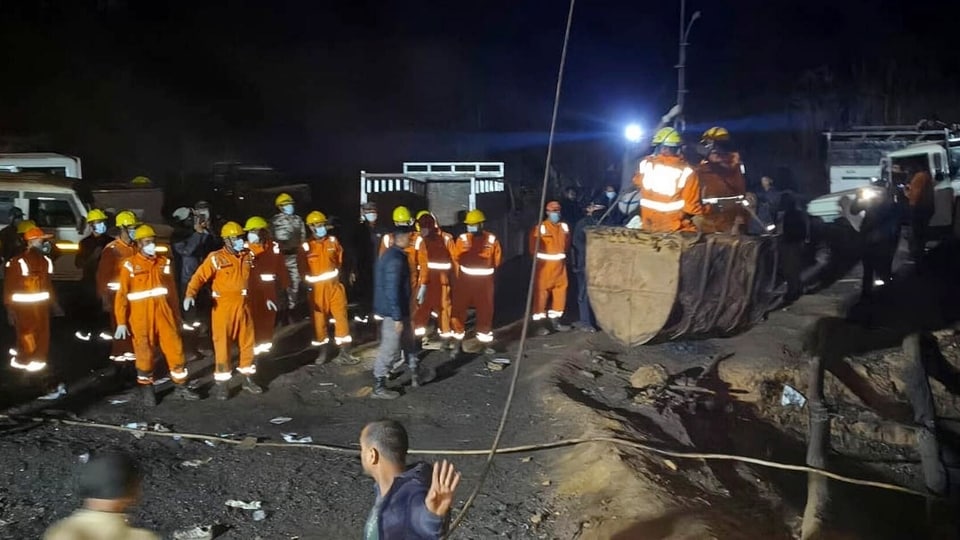
The blast happened inside an unauthorised mine in the Mynsyngat–Thangskai area, under the jurisdiction of the Umpleng police outpost.
“The total casualty is 25 now. Eighteen bodies were recovered yesterday. Four more bodies were recovered today. One injured person succumbed to injuries at NEIGRIHMS, and two bodies were brought by family members — one to Khliehriat Civil Hospital and another to Jowai Civil Hospital,” East Jaiñtia Hills superintendent of police Vikas Kumar Yadav said.
Police on Thursday registered a suo motu FIR at Khliehriat police station under relevant sections of the Bharatiya Nyaya Sanhita, the Mines and Minerals (Development and Regulation) Act, and the Explosives Substances Act. “Two people have been arrested so far,” Yadav said, adding that further investigation is underway to identify others involved in the operation. The two arrested are Forme Chyrmang (36) and Shamehi War (42).
Teams from the National Disaster Response Force, the State Disaster Response Force, and a special rescue unit are continuing rescue and search operations at the site. “The search operation is still underway, and all efforts are being made to find out any remaining victims and complete the identification process at the earliest,” the DGP said.
The deaths have once again drawn attention to rat-hole mining, a hazardous method that involves digging narrow horizontal tunnels, usually three-four feet high, to enter and extract coal. The practice, common in parts of Meghalaya, has been officially banned for more than a decade.
Amid mounting public anger, Meghalaya-based NGO Hynniewtrep Integrated Territorial Organisation (HITO) has stepped up pressure on the government by submitting a petition to governor CH Vijayashankar, demanding a central agency probe into the incident.
In the letter, HITO has rejected attempts to portray the blast as an accident, accusing the political leadership of sustained protection and deliberate non-enforcement that allowed illegal mining to flourish. The organisation has argued that district-level officials are routinely scapegoated after such disasters, while those with political influence remain untouched.
“Operations of this scale cannot exist without political patronage, deliberate non-enforcement, and advance protection. Every death emerging from these pits is therefore not incidental but the outcome of political decisions and political silence,” the letter said.
The organisation has also questioned the citizenship status of several deceased labourers, urging that no compensation or ex gratia payments be released until citizenship is conclusively verified.
It further pointed to the location of the mine, describing it as effectively “no man’s land” under Meghalaya’s land tenure system, vulnerable to encroachment by those with money, muscle power and political backing.
Several incidents that led to deaths of workers in these mines have taken place in Meghalaya over the years despite rulings by the National Green Tribunal (NGT) and the Supreme Court banning mining.
In 2019, Justice BP Katakey (Retd), who headed a committee by NGT on the issue, had submitted several recommendations regulating rat-hole coal mining in Meghalaya. The recommendations formed the basis of directions on the issue by SC in July 2019.
One of the SC directions was allowing sale of already extracted coal prior to a prohibition on rat-hole mining in Meghalaya by NGT in 2014. This direction was exploited as a loophole to extract fresh coal and pass it off as old stock.
In 2022, the Meghalaya high court again asked a panel led by Justice Katakey to review compliance. In his preliminary findings, the former judge reported widespread violations of tribunal and court orders.


