E-Paper



Miffed Odisha to apply for Jagannath patents amid spar with Bengal over deity
The Odisha government’s move has sparked a debate whether sacred words, steeped in centuries of devotion, can, or should, be patented by a state


The Jagannath temple in the coastal city of Puri is a beacon of spiritual and cultural identity. This 12th-century shrine, dedicated to the revered deity, Jagannath, is not just a religious site but a cornerstone of Odia heritage, drawing millions of pilgrims annually.
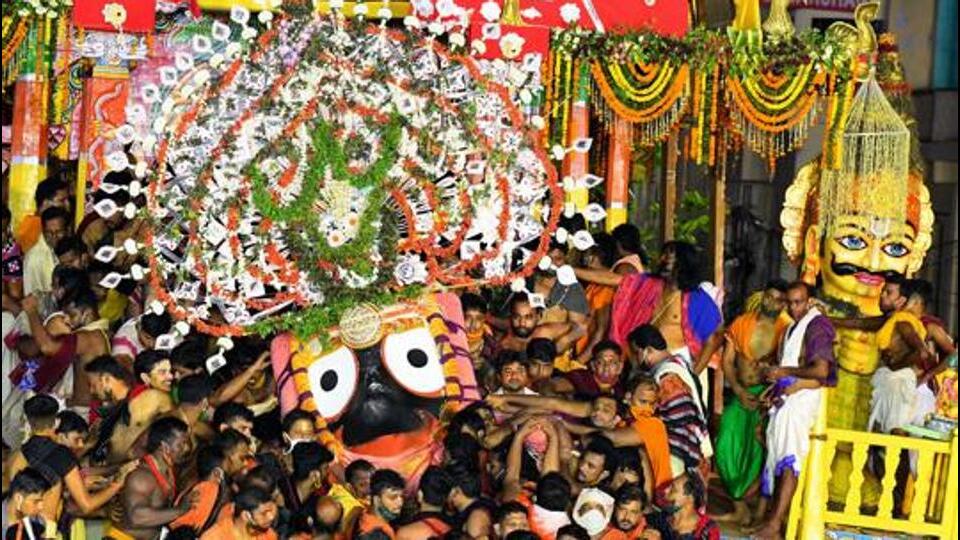
The Bharatiya Janata Party (BJP) government led by Mohan Majhi last week announced that it would seek patents or trademarks for terms intrinsically tied to the temple, including “Jagannath Dham,” “Srimandir,” “Mahaprasad,” and the temple’s logo. The announcement came a month after a controversy erupted
After West Bengal chief minister Mamata Banerjee inaugurated a Jagannath temple in Digha – a coastal town some 350 km from Puri -- and named it Jagannath dham.
Also Read: Odisha draws up ₹1,170 crore scheme to fund travel to Jagannath temple for 950,000 pilgrims
The controversy further intensified as Banerjee referred the new temple as “Jagannath Dham”, sparking widespread criticism because “Dham” is a sacred designation traditionally linked to Puri, as per revered Hindu spiritual leader
Adi Shankaracharya’s designation of four Dhams (Puri, Badrinath, Dwarka, Rameswaram).
Majhi shot off a letter to Banerjee asking her to desist from naming the Digha temple as Jagannath Dham. Puri Shankaracharya Swami Nischalananda Saraswati publicly denounced the decision, alleging that it exploits the diety’s name for commercial gain. Puri’s king Gajapati Maharaja Dibyasingha Deb said the nomenclature used for the Digha temple has deeply hurt the sentiments of devotees. “Terms like Nilachal Dham, Shreekhetra, Srimandir, and Jagannath Dham have always been exclusively associated with the sacred temple in Puri,” he said.
The controversy also deepened over a senior servitor of the temple claiming that surplus neem wood from the 2015 Nabakalebara ceremony at Puri temple was used to create idols for the Digha temple. Though a subsequent probe found the claim untrue, the servitor has been debarred from entering the temple for a month as he attended the consecration process of the Jagannath temple in Digha.
Can sacred terms be patented?
The Odisha government’s move has sparked a debate whether sacred words, steeped in centuries of devotion, can, or should, be patented by a state.
The Odisha government’s initiative aims to protect the cultural and spiritual identity of the Jagannath temple by trademarking terms that define its rituals and offerings. According to Sri Jagannath Temple Administration chief Arabinda Padhee, patenting these terms is a “legal measure aimed at preserving the sanctity, heritage, and unique identity of the Jagannath Temple”. The terms in question—such as “Jagannath Dham” (the sacred abode of Lord Jagannath), “Srimandir” (the temple itself), and “Mahaprasad” (the sanctified food offered to the deity)—are deeply embedded in Odia culture.
Also Read: Jagannath temple body to apply for patents on names
The move is also shaped by electoral politics. The BJP, which came to power in Odisha a year ago, is keen to consolidate its support among the people by championing the cause of religious identity and heritage. The dispute with West Bengal, ruled by the Trinamool Congress, allows the BJP to project itself as a defender of Odia pride and Hindu traditions, potentially strengthening its political base ahead of panchayat elections two years later.
But can such terms, tied to religious tradition, be legally protected under intellectual property law?
Lawyers say a patent is granted for an invention that has novelty and industrial applicability which means, if a thing or product or process is already existing, patent cannot be granted to it. Patents are for inventions.
“The Trade Marks Act, 1999 prohibits registration of marks that hurt religious sentiments or lack distinctiveness. Courts have historically ruled that religious terms cannot be monopolised unless they acquire a secondary commercial meaning. Odisha may struggle to prove these terms are uniquely tied to commercial goods/services rather than religious practice. Even if trademarks are granted, enforcing them against entities like West Bengal’s Digha temple or other religious institutions could lead to protracted litigation,” said Radha Charan Das, a senior lawyer of Orissa High Court.
“For example, terms like Mahaprasad (sacred offering) are used widely across India, complicating claims of exclusivity. If Odisha succeeds, other states might seek trademarks for shared cultural or religious terms risking legal chaos. This could also contravene Article 25 of the Constitution, which guarantees freedom of religion,” Das said.
But other legal experts argue that trademarking such terms is feasible if they are proven to have a distinctive association with the Jagannath Temple. “Odisha can argue that “Mahaprasad” is not a generic term for any consecrated food but specifically refers to the offerings prepared under the temple’s strict rituals, cooked by the Suar Mahasuar Nijog using traditional methods. Similarly, “Jagannath Dham” could be trademarked as a unique identifier of Puri’s temple, distinct from other Jagannath temples worldwide. However, the courts may hesitate to grant exclusive rights to words with broad spiritual significance as words like “Mahaprasad” may be deemed too generic or culturally universal,” said Srikanta Das, another lawyer.
Also read: HistoriCity | The treasures of Jagannath temple are in its shared history
“The process of patenting or trademarking requires demonstrating that the terms are not already in widespread use without permission,” he said.
Das said that the state government can at best apply GI tag for Mahaprasad like the Tirupati temple administration did for the famous Trirupati Laddoo in 2009, but it’s not easy.
Mahaprasad includes rice, dal and other ingredients which may complicate the GI application, as the tag typically applies to a specific product. By getting GI tag for Mahaprasad, it would restrict its production to the Jagannath Temple, requiring strict enforcement to prevent unauthorized use outside the temple, which could be logistically challenging given its widespread cultural use.
Also Read: Suspension of Odisha Jagannath temple servitor escalates TMC-BJP row in Bengal
Though the state government has not set a timeline for approaching the courts on patenting the terms, political analysts agree that the trademarking move also aligns with the BJP’s broader agenda of promoting Hindu cultural nationalism. “By asserting control over terms like “Jagannath Dham,” the party signals its commitment to safeguarding Hindu traditions, a narrative that resonates with its voter base,” said analyst Rabi Das.
In Puri, where the Jagannath Temple’s spire casts a long shadow over the city, the Odisha government’s quest to patent divinity may protect the temple’s legacy, but it also raises a question: can the sacred be bound by legalese?
 ABOUT THE AUTHORDebabrata Mohanty
Debabrata Mohanty is a senior assistant editor of Hindustan Times who works as state correspondent from Odisha covering the state's politics, governance, public policy, natural disasters, environment and its society for close to three decades. With his long years of reporting from the state capital of Bhubaneswar, Mohanty has been known as one of the most experienced and credible journalists covering Odisha for the national English dailies. His reporting combines on-ground detail with deep institutional knowledge detailing the state's changing politics, governance issues, administrative reforms and the functioning of its public institutions. He has regularly reported on issues ranging from legislative developments and public policy implementation. Politics is his core areas of expertise as he closely tracks Odisha's political landscape, including the rise and transformation of the Bharatiya Janata Party (BJP), the Biju Janata Dal (BJD), the two principal political parties in Odisha. His long association with the state's political establishment enables him to write on contemporary developments in a larger political context. Mohanty takes a deep interest in writing human interest stories, environmental issues and documenting the impact of cyclones, floods, heatwaves, and other climate-related events in one of the most disaster-prone states. His coverage extends to public health, governance reforms and stories on accountability of government institutions. Before joining Hindustan Times, Mohanty worked with The Indian Express, Mail Today, and The Telegraph, where he covered at least six general elections and as many assembly elections. In 2007, he was selected for the prestigious Chevening Young Indian Print Journalist Programme at the University of Lincoln, United Kingdom, where he received advanced training in print journalism. In 2009 he won the Press Institute of India-International Committee of Red Cross award on conflict reporting for his on-ground reportage of 2008 Kandhamal riots.Read More