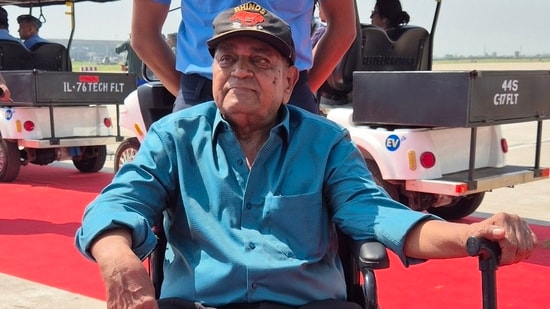
Group Captain Suresh Ratnaparkhi struggled to hold back tears as he sat in his wheelchair and stretched his hand out to touch a MiG-21 Bison that had just landed after its last operational sortie at the Chandigarh airbase where the Indian Air Force (IAF) on Friday decommissioned the last of its iconic Soviet-era fighter jets in a rousing send-off that evoked the aircraft’s heady decades in service and how it shaped the country’s air power.
Group Captain Suresh Ratnaparkhi struggled to hold back tears as he sat in his wheelchair (Rahul Singh/HT)
“She was my beloved and I touched her for the last time,” the 87-year-old former MiG-21 pilot said as India’s longest serving fighter jet retired after flying the Indian flag with distinction for 62 years.
Just moments earlier, Ratnaparkhi listened with rapt attention as defence minister Rajnath Singh described the MiG-21 as the cornerstone of India’s air power for decades, hailed it for acquitting itself honourably in different wars and conflicts, and recounted how the IAF’s first supersonic fighter jet excelled in every role assigned to it.
Astronaut Group Captain Captain Shubhanshu Shukla and MiG-21 pilot Group Captain Abhinandan Varthaman were in the audience too, along with chief of defence staff General Anil Chauhan and the three service chiefs. Chief of the air staff Air Chief Marshal AP Singh and Squadron Leader Priya Sharma were among the six fighter pilots who flew the last MiG-21 sorties.
“In every historic mission, the MiG-21 carried the Tricolour with honour. Its contribution has never been limited to a single event or battle, it has been a pillar of India’s air power for decades,” the defence minister said.
Ratnaparkhi, who travelled to Chandigarh from Goa for the decommissioning ceremony, couldn’t agree more.
“It was a beautiful aircraft that could do a lot of things. It served India well. The MiG-21 was difficult to handle and did not forgive. But every man who has flown it will tell you there’s never been a better fighter,” he said. Ratnaparkhi flew MiG-21s during 1966-89, logging 2,600 hours on all types except the newest Bison variant which came in later.
The day struck a nostalgic note not just for the hundreds of veteran MiG-21 pilots and their families who attended the send-off function --- the younger pilots strolled down memory lane too.
The MiG-21 was an integral part of his life, said Shukla, who recently became the first Indian astronaut to go to the International Space Station.
“The MiG-21 cockpit was my greatest teacher. It taught me a lot. I wish I could have been a part of the last flypast, but unfortunately there wasn’t enough time to make that possible,” he said. Shukla flew three MiG-21 variants --- Type 96, Type 75 and the Bison --- during 2007-17. Other variants operated by the IAF included Type 74 or MiG 21F, Type 76 or MiG 21PF, Type 77 or MiG 21FL and MiG 21 Bis.
The defence minister described the MiG-21 as a “bird for all seasons.” The fighter jet, he said, excelled in a variety of roles including as an interceptor deterring enemy aircraft, a ground-attack platform with offensive capability, a frontline air defence jet protecting Indian skies, and a trainer aircraft that groomed countless pilots.
“The foundation of our highly skilled fighter pilots was laid on the MiG-21. This legendary platform helped generations of air warriors learn how to fly, adapt, and succeed in the toughest conditions. Its role in shaping India’s air strategy cannot be overstated.”
To be sure, the MiG-21’s 62-year journey in the IAF was punctuated by frequent fatal crashes that put the aircraft’s safety record under running scrutiny and led to an understandable chorus of concern and calls for its early replacement. With upgrades, the IAF managed to keep them flying for so long.
More than 400 MiG-21s were involved in accidents that killed around 200 pilots, earning the fighter jets unfortunate epithets such as “Flying Coffin” and “Widow Maker”. To be sure, more MiG-21s crashed than any other fighter because they formed the bulk of the aircraft in the IAF for the longest time --- in the 1980s and 1990s, these planes accounted for more than 60% of the air force’s fighting strength. The maiden batch of six MiG-21Fs entered service in March-April 1963 and the IAF progressively inducted 874 MiG-21s (60% of these were produced under licence in India by Hindustan Aeronautics Limited).
The numbers are a testament to the aircraft’s popularity and multi-dimensional capabilities, the defence minister said, adding that the MiG-21 served as an enduring symbol of the deep ties between India and Russia.
“The legacy of the MiG-21 will live on in India’s pursuit of Atmanirbharta in defence. It will inspire the development of indigenous platforms such as the light combat aircraft (LCA Mk-1A) and the advanced medium combat aircraft. When the world looks at India, it should see a nation that began with the MiG-21 and now leads with futuristic defence technologies,” he said.
Singh sought to dispel the notion that the MiG-21 became outdated long ago. While the initial MiG-21s inducted in the 1960s and 70s were retired long ago, the aircraft in service thus far were not more than 40 years old, a lifespan considered normal for fighter jets worldwide, he said.
“The MiG-21 was continuously upgraded with advanced radars, avionics and weapon systems, thanks to the efforts of HAL that kept the aircraft technologically relevant and battle-ready for decades.”
Follow India news real-time updates and the latest news covered on Hindustan Times, featuring today's critical updates on Sonam Wangchuk LIVE and more across India.
Home/India News/MiG-21 ‘a Bird For All Seasons’, Says Rajnath As IAF Bids Adieu

 E-Paper