
 E-Paper



Defence to space exploration, India-US ties make a giant leap with landmark deals
The two countries will sign the Artemis Accords on space exploration and collaborate on renewable energy technologies

 Prefer HTon Google


Washington Partners of first resort, critical strategic partnership over the next decades, no partner more consequential than India now and into the future, trailblazing initiatives, inexorable trajectory, escape velocity, next generation defence partnership, key security providers in the Indo-Pacific, a delighted United States (US) and a surprised and thrilled India, and a spirit of trust and confidence. These were some of the phrases used by a senior administration official as Washington gave a preview of the joint statement during Prime Minister Narendra Modi’s state visit to the US, unveiling what would be the most ambitious and broad based agenda of collaboration between the two countries in their diplomatic history with a potentially transformative impact for years.
Read: PM Modi's US visit: New H1-B visa rules, defence and space — list of mega deals
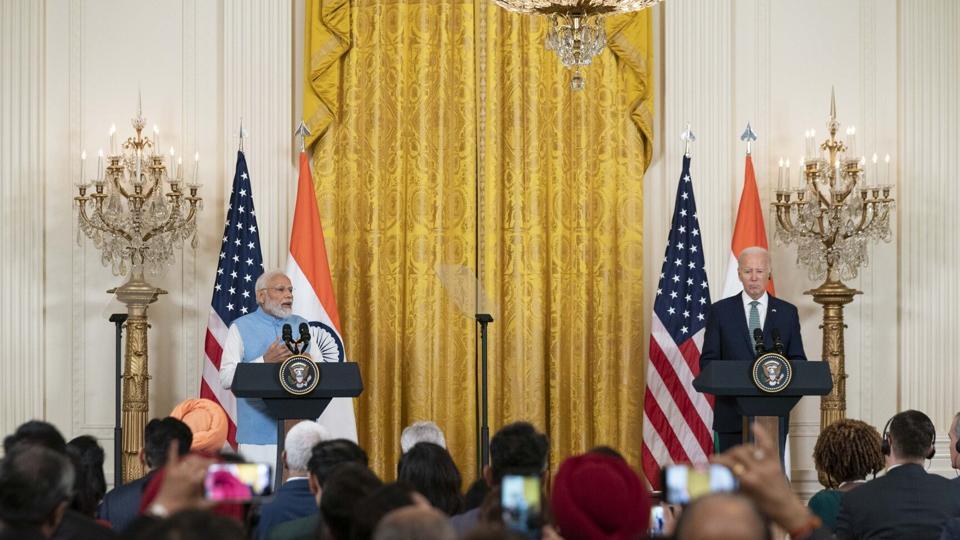
While the text of the joint statement was not out at the time of going to press, in their joint press appearance at the end of their bilateral talks, President Joe Biden and PM Modi confirmed and expanded on some of the deliverables in the offing. Biden said the two countries were demonstrating they were collaborating on nearly all human endeavours while Modi called it a special day in the history of ties.
Speaking to reporters on background late on Wednesday evening (Thursday morning IST), senior administration officials also laid out specific deliverables across multiple domains. HT was the first to report on several of these expected outcomes in the past two weeks, both in its stories and interviews with key officials. The joint statement was expected later on Thursday.
Defence, space and tech
On defence, the GE jet engine deal is through. Modi said that the old days of the “buyer-seller” relationship was over, and the GE jet engine deal through technology transfer and co-production was a “landmark agreement” that would add a new chapter to defence ties.
India will acquire Predator drones (“we are delighted..will substantially grow India’s intelligence, surveillance and reconnaissance capabilities”, officials said). American navy ships will undertake service and major repairs in Indian shipyards (“it will result in cost effective and time-saving sustainment for US military operations across multiple theatres”). India and the US have launched Indus-X to build a defence innovation bridge (“genuinely exciting…will facilitate joint innovation on defence technologies and accelerate the integration of India’s budding private sector defence industry with the US defence sector”).
On space, India will sign the Artemis Accords (“it will advance a common vision for space exploration for the benefit of all humankind”). Modi said that the decision was a big leap and it showed that even the “sky wasn’t the limit” for India-US ties. In a recent interview with HT, US national security adviser Jake Sullivan had said that “sky is the limit” for ties. The National Aeronautics and Space Administration (Nasa) and the Indian Space Research Organisation (Isro) will develop a “strategic framework” for human space flight operations this year and have a joint mission to the International Space Station in 2024.
On semiconductors, American companies will partner with India to build semiconductor ecosystem promotes supply chain diversification. This includes Micron which will put in over $800 million, with additional financial support from Indian government, for a $2.75 billion assembly and testing plant. Applied Materials will set up a new semiconductor centre for commercialisation and innovation in India. Lam research will announce a training programme for 60,000 Indian engineers. Modi hailed the Micron decision as “futuristic” and spoke about iCET as the new framework for cooperation. He also added this was essential to creating reliable, secure and trusted supply chains between trusted partners.
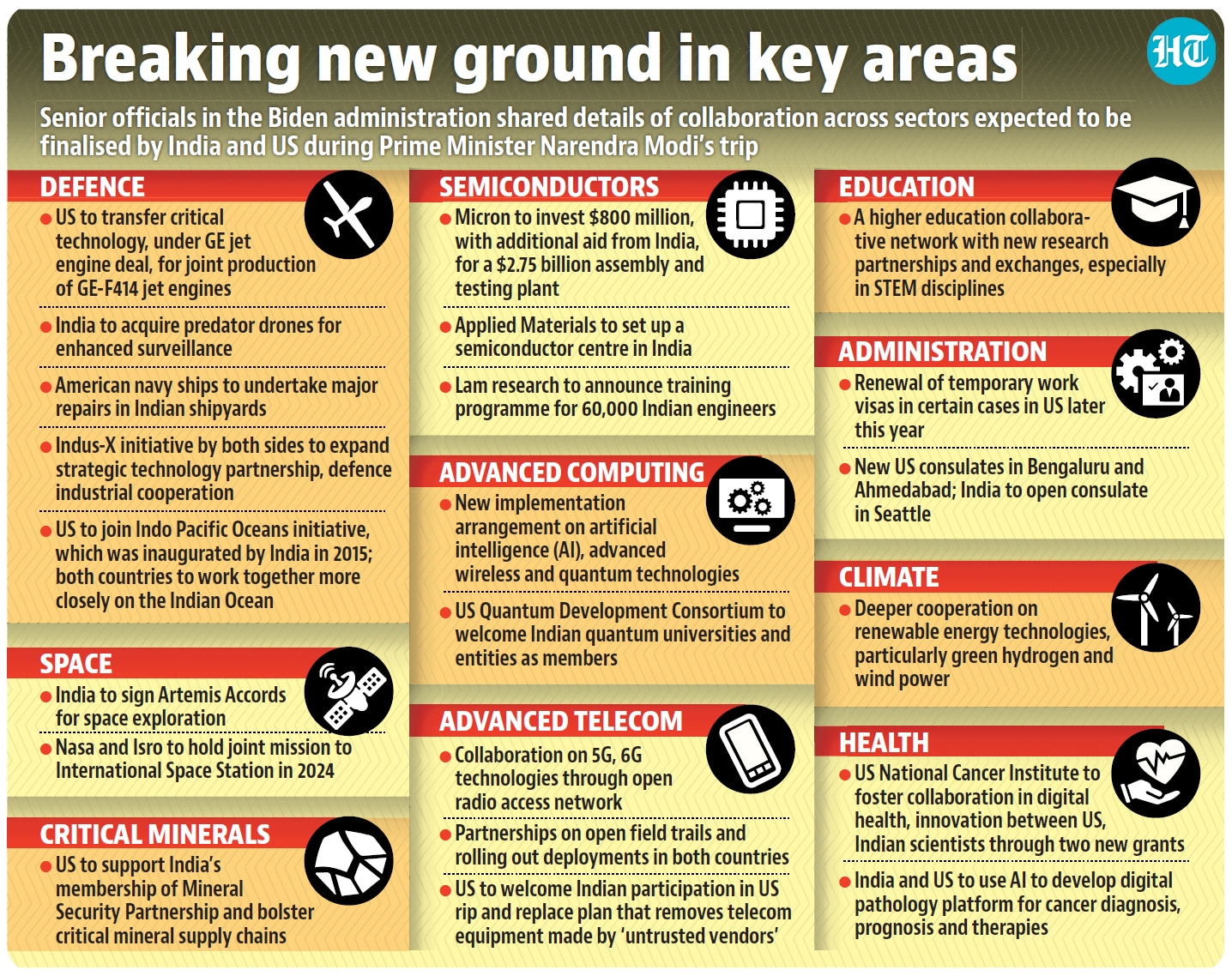
On critical minerals, the US will support India’s membership of the Mineral Security Partnership (“to ensure our respective markets are well supplied with the central critical minerals that are needed for our climate, economic and strategic technology goals”).
On advanced computing, the India-US quantum coordination mechanism will facilitate more collaboration between industries, academia, and government of both countries. The two countries have also signed a new implementation arrangement on AI, advanced wireless and quantum technologies. And the US Quantum Development Consortium is now welcoming into its membership Indian quantum universities and entities.
On advanced telecom, India and the US will work together on 5G and 6G technologies through the open radio access network (ORAN). The two will announce partnerships on open field trails and roll out deployments in both countries, with operators and vendors, with the backing of the US International Development Finance Corporation. The US will also welcome Indian participation in the US rip-and-replace programme that removes telecommunications equipment made by “untrusted vendors”.
Diplomatic ties, people to people links, climate
India and the US, based on an interim report of the Association of American Universities which have worked with IITs, as a part of the Initiative on Critical and Emerging Technologies (ICET), will announce the launch of a higher education collaborative network with new research partnerships and exchanges, especially in STEM disciplines.
Read: H1B visa rules change? US to ease norms during PM Modi's visit
On mobility, the US issued 125,000 visas to Indian students last year, a record, and believes that Indian students are “on pace to become the largest foreign student community in the US” (Chinese students currently lead the pack). The US will also launch a pilot to adjudicate domestic renewals of certain petition-based temporary work visas later this year (read H1B) , including for Indian nationals with the intent to implement this for an expanded pool.
America will also announce the opening of new consulates in Bengaluru and Ahmedabad, while India will reopen a consulate in Seattle and will explore new consulates.
On economic investments, while Modi hailed the two way engagement as good for the bilateral relationship and for the global economy, Biden spoke about both Air India’s order of Boeing aircrafts as well as new investments worth $2 billion to be announced by Indian companies in three different states.
On climate, the two leaders will announce deeper cooperation on renewable energy technologies, particularly green hydrogen, wind power and emerging technologies. There is expected to a commitment on climate finance too.
On health, the US National Cancer Institute will foster collaboration in digital health and innovation between the US and Indian scientists through two new grants and will use AI to develop a digital pathology platform for cancer diagnosis, prognosis and therapies. The two countries will also hold a cancer dialogue next year.


