
 E-Paper



PM Modi pushes symbolic measure to deal with Covid-19, government does substantive review
Through a meeting of Group of Ministers, chaired by defence minister Rajnath Singh, the government also embarked on a substantive review of the efforts to tackle both the pandemic and deal with the fallout of the nationwide lockdown.

 Prefer HTon Google


In a symbolic move on the coronavirus disease (Covid-19) pandemic, Prime Minister Narendra Modi on Friday gave a call to citizens to switch off the lights in their homes and light oil lamps, candles, and flash their mobile phone torches on April 5 at 9pm, for nine minutes. This, he suggested, will be a mark of the collective power of people and showcase their determination in taking the country from darkness to illumination.
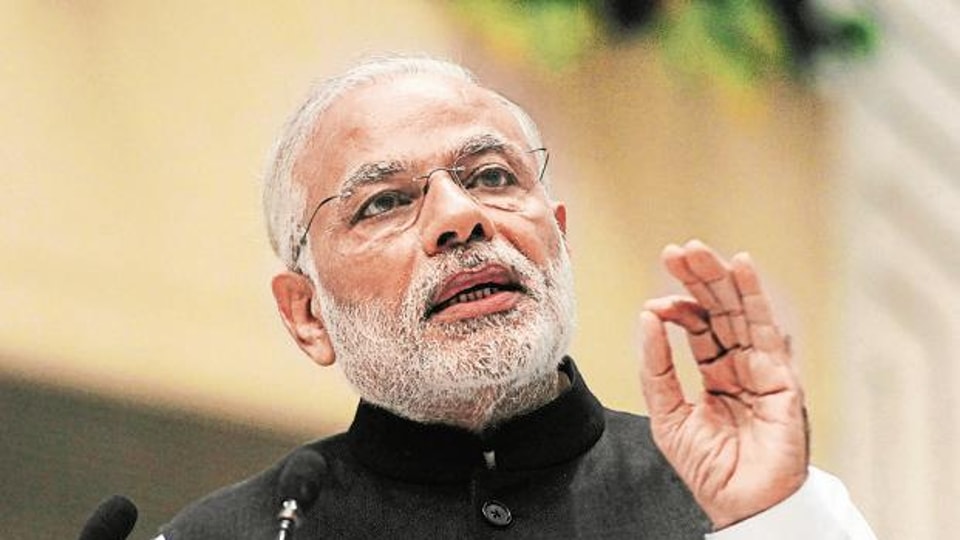
The government also embarked on a substantive review of the efforts to tackle both the pandemic and deal with the fallout of the nationwide lockdown, with a meeting of a Group of Ministers (GoM) led by defence minister Rajnath Singh. Key government stakeholders were represented at the meeting, where ministers felt that issues related to migrant workers had been addressed while impediments related to essential supplies were in the process of being addressed. The government also set up 10 groups of secretaries to deal with specific issues on Friday.
Addressing the nation, Modi said that Friday marked the ninth day of the lockdown — and praised citizens for their discipline and service. He also said that the battle against the pandemic was not an individual one but a collective one of 1.3 billion people.
Underlining that the poor had suffered the most due to the pandemic, and all efforts had to be directed to taking the country towards hope and certainty, the PM said: “This Sunday, on April 5, at 9pm, I want nine minutes of your life. Please switch off the lights of your house — and then either at the door, or in the balcony of your house, please light a candle, a diya, or flash the mobile phone light. That light will show that no one is alone.”
The PM was, however, quick to emphasise that no one should congregate on the occasion or go out on the streets — in what was possibly a reference to many citizens gathering in large crowds after applauding front line workers during the “janta curfew” on March 22, and thus undermining the principle of social distancing.
Opinion was divided on the PM’s address. Supporters saw it as a laudable effort to mobilise citizens in bleak times and motivate them and praised his consistent communication — this is the fourth time the PM has spoken to citizens in less than a fortnight.
But the Opposition was critical of the PM for not having addressed more critical issues. Congress spokesperson Pawan Khera said that the country was expecting the PM to speak on low testing, shortages of personal protective equipment (PPE) for health workers, relief for migrant workers and the poor, and the state of the economy. “People will support the PM in switching off lights and lighting candles, just as they did while clapping for doctors and paramedics, but some questions need to be asked and answered.”
The PM’s statement also led to a high-level review meeting in the power ministry to ensure that the fluctuation in the grid — on Sunday — did not lead to any power interruption and blackout. The grid is already confronting a situation where demand has dipped by up to 30% due to the lockdown.
For Sunday, there are concerns about the impact of the switching off, and then switching on, of lights, across millions of households, almost simultaneously, on the grid. This will first create a supply excess, and could potentially disrupt frequency. And then, once demand surges at the 10th minute, it will be a test of the supply capacity. Mishandling this process can potentially lead to extended power outage.
“This is absolutely unprecedented. If this is effectively implemented, then we are looking at an impact of 10-15GW of load going down and coming back again which will have a very severe impact on the grid. I am not aware of any event before leading to such a sharp fluctuation before,” said Vinay Rustagi, managing director at renewable energy consultancy Bridge to India Energy Private Limited. This, Rustagi emphasised, will need careful management and planning. “They will have to judicially use hydro and gas power plants to come back and curtail risk.”
But the power ministry is confident that it can manage the situation. An official said on condition of anonymity: “We are making arrangements since the event is known to us in advance. The current peak load of the country stands at around 120GW; of this domestic household lighting comprises of 12-15GW and we will need to manage and monitor this 15GW of fluctuation.” The fact that only lights may be off, and other electric household appliances will remain operational is also expected to ensure that the dip in demand may not be as drastic as expected.
Separately, a group of ministers met at defence minister Singh’s residence. Participants included home minister Amit Shah, food minister Ram Vilas Paswan, railways minister Piyush Goyal, petroleum minister Dharmendra Pradhan, agriculture and rural development minister Narendra Singh Tomar, civil aviation minister Hardeep Singh Puri, among others. This is the third meeting of the GoM since March 25.
Officials familiar with the proceedings of the meeting said that the ministers deliberated on various arrangements being made to deal with the increasing number of Covid-19 cases as well as to ensure adequate supplies of medicine and essential commodities during the lockdown.
“The ministers were briefed that supply of essential goods was continuing smoothly and no concerns were reported in this regard. However, at certain places, issues related to scarcity of workers for loading and unloading operations have created issues and are being addressed,” an official said on condition of anonymity.
Another official indicated that the government was fully aware of the need to ensure smooth supplies for the remaining period of the lockdown and that was the focus of the meeting. “To have the support of citizens in these difficult times, we have to ensure that they are not inconvenienced. Getting food and dairy items right to the neighbourhood level is key to ensure the success of the lockdown.”
On the movement of migrant workers, the GoM felt the issue has been resolved, as they are being looked after in temporary shelters set up by state governments, news agency Press Trust of India quoted an official as saying. The GoM also appreciated the contribution, dedication and the hard work of thousands of health professionals, police, paramilitary and armed forces, and those engaged in maintaining the supply chain of essential commodities across the country.
Experts have suggested that India should continue to confront key challenges in handling the pandemic. The lockdown has not yet led to the flattening of the curve of infections — though, to be sure, this was always expected to take some more time. More worryingly, there has been a surge in cases in recent days, largely because of the congregation at Nizamuddin’s Tablighi Jamaat. Health workers have got infected — due to the absence of PPE.


