
 E-Paper



PM Modi’s practical attitude has key role in transforming US ties: Jaishankar
External affairs minister (EAM) S Jaishankar made the remarks at an interaction at Columbia University, in the context of the need to challenge assumptions as the world changes and opportunities for India grow.

 Prefer HTon Google


It has taken a “lot of effort” to overcome the “wariness… suspicion and caution” of the past when it comes to the relationship with the United States (US), and Prime Minister Narendra Modi’s background, lack of “ideological baggage” and practical attitude has played a key role, external affairs minister S Jaishankar said on Wednesday.
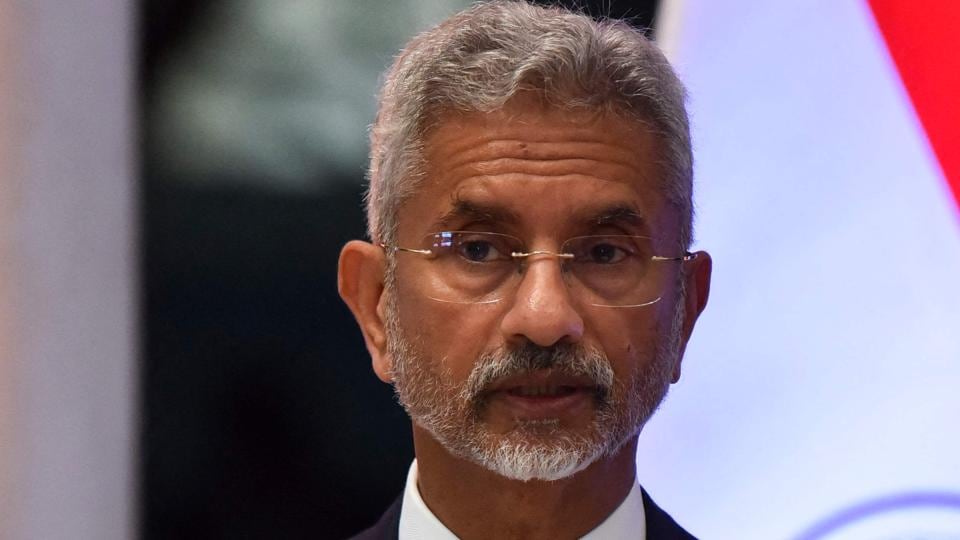
The minister made the remarks at an interaction at Columbia University, in the context of the need to challenge assumptions as the world changes and opportunities for India grow.
Also Read| Jaishankar meets Ukrainian PM, reiterates India’s position, discusses war and consequences
“I will give you a very simple example. Take our attitude to US. If you look at attitude to US from 1940s to 2000 — till say Bill Clinton came to India — due to various reasons, I am not saying who is at fault, we regarded the US with wariness and suspicion. It was a substantive relationship but the overall foreign policy towards US was of deep caution, if not deep suspicion.”
The minister, who was closely involved in negotiating the nuclear deal, said the agreement was a struggle even though the US was offering India clear advantages. “What held us back was innate suspicion… It has taken us a lot of effort to overcome earlier assumptions to forge a different relationship with US”. And it was here, that over the past eight years, Modi’s leadership and the fact that he did not carry “ideological baggage” and was “not rooted in a worldview that makes you distant from the US” played a key role.
“He has been practical, outcome-oriented, done a cost-benefit analysis and focused on convergences. You would not have had that if we held on to earlier assumptions,” he said.
At the same time, the minister acknowledged that the rise of China has been the biggest global development in recent decades from a political science and historical perspective, leading to the challenge of finding a modus vivendi between two rising powers in absolute proximity.
India’s relationship with China is “not normal”, Jaishankar added, in an allusion to the border situation.
Jaishankar also spoke about how the world is valuing “independent-minded countries”. In what appeared to be a reference to India’s position on the Ukraine war, its emphasis on the need for peace and focus on the consequences of the war, he said: “The world requires independent minded countries who take position. The politics of the last six months shows there is space for countries who are not a part of a polarised scenario. I think that demand in the market is very strong.”
He also reiterated India’s traditional position that the reform of the Security Council was overdue but acknowledged it was a hard task. “At the end of the day, P5 is a crucial definition of global order…But this is an order devised 80 years ago. By any stretch of human creativity, that was a long time ago. The number of independent countries have quadrupled in this period. Large parts of the world have been left out. Within a few years we will be the world’s most populous society amen third largest economy. To have such a country not in global council is not good for us but not for global council.”
Also Read| As UN gathers, India set to raise Global South’s issues
The minister said that he sensed greater support for India and India was commanding the trust of greater parts of the world. “A lot of countries think we speak for them with a high degree of empathy and accuracy.”
In a wide-ranging conversation with Columbia professor and former Niti Ayog vice chair Arvind Panagariya, Jaishankar spoke about his personal roots in a home with a father who was India’s most respected strategic analyst, K Subrahmanyam (“I had a home education in addition to school…we were an argumentative household”); his transition from the world of bureaucracy to politics (“the world of politics is very different from what imagine it to be... it is a continuing education”); and his predecessors (“Sushma Swaraj and I made a good team... she brought a lot of political experience and practicality of life”).
He also defended the ability of democracies to deliver in comparison to authoritarian regimes. He framed the changes under a democracy more sustainable, especially in diverse societies; he cited instances of India’s vast social safety support infrastructure as evidence of how democracies can deliver fast change; have the example of the “neighbour on the west” where authoritarian rule did not deliver; and suggested that democracy is often used as a “cop out” for bad governance. “Democracy makes it harder but makes it sustainable. A diverse society needs a democracy. At times, direction of the argument leads us to beat up democracy more than democracy deserves.”
Responding to a question on social divisions in India, the minister alleged there were narratives pushed out to secure votebanks which had only received tokenism in the past and pointed out that across India’s welfare delivery (ration, homes, cash transfers), there had been no discrimination.
As Panagariya spoke about how India will be the third largest economy in the world in five-to-seven years, and its strengths would only grow, Jaishankar said that he shared that optimism. At the same time, he introduced a caveat based on the unanticipated flow of historical events and pointed out that just a year ago, few would have thought that it was not just prices but availability of food, fertilisers and fuel that would be up in the air. But India, compared to earlier decades, was now a “fast embracer of change”.
“By the end of the decade, we would be the third largest economy. But only when your per capita income is at a much higher level, we are still at 2000 dollars range, when you start hitting the 10,000 plus zone, as China has done, it is really a different ball game,” the minister said.
When asked whether a lot of India’s recent achievements on the foreign policy front were more rhetorical than substantive, Jaishankar said that even he was his own worst critic, by any objective metric, the answer to that question would be a no. “If you take measurable indices of whether it is working or not — if your foreign trade is increasing, your foreign investment is increasing, if you are a part of key groupings, does your word count on issues such as climate and counter terrroism and black money, are you a part of key international institutions — we are more present, more influential, we are tabling new ideas and our economic footprint is increasing. I would recognise a lot of these achievements.”
To a separate a question on whether rebranding had driven perceptions of India, the minister laid out the more substantive elements of change.
“At the end of the day, the reputation of the product is as good as the product. I can make comparisons. Today, the fact that you are the fifth largest economy, how we have come through Covid, how we are dealing with headwinds of Ukraine, how we have transitioned to digital area, how our diaspora’s success has changed the perception of India have been factors. The world is a hard-headed place. People test you out through policies, practices, decisions.”
The minister claimed that the world was a “very competitive place”, and 200 or so countries tracked each other, judged you by crisis and non-crisis responses, and the ability to take stance. “If you are a part of a grouping as one of a herd versus your ability to stand your ground, all those things matter.”


