E-Paper



Monsoon finally reaches Kerala after 7-day delay, but onset weak
IMD extended range forecast released on Thursday showed rainfall picking up only after June 15.

 Prefer HTon Google


The monsoon arrived over Kerala on Thursday, seven days after it normally arrives in the state on June 1, the India Meteorological Department (IMD) announced even as climate scientists and meteorologists warned that the onset of the weather system is likely to remain weak, and its progress over the peninsula, slow, on account of severe Cyclone Biparjoy.

Read here: Monsoon arrives in Kerala after 7-day delay; progress to be slow in 1st week
“During [the past] 24 hours, clouding has increased over Southeast Arabian sea with Outgoing Longwave Radiation(OLR) being <200 w/m2. The depth of westerlies over [the] Southeast Arabian Sea extends up to mid-tropospheric levels. The strength of Westerlies in the lower levels has increased by about 19 knots. Thus, there has been widespread rainfall over Kerala during [the] past 24 hours... Southwest Monsoon has set in over Kerala,” IMD said in a statement.
IMD extended range forecast released on Thursday showed rainfall picking up only after June 15.
IMD director general M Mohapatra said that all criteria for declaring the onset have been met, without elaborating. Last year, IMD announced the onset despite one of the three criteria not being met. IMD declares monsoon onset over Kerala based on three criteria: weather stations in Kerala, situated in Minicoy, Amini, Thiruvananthapuram, Punalur, Kollam, Allapuzha, Kottayam, Kochi, Thrissur, Kozhikode, Thalassery, Kannur, Kudulu and the one in Mangalore in Karnataka reporting rainfall of 2.5mm or more for two consecutive days after May 10; a specified depth of westerlies; and low satellite derived Outgoing Longwave Radiation (OLR). OLR represents the total radiation going to space emitted by the atmosphere or extent of cloudiness.
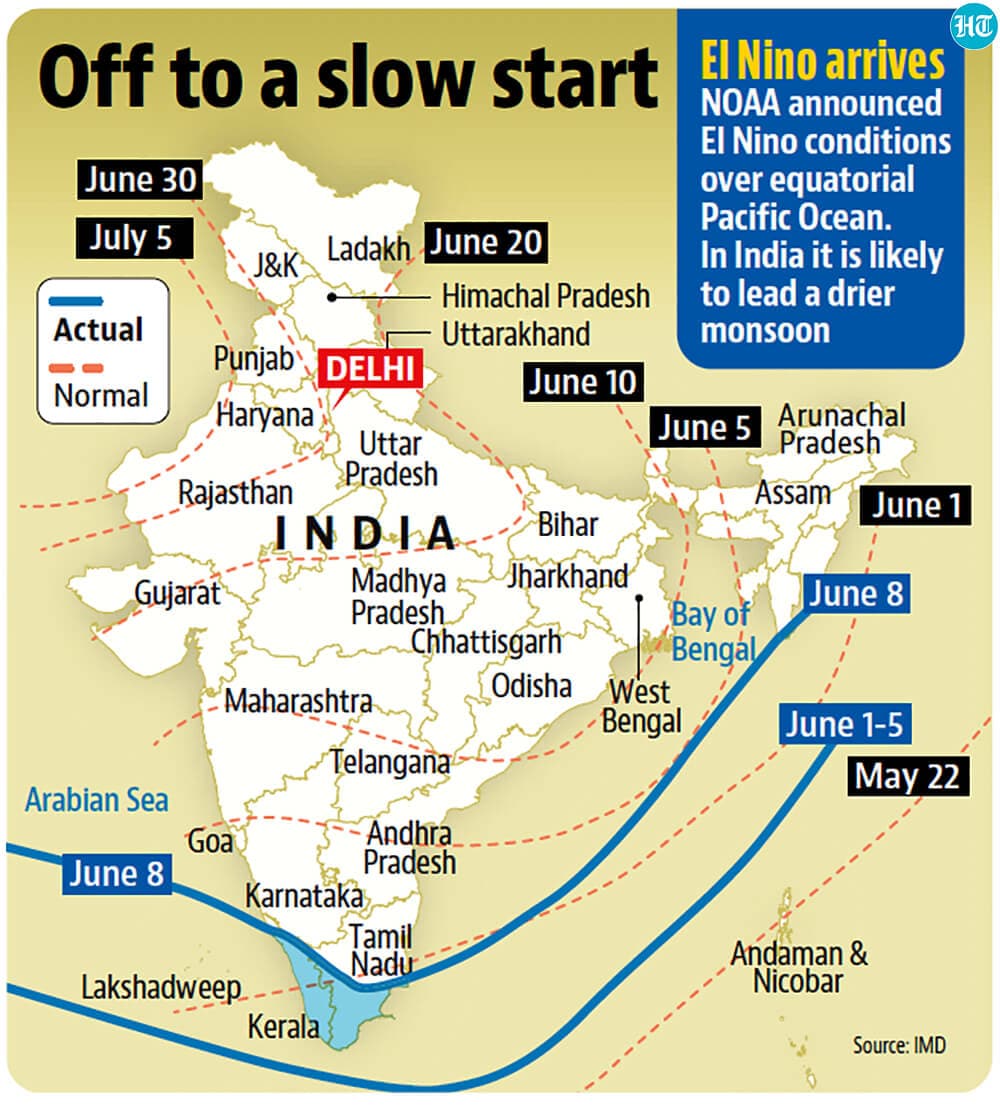
Monsoon normally sets in over Kerala around June 1. It advances northwards, usually in surges, and covers the entire country around July 15. This year, IMD has predicted a normal monsoon, with expected rainfall of 96% of the long period average (LPA), although this proportion is at the lowest end of the normal range. There has been anxiety over the monsoon’s performance this year on account of the El Nino weather phenomenon, which is correlated with poor monsoon performance. Private forecaster Skymet Weather has forecast “below normal” rainfall at 94% of LPA
IMD added that conditions were favourable for further advance of the monsoon into more parts of the central Arabian Sea, Tamil Nadu, Karnataka, and southwest, central, northeast Bay of Bengal, the northeastern states, and remaining parts of Kerala over the Thursday and Friday.
But it may not mean plentiful rains, an expert said.
“The onset criteria are gradually being met but we cannot expect widespread rains specially in the interior parts of south peninsula for the next four to five days. There will be moderate rainfall over coastal Kerala and coastal Karnataka. Active monsoon conditions may pick up only after June 14-15. As expected, this has been a weak onset with slow progression expected,” said Mahesh Palawat, vice president, climate and meteorology at Skymet Weather.
Read here: El Nino develops, experts wary of poor monsoon spell
“We may not expect widespread rains everywhere. We expect some rains along the west coast in the next three to four days. Once this cyclone moves away, the Bay of Bengal current also will get strengthened. By 20th June Bay of Bengal also will be active... (But) I am worried about monsoon in interior parts of the country. There could be delay in onset here. Farmers should be very careful and not go in for an early sowing,” said M Rajeevan, former secretary, ministry of earth sciences. June and July are the sowing season for monsoon-grown and winter harvested crops, and in some cases, farmers sow in anticipation of the monsoon’s arrival, especially if IMD has declared its onset. That is one reason IMD has to ensure that its onset announcement happens only after the defined criteria have been met.
Skymet’s Palawat asked farmers to consider commencing the sowing after a week or 10 days in view of the weak onset. “Once rains pick up sowing can begin so that crop is not affected. June rains may be below normal due to delay in rains.”
IMD has also said June rainfall will be deficient across India.
The formation of a very severe cyclone, Biparjoy over the southeast Arabian Sea, climate experts and meteorologists said, has pulled all the convection and moisture along its track leading to weakening of monsoon flow over Kerala. It has also resulted in some rain over the west coast, although this is not monsoon rain.
Indeed, an IMD official admitted this in private earlier this week.
“Biparjoy is not good for our monsoon because it is pulling all the moisture along with it away from the Indian coast. Its formation is not near the India coast and hence monsoon’s progress will remain very poor until around June 12. It may strengthen the cross-equatorial flow after the cyclone dissipates, but that’s a long way away,” a senior IMD official who did not wish to be named had said on June 6 when the cyclone formed.
The monsoon is critical for India’s economy as almost half of India’s farmed area accounting for about 40% of production is rain-fed. As many as 47% of the country’s population is dependent on agriculture for livelihood. A bountiful monsoon is directly linked to a healthy rural economy.
Experts say a delayed onset has little effect on monsoon rains.
But most add that the emergence of the El Nino phenomenon is cause for concern. El Nino is characterised by an unusual warming of waters in the eastern equatorial Pacific Ocean, which has a high correlation with warmer summers, drought, and weaker monsoon rains in India.
There have been 10 other years since 1971 when the monsoon has arrived on or after June 8, with 2019 being the only year when the monsoon arrived exactly on June 8. The onset over Kerala was on June 9 in 1996 and 2002; on June 10 in 1995; on June 12 in 1979, 1983, 1986, and 1997; on June 13 in 2003; and June 19 in 1972.
HT has analysed data only since 1971 because onset dates by the new objective criteria in use since 2006 were available only as far back as 1971. These reworked onset dates from 1971 to 2005 were calculated retrospectively by climate scientists DS Pai and Rajeevan M Nair for their research paper “Summer monsoon onset over Kerala: New definition and prediction”.
An analysis of monsoon rains (total rain over India in the normal monsoon months of June to September) in the 10 years when it set over Kerala this late shows that it has no relationship with the rainfall. There was a surplus and deficit in five years each compared to the 1961-2010 average, the benchmark for this period.
Read here: Not the first time that monsoon has missed date with Kerala. Check previous instances
To be sure, the monsoon was also affected by El Nino in five of the 10 delayed onset years. Three of these five years coincide with the five years of deficit rains in June and June-September (not necessarily the same three years for both).
(Abhiehsk Jha contributed to this report)