
 E-Paper



Monsoon’s first heavy spell leaves 9 dead, NCR crippled
Eight people died in Gurugram and Ghaziabad due to heavy rain-induced incidents, highlighting the NCR's infrastructure failures amid severe waterlogging.

 Prefer HTon Google


Eight people were killed in Gurugram and one person was killed in Ghaziabad, officials said after they took stock of the aftermath of Wednesday’s showers that caused widespread waterlogging and traffic chaos that persisted across parts of the Delhi-National Capital Region (NCR) on Thursday.
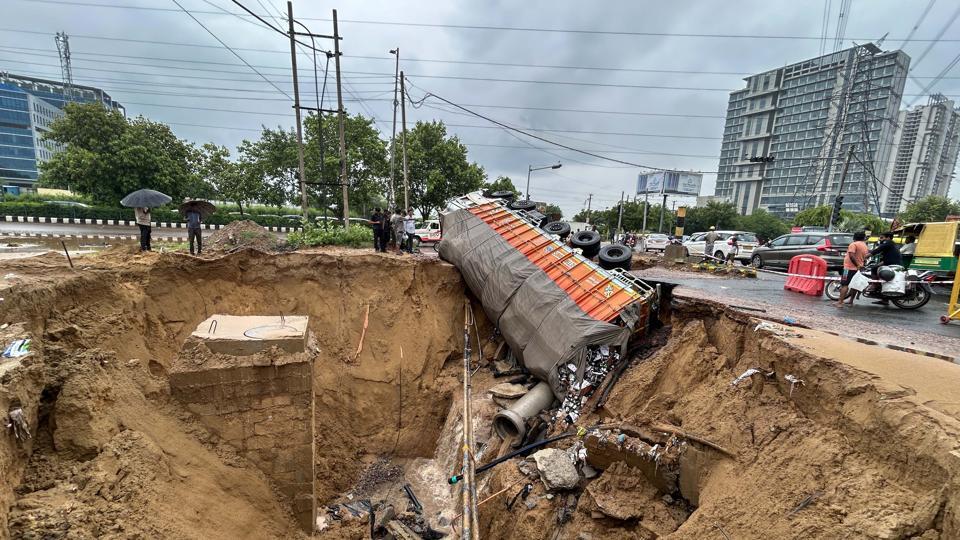
The deaths and civic struggles hours after the first heavy spell of rain this monsoon underscored the fragility of public infrastructure in NCR and the inability of decades-old drainage networks to tackle seasonal weather events.
Gurugram was the hit hardest with 133mm of rain between Wednesday evening and Thursday morning. With most of the city’s roads inundated, people had to wade through knee-deep water. A road caved in at 10.30pm Wednesday. As commuters were held up in long lines gridlocked vehicle, the deputy commissioner issued a work-from-home advisory at 8.53am, asking people to stay indoors.
Among those who died in rain-related incident was 25-year-old Akshat Kumar Jain, a software engineer, who lost control of his bike on Wednesday and hit an electric pole from which live wires had fallen into the water that had pooled around it.. He was electrocuted, said Sandeep Kumar, Gurugram police public relations officer.
In Sector 18, Pawan Kumar, a 26-year old delivery executive was similarly electrocuted when he stopped his bike near an electricity pole at 1am on Thursday, said police.
In Sector 8, 22-year-old Prashant Mishra, an employee at a private firm, was climbing rain-soaked stairs when he touched a railing that was in contact with a wire that had been dislodged by the rain.
An auto-rickshaw driver, Shailendra Kumar, 28, who had stepped out to relieve himself, slipped into an open man-hole and drowned in Sector 49. Three teens, Ashish Kumar, Surjeet and Devenderdrowned at an Aravalli quarry near Alipur village.
On Khandsa Road, a taxi driver taking a contractual employee of an airline operator to her residence in Sector 37 along with a security guard rammed his vehicle into a waist-high stack of concrete median blocks around 3.30am. Officials said the driver was blinded by the rain and did not see the obstruction on the road.
One of the passengers, 24-year-old year Vanshika, died and the driver and guard were injured.
Kumar of the Gurugram police said that a case of causing death by negligence was filed at the Sector 37 police station over Vanshika’s death.
“We have asked the discom and MCG (Municipal Corporation of Gurugram) officials to fix the responsibility of erring employees in the drowning and electrocution cases,” he said.
Deputy commissioner of police (traffic) Rajesh Kumar Mohan said police personnel remained deployed at more that 100 locations till 12.30am on Thursday to control traffic.
“More than 222 vehicles broke down across the city, which traffic police personnel helped get towed. Uprooted trees were also removed from multiple locations,” Mohan said.
In Ghaziabad, 30-year-old Junaida Khatoon drowned in a drain after the wall of her shanty near the Vivekanand Nagar rail-over-bridge collapsed. Police recovered her body in the morning, officers said on Thursday.
“Police reached the spot on time. But we could not rope in divers as it is a major drain and there was heavy flow due to heavy rainfall. The body was discovered around 7am on Thursday after the water subsided and it was sent for autopsy,” said assistant commissioner of police (Kavi Nagar circle) Bhaskar Verma.
In Delhi, chief minister Rekha Gupta held a review meeting and pointed out that the government had averted waterlogging at recurrent pain points like Minto Bridge and ITO junction, even as she directed officials to implement similar measures at other locations where rainwater had accumulated.
“Under no circumstances will the public be allowed to suffer,” Gupta said after meeting officials from the public works and irrigation and flood control departments.
The India Meteorological Department (IMD) has predicted little rain for the next six days in Delhi, with no colour-coded alerts in place.
The showers between Wednesday evening and Thursday were largely uneven, records from the agency’s gauges showed, though a clutch of stations received “heavy” rainfall.
IMD classifies rainfall up to 15.5m in a 24-hour period as “light”, between 15.6mm and 64.4mm as “moderate” and over 64.4mm as “heavy”.
In the 24 hours till 8:30 am on Thursday, Safdarjung – Delhi’s base station – received 20.5mm of rainfall. In the same period, Najafgarh logged 105.5mm, Pusa 82mm, Ayanagar 73mm and Ridge 69.2mm and Palam 59.8mm. Pragati Maidan received 47.7mm rain, Naraina got 20.5mm, Janakpuri 20mm and Lodhi Road.
Noida received 46mm, said IMD.
The showers continued beyond 8.30, with Safdarjung adding another 17.1mm till 5.30 pm; Palam 18.1mm, Lodhi road 12.2mm and Pusa 5.5mm. Gurugram recorded another 7.5mm during this period and Noida 1.5mm, data showed.
However, these gave way to a largely dry evening, allowing overwhelmed drainage systems to cope with the rainwater and traffic police to clear the streets.
The Delhi traffic police said 12 major waterlogging points were the epicentres of Delhi’s traffic struggles on Wednesday night, including Tolstoy road between Sansad Marg to Janpath road crossing and Balbir Singh Sidhu Marg – under the Punjabi Bagh flyover on the stretch coming from Railway bridge to Punjabi Bagh roundabout.
The key areas impacted were primarily in southwest, north and east Delhi, including Wazirabad road, Najafgarh Dhansa road, Nangloi-Najafgarh road, Swami Dayananand Marg and Delhi-Shamli Saharanpur road.
Underpasses in Ghazipur, Zakhira and Mayur Vihar remained inundated, as did parts of ITO, Rohtak Road and the stretch from Nangloi to Najafgarh. Officials said pumps remained deployed through the day to dry streets out.
“We saw problems on Wednesday night as it was in peak evening hours when the rain began and it continued till beyond midnight. We coordinated with civic agencies and arranged mobile water pumps too and the situation was gradually brought under control. Where snarls were reported, we deployed extra personnel,” said Additional commissioner of police (traffic) Dinesh Kumar Gupta, stating despite overnight rain, the situation was much better on Thursday morning.
Delhi has now logged 55.8mm rain this month. It normally records 209.7mm in July.
Residents across the city said the waterlogging showed civic authorities were unprepared for the monsoon.
“It was the first major monsoon rain of the season and the entire area had knee-deep water. Sewage water was overflowing... We see this problem every year. Despite multiple complaints each year, nothing changes,” said SP Jain, 88, who lives near the Ghanta Ghar on Sabzi Mandi road in north Delhi.
Chitra Jain, president, New Friends Colony (NFC) RWA Ashoka Park said Wednesday night’s rain resulted in a complete disruption of traffic movement and left people stranded for several hours.
“CV Raman and JD Musafir road were completely waterlogged. Many residents took an hour to reach their home. Every year these roads get congested after a brief spell of rain,” she said, adding that several residents also reported that water had reached their doorsteps.
Gupta on Thursday directed officials from the public works and irrigation and flood control departments to inspect stormwater drains across the city and clear blockages.
Asking for smaller drains and culverts to be given special attention, she further instructed for garbage to be removed from the roadside, stating it was a factor behind drains getting clogged.
At the same time, civic agencies’ claims of widespread desilting fell flat on Wednesday and Thursday. MCD in its official report on Thursday said that 170,619 metric tonnes (mt) of silt was removed from its drains in the run-up to monsoon this year, 2.8 times more than last year.
Delhi mayor Raja Iqbal Singh defended the Municipal Corporation of Delhi (MCD) and said the Bharatiya Janata Party (BJP) was in power in the civic body “for just two months”, but has already hit “record desilting work”.
“Last year, 77,000 metric tonnes of silt were removed. This year, we have already cleared 1.4 lakh (140,000) metric tonnes,” mayor said.
MCD officials said that the waterlogging has primarily occurred in low lying areas with structural issues. “Heavy rainfall coupled with elevations issues triggered the waterlogging and it needs long term investment in improving the drainage system,” officials said.
Similarly, the PWD desilting report till June 30 claimed that 83.8% desilting progress had been achieved with 1,791 km of drains out of its 2,137 km network being completely cleared. With 13 divisions under PWD reporting more than 90% desilting levels, the impact was not as visible on Wednesday night.
The opposition Aam Aadmi Party (AAP) slammed the Delhi government.
The party’s Delhi president Saurabh Bharadwaj said, “For months, all we saw were photo ops in the name of desilting. The LG went, the chief minister went, ministers went, even senior officers paraded for cameras. They all claimed Delhi would never flood again,” said Bharadwaj. “BJP minister Parvesh Verma even said he had 400 suspension letters ready for officers who fail to prevent waterlogging. Now that entire Delhi is flooded, how many officers have actually been suspended?”


