
 E-Paper



'Nehru, Indira were not fools': JNU VC says uniformity doesn't work in India
“If somebody wants to wear a hijab, it's their choice and if somebody doesn't want to wear it, they should not be forced,” JNU VC Santishree Pandit said.

 Prefer HTon Google


India, being a nation for all communities, cannot adopt uniformity in religion, language or dress code, Jawaharlal Nehru University's vice chancellor Santishree Pandit said.
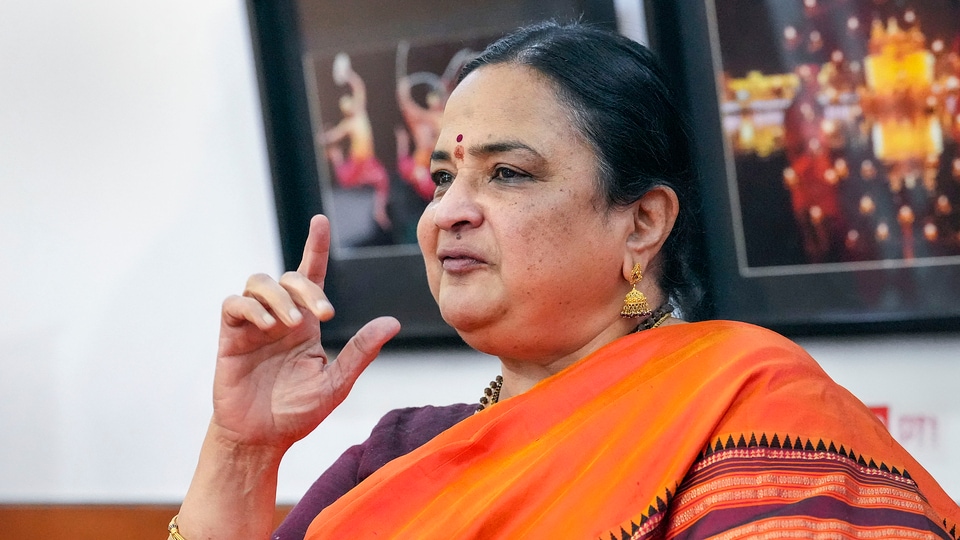
In an interview with PTI, JNU VC Santishree Pandit expressed the opposition to imposing a single language, highlighting the challenges of such an approach, especially in states where Hindi may not be widely accepted.
“I would not agree on uniformity in either religion, race or language. One language should not be imposed. If some people want to change it (official language) to Hindi in some states, they can. But in the south, it will be difficult... in east India, even in Maharashtra, I don't think Hindi is acceptable,” the JNU VC said.
ALSO READ- In first JNU student polls in four years, Left sweeps 4-0
"I would rather say that Hindi can be there but I don't think a single language should be imposed. Both (Jawaharlal) Nehru and Indira Gandhi were not fools to talk about the tri-language formula because, in India, uniformity doesn't work in any form," she added.
Pandit urged caution and advocated "to go slow in having one language", recognising the sensitivity of language issues in India. "All languages are good. I am not against any language but for me, I am the most comfortable in English."
ALSO READ- Who is Dhananjay, JNU Students Union's first Dalit president since 1996?
India not for one particular community: JNU VC
Pandit also stressed that a single identity or religion would not suffice in India, asserting that universities should prioritise knowledge-seeking above all else, irrespective of any particular community's interests.
“I don't think any one religion will work here as these are individual issues, but people at the helm want to do this. As a university, we should be above all this. For us, seeking knowledge is important. The nation is not for one particular community.”
'Those who want to wear a hijab, it's their choice': Santishree Pandit
Regarding dress codes in educational institutions, Pandit said “I am against a dress code. I think (educational) spaces should be open. If somebody wants to wear a hijab, it's their choice and if somebody doesn't want to wear it, they should not be forced.”
ALSO READ- On hijab ban lift, Karnataka minister Priyank Kharge's message for BJP: ‘Set your house...'
“In JNU, people wear shorts and there are also those who wear traditional attire, that's their personal choice. As long as they don't force me to do the same I have no problem,” Pandit stressed the importance of individual autonomy in personal matters like food and clothing.
‘Mughals who ruled for less than 200 years occupy more than 200 pages’: JNU VC
Pandit called for the need for a balanced representation of cultural histories within the Indian education system. She said that while the Mughal Empire receives extensive coverage, other significant Indian kingdoms like the Cholas, Marathas, Satavahanas, and Kakatiyas are often overlooked.
"In Indian history, Mughals who ruled for less than 200 years occupy more than 200 pages. I am not against them, give them their place but we have the Cholas, the longest-ruling kingdom globally, and they don't have even half a page.
"Similarly, Marathas, Satavahanas or the Kakatiyas, do you even know such kingdoms existed? This is because of ignorance. We need to be proud of our history. Don't look at this from a religious lens, throw religion out. All I am asking is to give everyone space," she said.


