
 E-Paper



New ships: Navy to break own records
At present, the duration of warship construction has been reduced to 31 months as opposed to 55-60 months in the past

 Prefer HTon Google


On May 10, the Indian Navy was told to stand down, 200 nautical miles short of Karachi, after India and Pakistan ceased hostilities. It is believed that in a review meeting soon after, Prime Minister Narendra Modi told the Navy that its time would come.
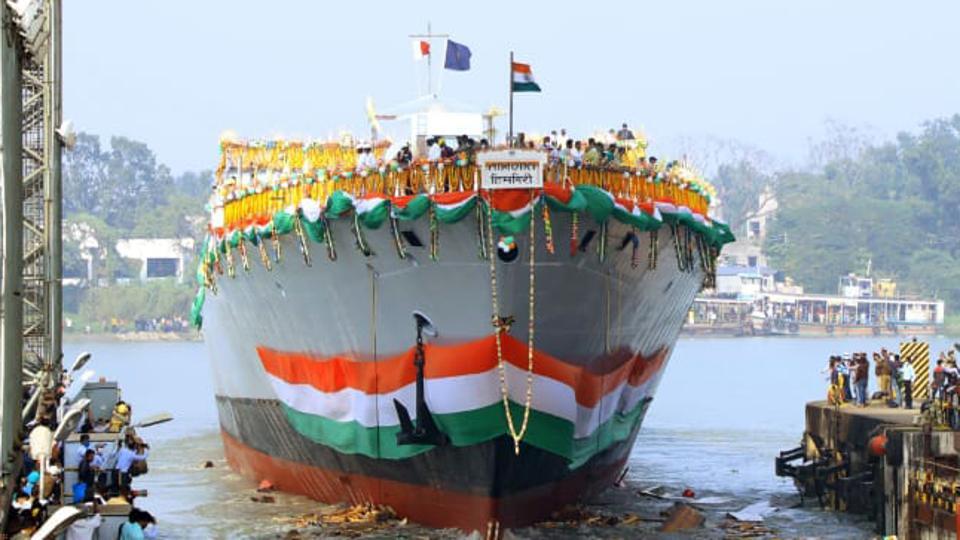
On Diwali, Modi spent more than 17 hours on Indian aircraft carrier INS Vikrant watching night-fighter operations and live firing off the coast of Goa. But there’s more to New Delhi’s renewed focus on its Navy than statements of intent.India’s focus on enhancing its maritime military capabilities and power projection in the Indo-Pacific, has meant that the Indian Navy has set a record by launching no less than 12 (11 warships, one submarine) since December 2024.
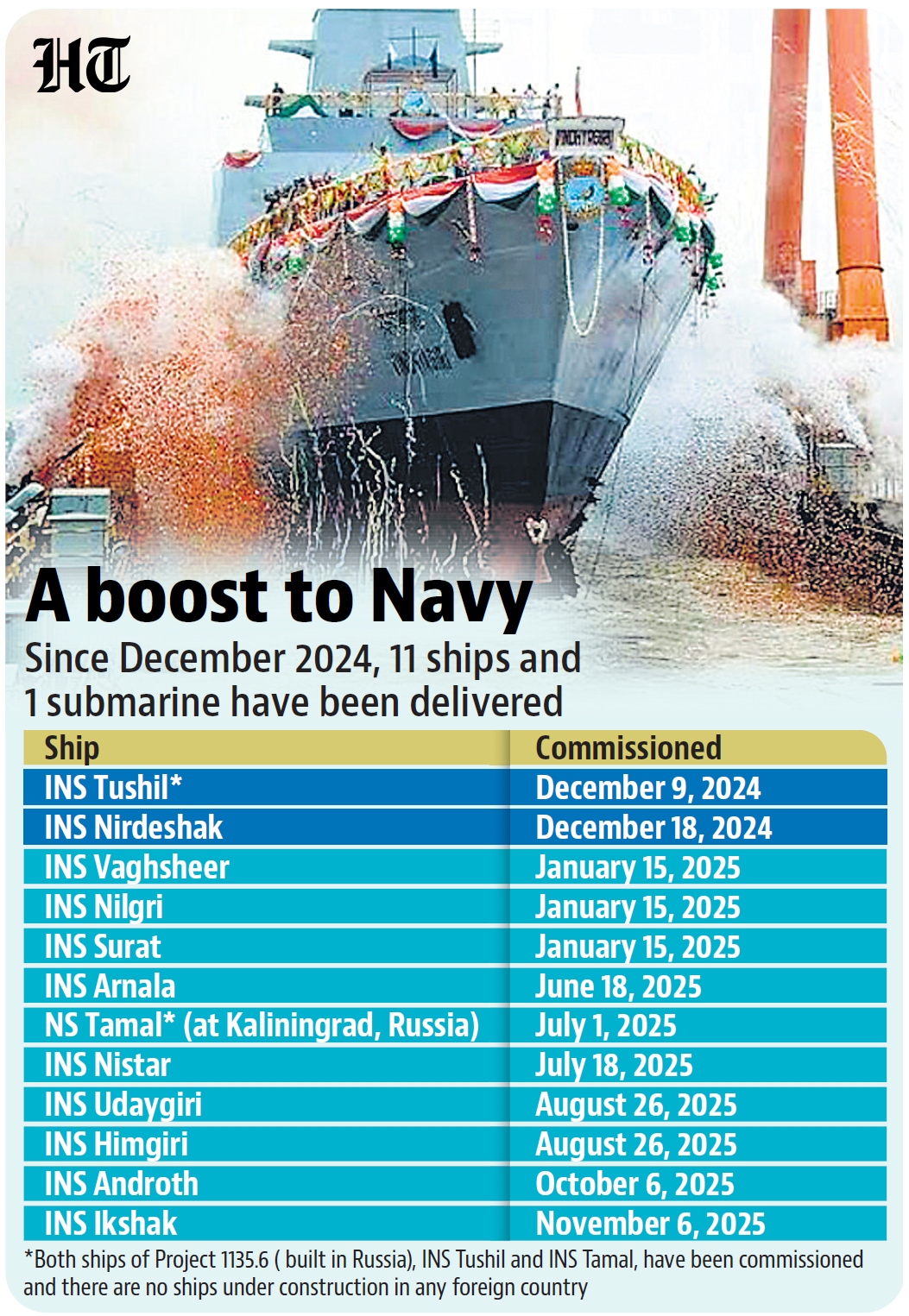
Today, the duration of warship construction (from keel laying to commissioning) has been reduced to 31 months as opposed to 55-60 months in the past. Guided missile destroyer INS Surat, commissioned by PM Modi, on January 15, was constructed in a mere 31 months. If 12 surface and sub-surface combatants is a record -- it is -- it won’t last long with the Indian Navy planning to add 17 ships in 2026. This includes guided missile frigates, next generation off-shore patrol vessels, multi-purpose vessels, and anti-submarine warfare vessels .
The Indian Navy is now commissioning one ship in 40 days but the numbers pale in comparison to the US, which does one ship in 18 days, and China, which does one in a week’s time.Besides building warships, the Indian Navy is acquiring submarine deterrence with Project 75 I (air-independent propulsion or AIP) submarine set to sign this financial year. Price negotiations are currently underway and the government has set aside some ₹42,968 crore for acquisition of six submarines to be constructed at Mazagon Dockyards Limited with AIP being provided by German firm ThyssenKrupp Maritime Systems under a joint venture.China commissioned its state of the art 80,000 ton Fujian aircraft carrier on November 5, and India is concerned about Beijing helping Islamabad build its Navy with new frigates and submarines.
As of now Pakistan has 53 combatants in its Navy with five submarines (Agosta 90B and Agosta 70), four Zulfiquar and four Tughril class frigates. Four Yuan (Hangor) class submarines are being built in Wuhan for delivery to Pakistan in December 2025 and January 2026. Four more Hangor classes will be constructed in Karachi and delivered end-December 2026 onwards. And Pakistan will get delivery of its Jinnah class frigates in June 2030.Apart from monitoring the Pakistan Navy, India is noting maritime developments in the Indo-Pacific with the Chinese PLAN expanding its area of influence all the way up to Gulf of Aden.
On November 12-14, Indian Navy Chief Admiral Tripathi visited INDO-PACOM headquarters in Hawaii and met the US Indo-Pacific fleet commander Admiral Samuel J Paparo. The two navies have decided to increase the complexity of bilateral exercises, training and port visits keeping the Indo-Pacific in mind. With Indian Navy set to acquire a nuclear attack submarine from Russia in 2028 and 26 Rafale-Marine jets a year later, India’s power projection on high seas is set to increase manifolds this decade.


