
 E-Paper



No proposal to reintroduce NJAC Act: Rijiju tells House
The law minister said appointment of judges required consultation and approval from various constitutional authorities at the state and central levels, and the government appoints only those persons as judges of the high courts who are recommended by the Supreme Court collegium


The government has no proposal to reintroduce the National Judicial Appointments Commission (NJAC) for appointment of judges to the high courts and the Supreme Court, Union law minister Kiren Rijiju told the Rajya Sabha on Thursday.
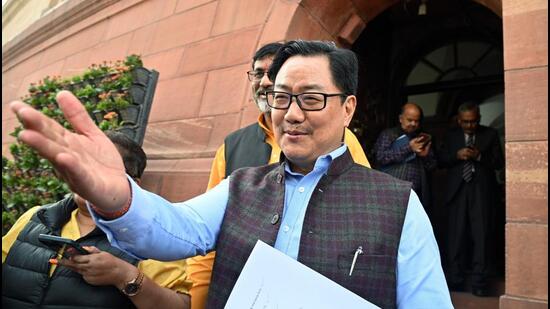
“No sir, at present there is no such proposal,” Rijiju said in a written response to a question put by Congress party president Mallikarjun Kharge and Communist Party of India leader John Brittas on whether the government proposes to reintroduce the NJAC with suitable modifications.
Rijiju said appointment of judges required consultation and approval from various constitutional authorities at the state and central levels. The government appoints only those persons as judges of the high courts who are recommended by the Supreme Court collegium, the law minister said.
On Wednesday, vice-president and Rajya Sabha chairperson Jagdeep Dhankhar, in his maiden address to the Upper House, strongly raised the issue of the NJAC, which was scrapped by the Supreme Court. He said a law passed by Parliament was “undone by the Supreme Court”, which was a “severe compromise of parliamentary sovereignty and disregard of the mandate of the people”.
Rijiju said, as on December 5, there was one proposal for appointment of a Supreme Court judge and eight proposals for appointment of high court judges as recommended by the collegium which were pending before the government.
“Appointment of the judges of the constitutional courts is a continuous, integrated and collaborative process between the executive and the judiciary. It requires consultation and approval from various constitutional authorities both at state and central level. Government appoints only those persons as judges of high courts who are recommended by Supreme Court collegium,” the minister stated in his reply.
The law minister also said there are 11 proposals of transfers of high court judges, one proposal of transfer of a chief justice and one proposal for appointment of a high court chief justice as recommended by the collegium which were “under the consideration” of the government.
Answering a question on the number of vacancies in the Supreme Court and various high courts, Rijiju said: “As on December 5, 2022, against the sanctioned strength of 34 Judges, 27 judges are working in the Supreme Court, leaving 7 vacancies. In the high courts, against the sanctioned strength of 1108, there are 778 judges working, leaving 330 vacancies.”
“The Supreme Court while hearing a court case has expressed its opinion over delay in notifying the names of judges recommended by the collegium,” the reply said.
In the last five years, a total of 256 proposals have been remitted by the government to the high courts on the advice of the Supreme Court collegium, the law minister’s response said.


