
 E-Paper



Nobel for lifting the curtain on banking pitfalls
At one level, the topic of this year’s prize – the bank – is very easy to understand. All of us have familiarity with banking services from depositing our money to securing loans for purchasing vehicles and building houses. However, as the global financial crisis showed, the incentive structure governing this sector could be extremely subtle and complex. The Nobel laureates’ work arguably enhances our understanding in this extremely important sector.

 Prefer HTon Google


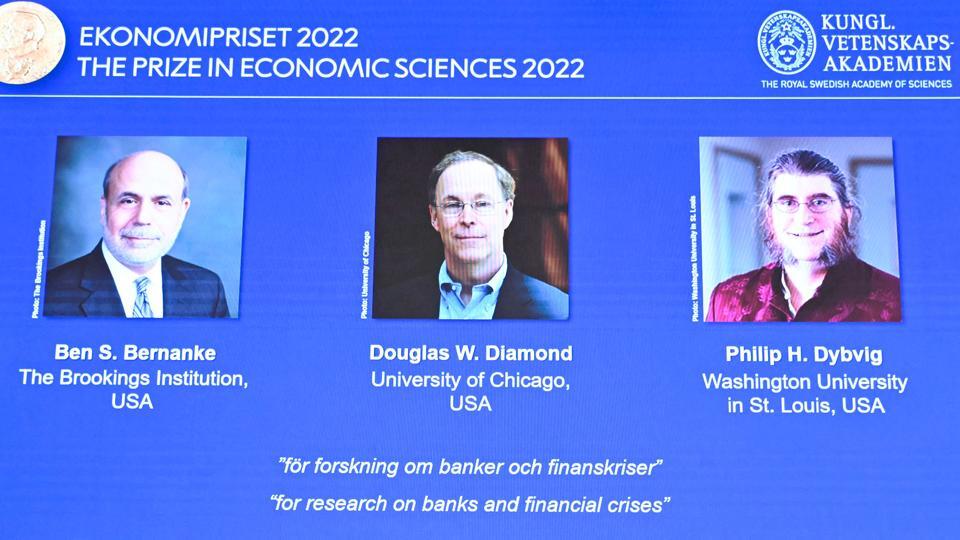
There is nothing more deceptive than an obvious fact. This dogma – attributed to Sherlock Holmes – could have been the motto of this year’s Sveriges Riksbank Prize in Economic Sciences in Memory of Alfred Nobel, more popularly known as the Economics Nobel Prize. The prize this year has been awarded to Ben S Bernanke, Douglas W Diamond, Philip H Dybvig “for research on banks and financial crises”.
At one level, the topic of this year’s prize – the bank – is very easy to understand. All of us have familiarity with banking services from depositing our money to securing loans for purchasing vehicles and building houses. However, as the global financial crisis showed, the incentive structure governing this sector could be extremely subtle and complex. The Nobel laureates’ work arguably enhances our understanding in this extremely important sector.
Banks and similar institutions have existed for millennia. Their operations have been critical for mitigating, diversifying and optimally allocating individual risk – for example by maturity transformation and screening. At the same time, occasionally, their behaviour has amplified risk, for example during financial crises with severe and persistent consequences.
Diamond and Dybvig’s seminal paper was one of the first to formally explain this duality. Let us assume that you have some savings, and you want to earn some return on it. You can invest in some projects that promise a certain return. However, there is a catch. Investment value will fructify in the long run while a need for cash may arise in the short term. Maybe you need money for the treatment of a medical emergency or a similar unforeseen contingency.
In the absence of a financial intermediary, the only way of meeting the need would be to liquidate the investment altogether. That would be inefficient. What you really need is an “implicit insurance” – that is, a way to trade off consumption in the good times for the time when you are hit by the liquidity shock.
Financial institutions such as banks – by pooling deposits from a number of depositors – can insure you against exactly this kind of risk. But this financial arrangement opens up the possibility of bank runs as well. Whether the depositor really has a need or not is not known to the bank. This opens up the possibility that a sufficient number of depositors may start liquidating their deposits collectively, giving rise to the bank run. Diamond and Dybvig showed that the maturity transformation and the possibility of bank runs are inherently coupled.
Diamond further argued that another way banks help depositors is by screening the projects for them. Given that individual depositors operate at a small scale, it may not make sense for an individual depositor to spend resources in monitoring different projects. Financial institutions operate at a different scale; they typically invest lots of resources in monitoring their debtors’ behaviour. This delegation of investment decision on the asset side as important job of the banks as the maturity transformation on the liability side.
The seminal works by Diamond and Dybvig spawned a huge volume of literature deepening our understanding of financial institutions in general and banks in particular.
What happens when bank runs do occur? What would be the macroeconomic consequences? One particular case study was the Great Depression. During the Great Depression, the bank failure was extensive. The economy too suffered a prolonged and persistent depression. Was it merely a coincidence?
Milton Friedman and Anna Schwartz argued that the real economy was impacted by the collapse of money supply. Ben Bernanke – this year’s third winner – took a contrarian view. The mechanism he proposed was slightly different. He showed that it was not the variation in the monetary aggregates, but the variables proxying credit creation that explained the Great Depression better. It was the collapse of credit networks that was responsible for economic disruption
If these insights seem commonplace now, please remember that the debates were happening in the 1980s. By then, the memory of the Great Depression had faded away, and the Global Financial Crisis (which happened under Bernanke’s watch when he was chairman of the US Federal Reserve) was still in the future. Academic debates were mostly informed by the Efficient Market Hypothesis that assumed away the frictions like financial intermediation. In the given intellectual context, the work of the Nobel laureates was prescient and ahead of the curve.
The work of the Nobel laureates has informed policymaking. Policymakers are now more sensitive to the catastrophic squeeze on credit flow, for example. An array of policy options – ranging from central banks playing the role of the lender of last resort, deposit insurance, banks being asked to maintain capital buffers and bank supervision have been proposed and experimented.
As the world grapples with many sources of risk – from pandemic to climate change – the design of financial intermediation will ensure whether those risks are being mitigated or propagated. In a sense, the award could not have been timed better.
(Avinash Tripathi teaches economics in Azim Premji University, Bengaluru.)


