
 E-Paper



NSG turns to home ministry for deployment in Kashmir
NSG director general flew down to Srinagar and met the governor Malik well as state DGPapparently to remind them that the decision to deploy house intervention teams of NSG was taken by the home ministry and under the explicit directive of National Security Advisor Ajit Doval.


The National Security Guards (NSG) has sought the intervention of the home ministry after Jammu and Kashmir governor Satya Pal Malik said on record on October 18 that there was no move to deploy the elite counter-terror force in the Valley. Indeed, the force, which was asked in May 2018 to handle specialised house intervention actions in the Valley, was not used in the Fateh Kadal encounter on Wednesday, and actually told only to be on standby by the state police. Two Lashkar-e-Taiba (LeT) militants were killed by special operations group team of the state, and one Jammu & Kashmir police commando lost his life and two others were injured in the encounter.
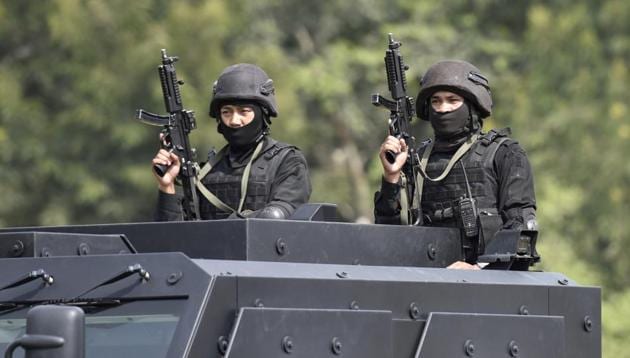
NSG director general (DG) Sudeep Lakhtakia, who has handled Naxal and Islamist insurgency in stints in Andhra police and the Central Reserve Police Force, flew down to Srinagar a day after the encounter and met governor Malik well as state director general of police (DGP) Dilbagh Singh apparently to remind them that the decision to deploy house intervention teams of NSG was taken by the home ministry and under the explicit directive of National Security Advisor Ajit Doval. The home ministry has also taken serious note of governor Malik’s interview to PTI in which he also stated that the NSG was a specialized force that could be only used in the gravest of grave situation.
The home ministry decided to deploy NSG teams in the Valley for purely house intervention operations so that casualties of security forces would be minimized; the elite force uses state of the art weapons such as corner shot rifles and wall radars to neutralize the targets.
Rather than face adversary upfront, the NSG uses high end techniques to avoid any casualties and also ensure minimum damage to the structure where the terrorists are holed up. In the Fateh Kadal case, commando Kamal Kishore lost his life and the building where the terrorists were holed up was almost completely destroyed due to use of heavy weaponry and grenades. According to home ministry officials, NSG seems to be caught in a turf war with the already deployed security forces and the army, which are still to come to terms with the presence of the elite force in the state. NSG faced a similar situation as far as the army was concerned when it was used to neutralize Jaish-e-Mohammed terrorists who had stormed into the Pathankot airbase on January 2, 2016.
According to NSG officials who asked not to be named, its Srinagar house intervention team was first told to be on standby by the state police for the Fateh Kadal encounter and then inexplicably told to stand down. NSG DG Lakhtakia made it known to Jammu and Kashmir police officials that the force was in Kashmir under the home ministry directive and is willing to partner Indian security forces in their efforts to eradicate terrorism. J&K DGP Dilbagh Singh said: “The NSG was not involved in the operation. We will use the NSG whenever required.”
(Sudhi Ranjan Sen contributed to this story)


