E-Paper



Number Theory: Poll bonds, their sway on India's political finance
This is the first of a two-part series on India’s political funding. The second part will look at problems at political funding at the grassroot level.
Published on: Feb 27, 2024, 08:39:59 IST

 Prefer HTon Google
Share via


Copy link

The Supreme Court’s judgement declaring electoral bonds unconstitutional has revived the debate on political funding in India. While the judgement on electoral bonds has been widely praised, the problems with India’s political funding go beyond the electoral bond issue. This two-part data journalism series will try to explain the issues in detail. The first part will look at the problems with the electoral bond scheme and the second part will look at problems which go beyond electoral bonds.

Poll bonds, their sway on India's political finance
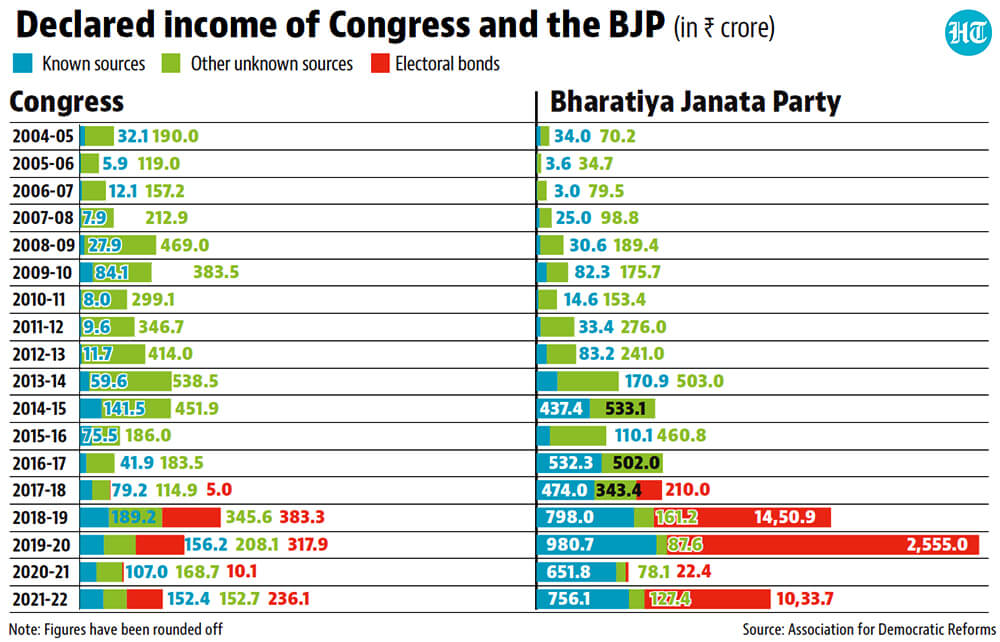
 Ruling party has generally had a funding advantage in India, but the scale has increased significantly post-2014HT has looked at data from 2004-05 to compare declared incomes of the Congress and the Bharatiya Janata Party (BJP). The Congress, which was in power from 2004-05 to 2013-14, was ahead of the BJP in total income in every year until 2012-13. The BJP has had a bigger income than the Congress in every year since 2013-14 to 2021-22, the latest period for which the Association for Democratic Reforms (ADR) has released bifurcated data on the sources of income of the two parties. The fact that the BJP surged ahead of the Congress in terms of income in 2013-14 suggests that many had a good idea of what was going to happen in the 2014 general elections, when the Congress suffered its worst ever defeat. To be sure, what has changed in the post-2014 phase is the magnitude of difference between the incomes of the ruling and the second largest party in India.
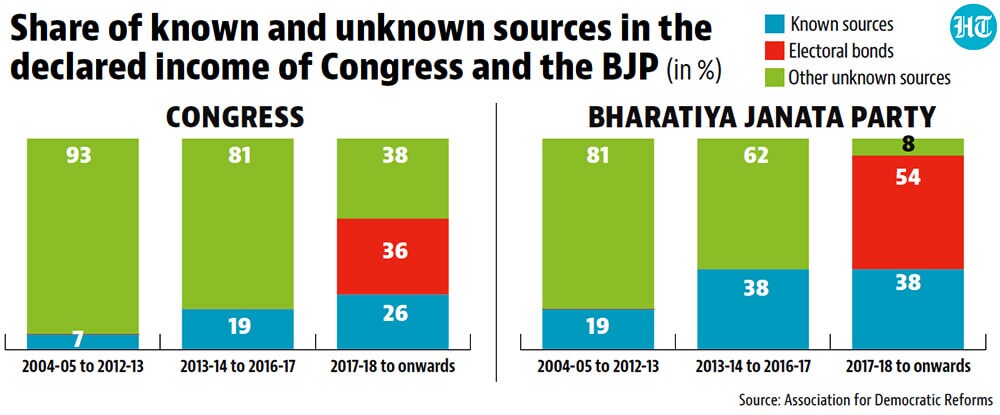
- A break-up of known and unknown funding shows an interesting difference between the Congress and the BJPWhile the electoral bond scheme has been rightly criticized and annulled by the Supreme Court for promoting opacity in political funding, they did not introduce it to India’s political finance rules. Political parties in India are allowed to take cash donations and they need not declare the identity of the donors who contribute less than ₹20,000. It is widely believed that this route is abused to accept unaccounted incomes as political donations. A comparison of known and unknown sources of income for the BJP and the Congress since 2004-05 shows that the former had a lead in terms of income from known sources (largely corporate donations) even when the Congress was in power. Congress’s lead in terms of overall income vis-a-vis the BJP, during the UPA years, came from its advantage from unknown sources of income. While the Congress lost out to the BJP from both these sources between 2014-15 and 2017-18, it regained its lead in the period after that. It is important to note that this is also the period when electoral bonds really became a significant source of political funding. As far as funding from known sources and electoral bonds (where details are not available to the voters) is concerned, the BJP has had a massive lead over the Congress in the period after introduction of Electoral Bonds.
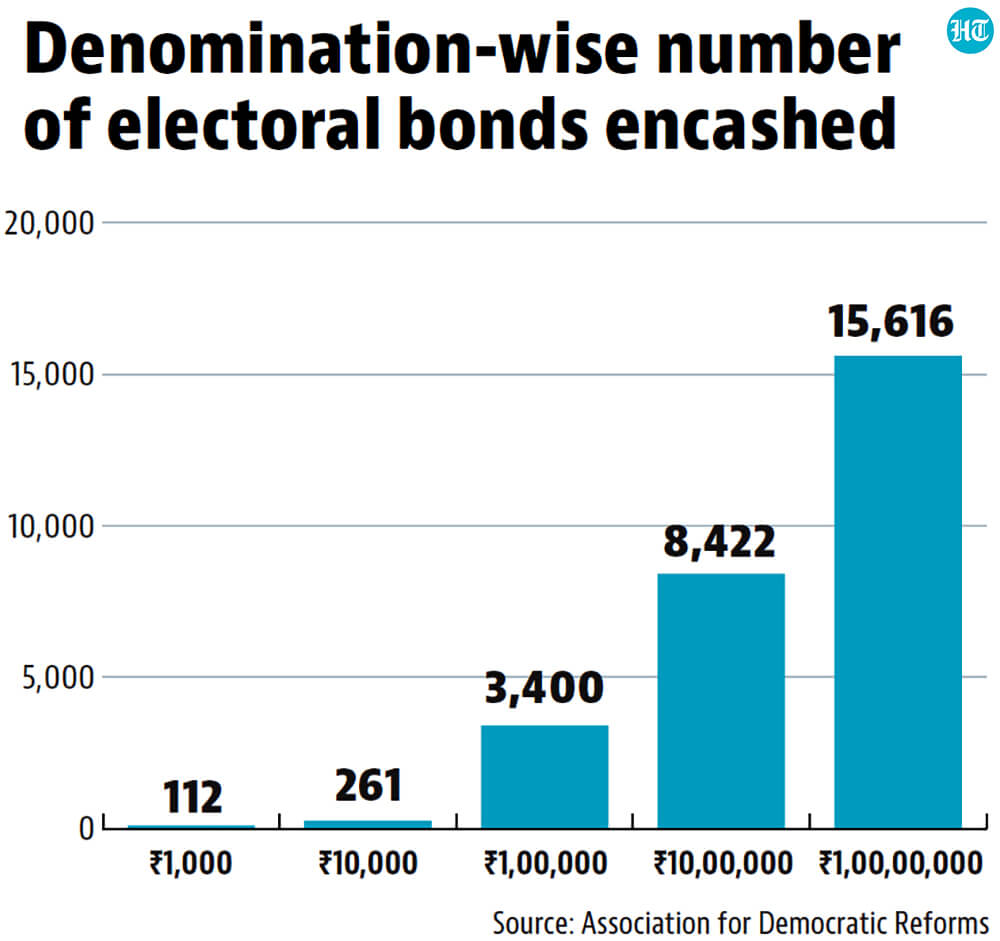
- Could electoral bonds have attracted some of the money using the unknown source route before the scheme?Given the fact that the BJP received less money from the unknown source route in the period after electoral bonds came into being, it is an interesting question to ask. This analysis has to be done with an eye on an important tweak in political funding rules after the electoral bonds came into being. Prior to the legislation on electoral bonds, loss-making companies were not allowed to make political donations and even profit-making companies were only allowed to donate a certain part of their profits. The 2017 amendment of the Companies Act (which was done along with the law on electoral bonds) removed any restrictions on political donations made by companies and allowed even loss-making companies to donate unlimited amounts to political parties. The Supreme Court’s judgement has also declared this amendment to the Companies Act unconstitutional while observing that a loss-making company is more likely to donate to political parties with a quid pro quo in mind rather than for income tax benefits, which is the only tangible legal benefit from political donations. To be sure, a conclusive validation or rejection of the theory of loss-making companies donating to political parties will require a full disclosure and mapping of donors and recipients under the scheme. However, what is known already about the scheme is that an overwhelming part of the money donated was in denominations of more than a crore which is unlikely to have come from non-rich donors.