E-Paper



Number Theory: Understanding India's demographic challenge
India is the world’s most populous country, and will retain that position even in 2100
Updated on: Jul 13, 2024, 13:57:26 IST

 Prefer HTon Google
Share via


Copy link

India’s population is expected to have reached 1.451 billion in 2024, according to the World Population Prospects (WPP) report released by the United Nations on Thursday. India is the world’s most populous country, and will retain that position even in 2100, the report said. What do these projections mean for India’s economic future? Here are four charts which use data from the WPP report and other official sources to put India’s demographic challenge in perspective.

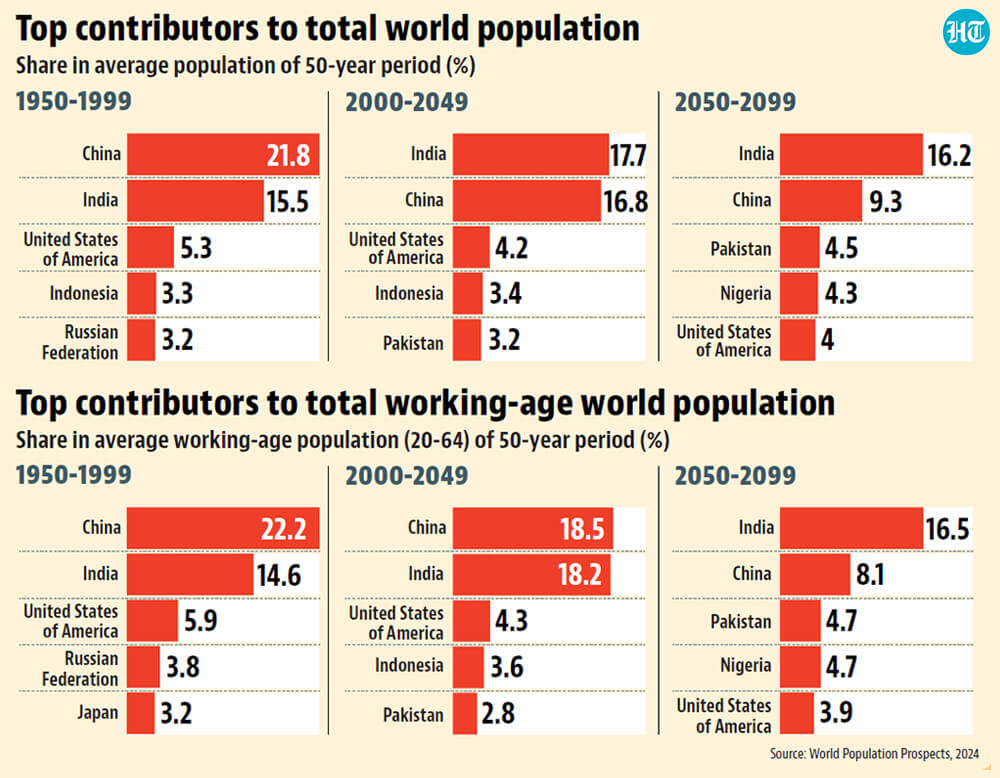
 India has the potential to be a demographic asset rather than a liability to the world until the end of the centuryAn increasing population, unlike what many people believe is not an unmitigated economic liability. This is for the simple reason that a bigger population also means more working hands for the economy. To be sure, not every country can count a rising population as an economic blessing as this depends on the age-wise composition of the population which can be divided into people below the working age, in working age, and past their working age. A higher ratio of dependents means a bigger demand on the income generated by the working age population. HT has divided the WPP dataset – it gives numbers from 1950 to 2100 – into three time periods of half a century each and looked at the top five contributors to total and working age population in the world. While China was the leading country in the world in terms of contribution to total population of the world between 1950 and 1999, India is in the top position for the 2000-2049 and 2050-2099 periods. When it comes to the share of working age population, China led the pack between 1950-1999 and will do so in 2000-2049, with India being a distant and close second in the two periods respectively. The tables will turn in the 2050-2099 period with India’s contribution to working age population in the world rising to 16.5% on average compared to just 8.1% for China. In fact, India will make a bigger contribution to the world’s working age population than to its total population in both the first and second half of the current century.
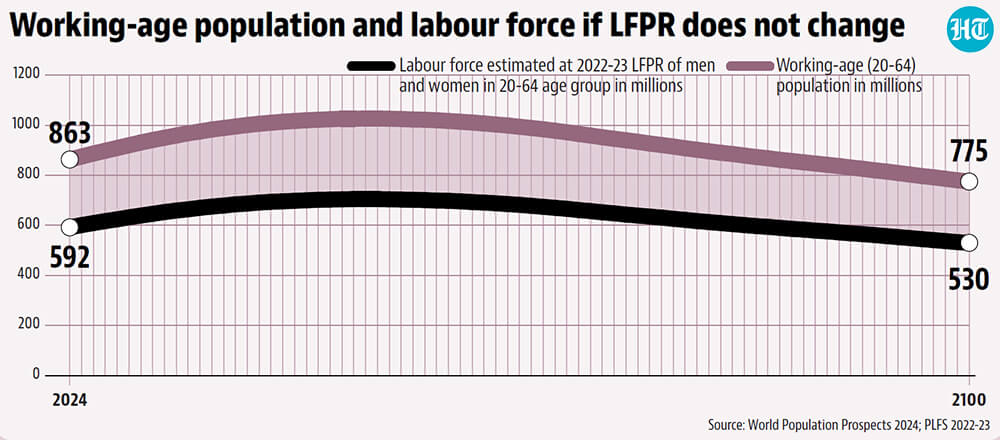
- But exploiting this demographic dividend requires a big boost to India’s labour marketA working age population does not automatically mean a boost to economic fortunes of a country. For these benefits to accrue, that population has to be employed gainfully. One of the biggest roadblocks to India successfully exploiting its demographic dividend is the gender divide in the labour force participation rate (LFPR) which brings the overall number down. LFPR is the share of population which is either working or looking for a job. According to the latest Periodic Labour Force Survey (PLFS) report – it is the official source of employment statistics in the country – India’s female LPFR is 28 percentage points lower than its male LFPR. In the 20-64 age group, which the WPP considered as the working age group, this gap is 49 percentage points. This means that around one-third of India’s current working age population of 863 million is not even looking for work at the moment. Unless India is able to boost its female and by extension overall LFPR, it is expected to forego the use of this fraction of its working-age population every year. In absolute terms, the number of such people is 271 million in 2024, will increase to 322 million by 2050, and will be 245 million in 2100.
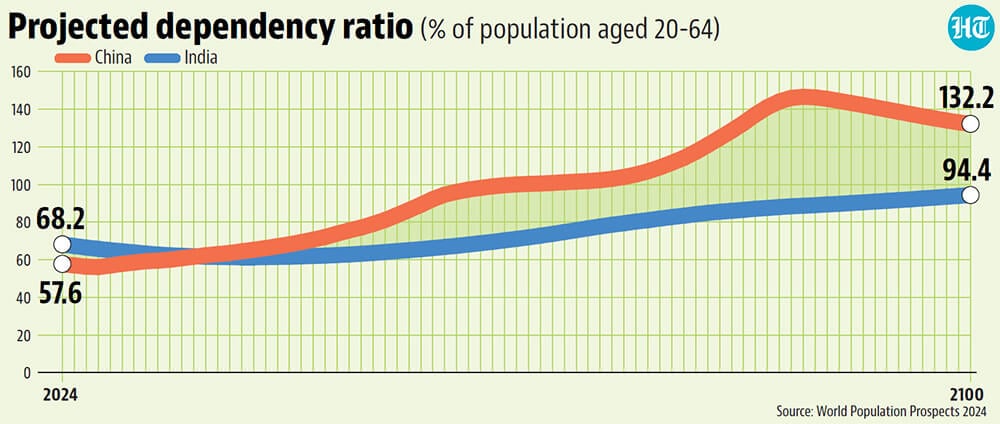
- India also needs to find better paying jobs for its workers very soonThis is where the other part of the age-composition of population matters for the economy. If the share of population below and above the working age population starts increasing and a country does not have widespread retirement cover for its elderly population, the working age population must earn more to support the young and the old. India has enjoyed a prolonged sweet spot on this front as its dependency ratio – defined as the population outside working age as a percent of the working age population – has been falling continuously after 1970 and is expected to do so till 2039, after which it will start rising. To be sure, India will still be better off than China on this front for the entire century but this statistical comfort needs to be read with the fact that per capita incomes in China are 2.4 times that of India in purchasing power parity terms.