E-Paper



Number Theory: What explains the fall in bad loans in India?
This is the first of a 2-part series on macroeconomic lessons from India’s bad loan crisis. The second part will discuss India’s growth concerns in post-NPA era
Published on: Oct 12, 2023, 10:19:09 IST


Share via


Copy link

The stress in India’s banking sector, as far as Non-Performing Assets (NPAs) or bad loans are concerned, has come down significantly. With bank and corporate balance sheets back in good health, there is already talk of a new investment cycle, even if nascent, taking shape.

This two-part data journalism series will try to present a macroeconomic snapshot of the evolution of the NPA crisis and list the key takeaways from it for India’s future economic growth. The first part of the series will explain the exact mechanics of the resolution of India’s NPA crisis and the second part will discuss its larger macroeconomic implications.
What explains the fall in bad loans in India?
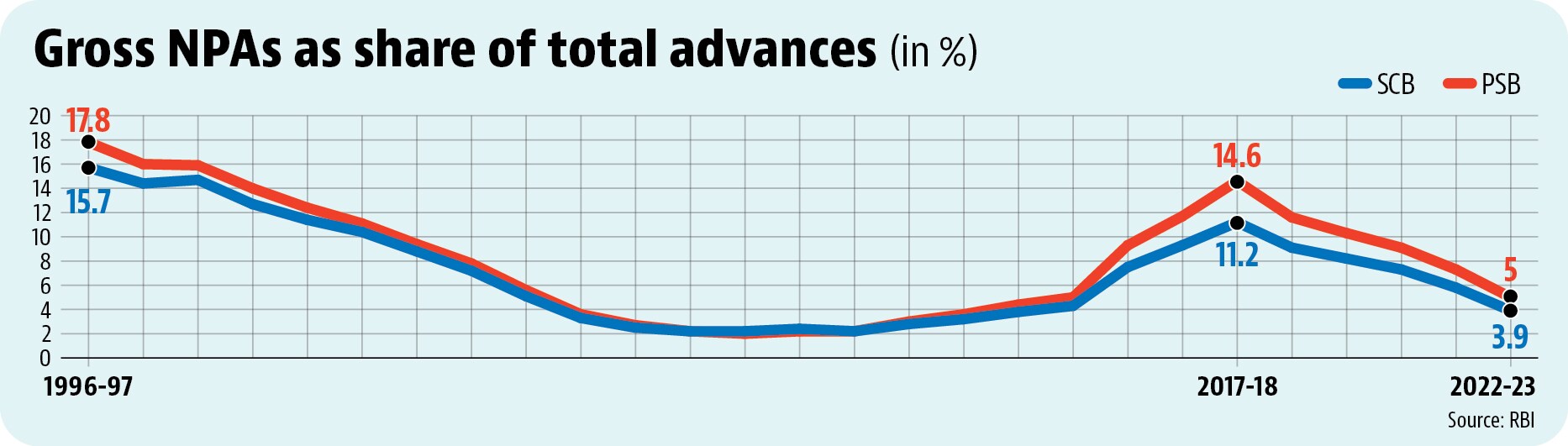
 NPAs have come down significantly…At the peak of the bad loan crisis in 2017-18, gross NPAs or GNPAs accounted for 11.2% of total loans and advances of all Scheduled Commercial Banks (SCBs). This number was 14.6% for Public Sector Banks (PSBs). This number has fallen consistently since then and was 3.9% and 5.2% for SCBs and PSBs according to RBI’s June 2023 Financial Stability Report. A Right to Information (RTI) response by RBI to Prasenjit Bose on October 6, 2023 – HT has a copy of the document – shows that the GNPA ratio for PSBs is 5% as on March 31, 2023. What explains the fall in NPAs in Indian banks?
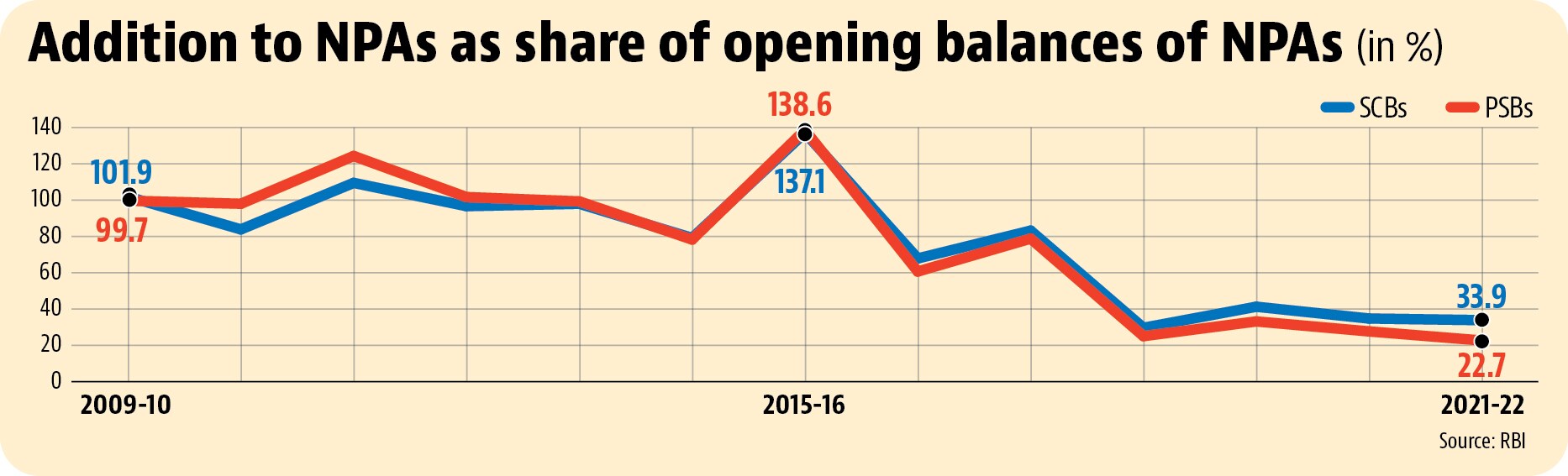
- New NPAs not being created has played a big role in their reductionAn analysis of RBI data on movement of NPAs for SCBs shows that the biggest reason for the fall in NPAs in absolute terms has been a decline in creation of new NPAs. This becomes clear if one looks at addition of new NPAs as the share of opening balance of NPAs in that year. Between 2009-10 and 2015-16 the addition to NPAs in each year was higher than the opening balance in three years (2009-10, 2011-12 and 2015-16), at least 90% of the opening balance in 2012-13 and 2013-14 and 83.9% and 79.2% in 2010-11 and 2014-15. This number has fallen almost consistently in the period after that and it was around one-third in 2020-21 and 2021-22.
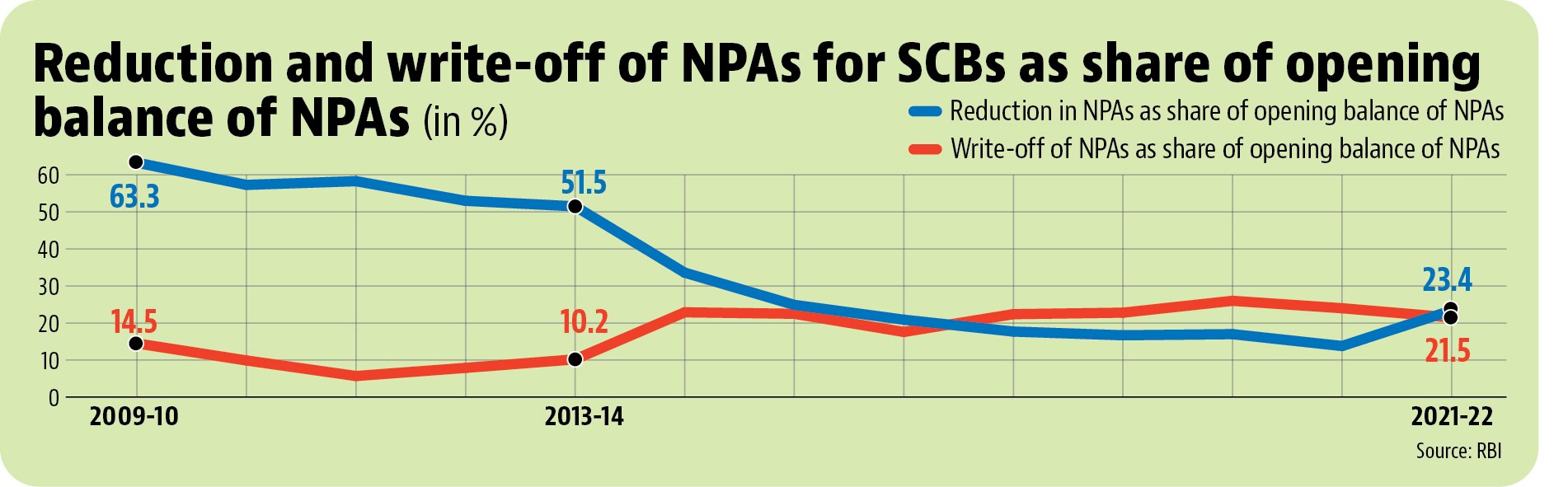
- But write-offs have also played a big role in bringing down existing NPAsTo be sure, just the fact that new NPAs are not being created cannot solve a bad loan problem for banks. This is because banks must get rid of existing bad loans or NPAs on their books. Logically speaking, this can be done in two ways. Either the borrower pays up and NPAs cease to be NPAs (reduction of NPAs), or the bank writes off the NPA from its books after recording it as capital loss. A comparison of yearly reduction and write-off of NPAs as a share of opening balances shows that the latter have played a bigger role in bringing down the total value of values than the former in four out of five years since 2017-18 which is when the NPA crisis peaked.
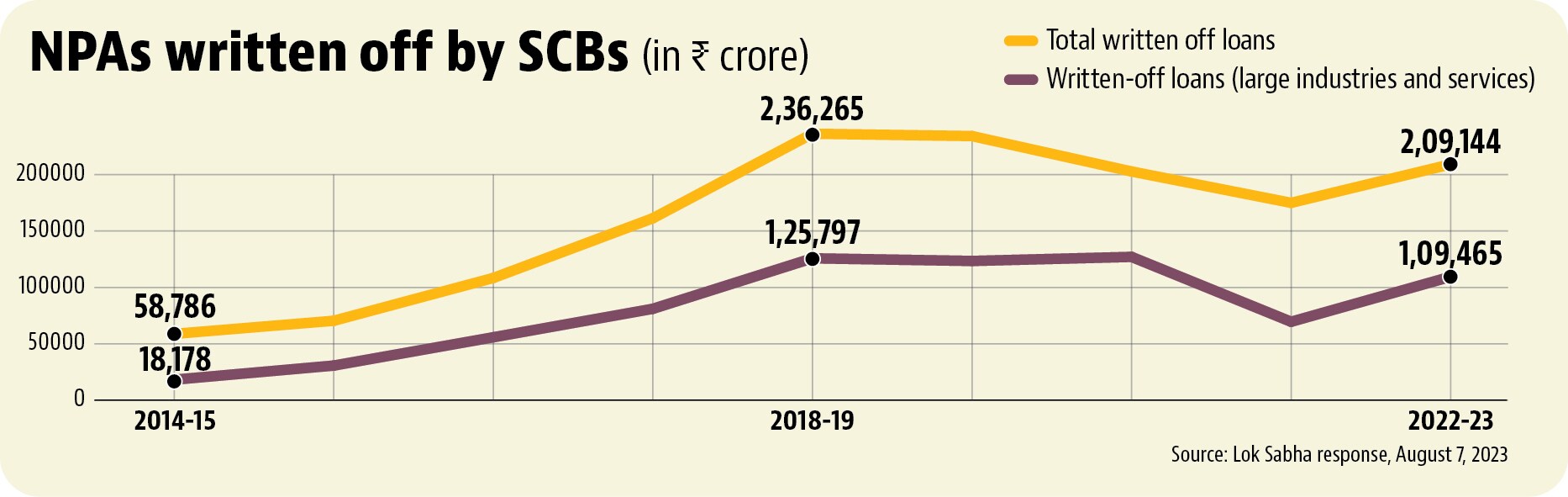
- SCBs have written off ₹14.6 lakh crore in NPAs since 2014-15The cumulative amount of NPAs written off by SCBs and PSBs between 2009-10 and 2021-22, according to the RBI data on movement of NPAs is ₹13.2 lakh crore and ₹9.7 lakh crore respectively. To be sure, this data is dated and does not have the numbers for 2022-23. A Lok Sabha reply by the government on August 7, 2023 said that SCBs had written off ₹14.6 lakh crore in NPAs between 2014-15 and 2022-23. 50% of these NPAs are for “large industries and services”, the reply said, although it did not define this category exactly. There is no information in the public domain about the borrowers whose NPAs have been written off by banks in keeping with banking laws in India.
- The fiscal cost of writing off NPAsWriting off a bad loan is not a cost-free exercise for a bank. Not only does the exercise affect its books via the immediate loss by writing off the NPA, the bank must also make sure that its capital adequacy ratios do not slip below statutory levels which can either limit its credit creation capacity or, worse, trigger a bank run. Given the fact that PSBs account for an overwhelming share of written off NPAs in India, it is not surprising that it is the government which infused capital in these banks to make sure that their viability did not suffer. On February 7, 2022 the government informed the Lok Sabha that it had infused ₹3.1 lakh crore to recapitalize PSBs of which ₹34,997 crore came through budgetary allocations and another ₹2.76 lakh crore through issuance of recapitalization bonds to banks. The latter is essentially a long-term debt by the government and will entail regular interest payments. Simply speaking, recapitalization of PSBs by the government is nothing but a socialisation of the bank’s losses (on account of overwhelmingly large borrowers not paying up) using taxpayers’ money. Should this be treated as a one-time expense and forgotten? This is the question which the second part of this series will try and address.