
 E-Paper



NW India records very poor AQI; dense fog also likely: IMD
Higher air pollution levels are likely to be due to reduced wind speed in the morning and moisture in the air which tends to make pollution particles heavy and cling together


Many towns and cities in northwest India recorded very poor quality air on Wednesday morning. This includes Delhi with an air quality index (AQI) of 341, Faridabad, Ghaziabad, Greater Noida, Noida, Rohtak etc.
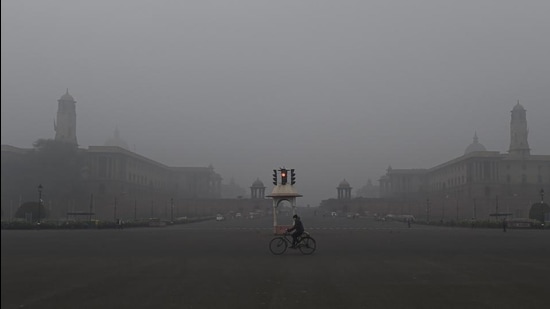
This in spite of strong winds of 15 to 25 kmph blowing during the day. Higher air pollution levels are likely to be due to reduced wind speed in the morning and moisture in the air which tends to make pollution particles heavy and cling together. Dense fog is also likely in many parts of NW India on Wednesday morning.
Many stations recorded cold day/severe cold day and cold wave on Tuesday. “There is uplifted fog and cloud cover in many parts of NW India because of which the day temperatures are falling, nights are also very cold. This is because an intense Western Disturbance has passed on January 8 and northwesterly winds are blowing from the direction of the snow-clad Himalayas. The feels-like temperature in many parts of northwest India is at least 2 degrees lower because of chilly winds and cold days,” said Kuldeep Shrivastava, head of the regional weather forecasting Centre.
The feels-like temperature takes into account wind speeds and humidity to assess how the human body actually perceives the temperature. In winter, a strong wind can make a day feel much colder than what the measured temperature would indicate.
Shrivastava added, “The minimum and maximum temperatures may fall by 1 or 2 degrees in the next three days and both a cold day and cold wave may be recorded over many places including Delhi.”
There is no likelihood of a Western Disturbance affecting the Western Himalayan region for four to five days during which period, the temperatures are likely to be lower than normal and winds are likely to be northwesterly.
Some parts of Punjab, Haryana, Uttar Pradesh and West Rajasthan recorded cold wave and severe cold wave conditions on Monday and Tuesday according to the Regional Meteorological Centre.
IMD has warned of minimum and maximum temperatures falling further in the coming days. Amid the prevalence of north/northwesterly winds, minimum temperatures are likely to be below normal over most parts of northwest India during Punjab, Haryana, Chandigarh, Delhi, Uttar Pradesh and Uttarakhand. Dense or very dense fog is expected to envelop parts of the region
Cold Wave/ Severe Cold Wave conditions are also likely over some parts over Punjab, Haryana, Chandigarh, Delhi and in isolated parts over Uttar Pradesh, north Madhya Pradesh and Rajasthan during the next three days. Ground frost is likely in isolated pockets over south Punjab, Haryana, Chandigarh and north Rajasthan during the next two days. Dense to very dense fog conditions are likely in some places.
Cold day conditions intensified on Tuesday with Delhi’s Palam recording 14.8 degrees C, 5.7 degrees C below normal; Chandigarh 11.1 degrees C, 9.6 degrees C below normal; Ambala 12.6 degrees C, 6.7 degrees C below normal; Gorakhpur 15.2 degrees C, 7.3 degrees C below normal; and Rohtak 14.9 degrees C, 5.7 degrees C below normal.
According to IMD, a cold day or severe cold day is classified as such based on two parameters—a minimum temperature of under 10 degrees and maximum temperature of 4.5 degrees C or 6.4 degrees C below normal, respectively.
A cold wave occurs in the plains when the minimum temperature is 10 degrees Celsius or below and/or is 4.5 notches lower than the season’s normal for two consecutive days. A cold wave is also declared when the minimum temperature is less than 4 degrees C in the plains.


