
 E-Paper



Operation Sindoor an 88-hour trailer: Indian Army chief warns Pakistan
The army chief’s comments come weeks after he warned Pakistan that if it wants to stay on the world map, it will have to stop sponsoring cross border terrorism.

 Prefer HTon Google


Army chief General Upendra Dwivedi on Monday likened the four-day military confrontation with Pakistan in May under Operation Sindoor to a trailer, saying the film hadn’t even begun, a stern warning to the neighbour of an overwhelming response if it attempted any mischief.
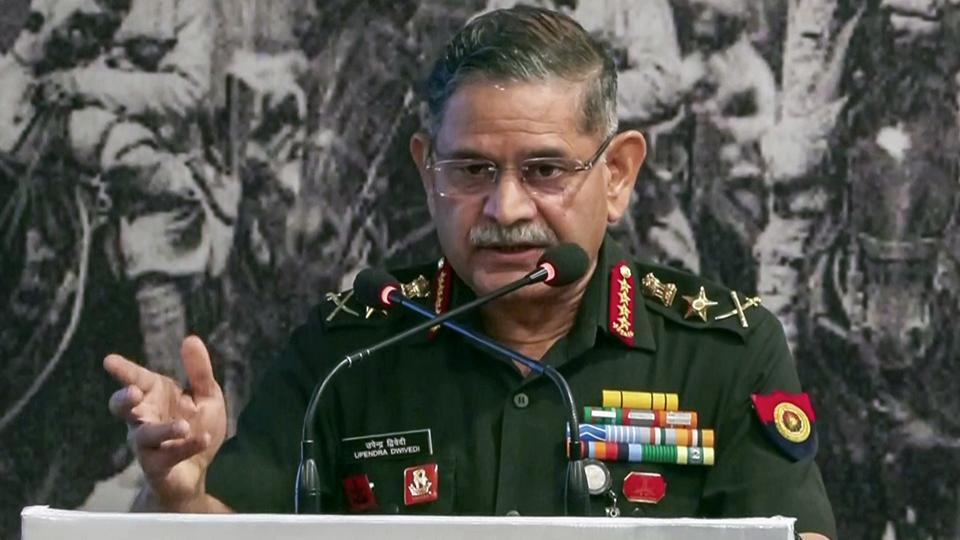
“As far as Sindoor 1.0 is concerned, I would like to say that the movie had not even started. We just showed them a trailer and that trailer ended in 88 hours…We are fully prepared for how things unfold in the future, and if Pakistan gives us a chance (again), we will educate them on how a responsible nation should behave with its neighbours,” Dwivedi said at a curtain-raiser to the Chanakya Defence Dialogue scheduled to take place on November 27-28.
Operation Sindoor marked New Delhi’s direct military response to the April 22 Pahalgam terror attack in which 26 people were killed. India launched the operation in the early hours of May 7 and struck terror and military installations in Pakistan and Pakistan-occupied Kashmir (PoK) before the May 10 ceasefire.
The clash involved fighter jets, missiles, armed drones, and a fierce artillery duel.
Dwivedi said even if India received a “bairang chitthi” (unstamped letter), it knew who to respond to; a likely reference to unclaimed terror attacks but suspected to have been orchestrated from across the border.
“We are saying you follow the peace process...Till the time that does not happen, whether it is the terrorists or their masters, they are the same for us. Whoever encourages terrorism, we will respond. Even if we get a ‘bairang chitthi’, we know who to respond to. We are not worried about that.”
“We talk about progress, we talk about taking everyone together… anyone who puts hurdles in our way, we will have to take some action against them.”
Asked if deterrence was working in the context of the 10/11 Red Fort blast as India’s enemies were also exploring new methods to target the country, the army chief said India’s military power was growing by the day and deterrence was working. “Military power, and political intent contribute to deterrence. Today, we have deterrence and the other side believes that we will act if they do something wrong,” he said.
The army chief’s comments come weeks after he warned Pakistan that if it wants to stay on the world map, it will have to stop sponsoring cross border terrorism, adding that next time India will not exercise the restraint it showed during Operation Sindoor.
“India, as a country, is fully prepared this time. And this time, it will not show the restraint that it showed during Operation Sindoor 1.0. This time we will take a step forward and act in a manner that will make Pakistan think whether it wants to remain on the world map or not. If it wants to retain its place on the world map, it will have to spot state-sponsored terrorism,” he said on October 3, addressing soldiers at Anupgarh in Rajasthan’s Sriganganagar district.
On Monday, Dwivedi said the ‘new normal’ created by Operation Sindoor would remain a big warning for Pakistan, adding that state-sponsored terrorism was a cause of concern for India. Days after four-day clash with Pakistan, Prime Minister Narendra Modi said Operation Sindoor was now India’s policy against terror and added that the early morning May 7 strikes on “universities of terror” sponsored by Islamabad marked a ‘new normal.’
Dwivedi reiterated the Indian stand that “blood and water cannot flow together, and talks and terror can’t go on together,” adding that the country was not scared of any (nuclear) blackmail by Pakistan.
The army chief delved into the key lessons drawn from Operation Sindoor including taking swift decisions, fighting a war jointly and staying prepared to fight longer wars.
“Today’s warfare is multi-domain in nature and many of its aspects are interconnected. If I say the army can fight a war alone, that is not the case. The faster we integrate, the better we can fight this war jointly…We fought the war for 88 hours, but tomorrow it can go on for four months of even four years. We will have to stay prepared…”


