E-Paper



Panel slams IIMA for new logo, renovations
An expert committee has identified key challenges facing the Indian Institute of Management Ahmedabad (IIMA), including global competition, a decline in rankings, and alumni concerns. The committee has called for improved strategic focus, enhanced alumni involvement, and prioritisation of research. It also criticised the institute for changing its logo and demolishing dorms without consulting alumni. The committee's recommendations are in line with the IIM Act, 2017, which requires performance evaluations and public availability of reports for each IIM. The IIMA board set up the independent expert group to conduct the evaluation.


Ahmedabad An independent expert committee that reviewed the Indian Institute of Management-Ahmedabad (IIMA) has listed key challenges faced by the institute in the wake of global competition, while calling for an improved “strategic focus” on retaining its top position. It also pulled up the institute for changing its logo and demolishing iconic dorms “without consulting” the alumni.
The committee, led by former NASSCOM president Kiran Karnik, in its 71-page report has underscored several imperative recommendations, including enhancing inclusive decision-making and alumni involvement, improving rankings, prioritising world-class research, ensuring affordability for students, and preserving architectural heritage.
“Many alumni are concerned about possible damage to IIMA’s reputation as an eminent institution of repute because of its slippage on global rankings and some negative coverage in the media,” the report, dated May 12 and recently uploaded on the institute’s website, said. “Having better mechanisms of engagement with alumni would help in removing some of the apprehensions on this front.”
In 2009-10, IIMA ranked 11th in the FT (Financial Times) Rankings for the one-year programme and 41st in the Economist Rankings for the two-year programme. However, its current rankings have gone down to 51 in the FT Rankings and 99 in the Economist Rankings.
The committee report is in line with the IIM Act, 2017, which mandates that boards of each IIM conduct performance evaluations through an independent agency or group of experts and make it publicly available. Following its meetings in April and September last year, the IIMA board set up an independent expert group (IEG), chaired by Karnik and comprising Nagpurnanand Prabhala, professor, Johns Hopkins University; Janat Shah, professor, IIM-Udaipur; and Ram Singh, professor, Delhi School of Economics as its members.
In today’s business school, there is no escape from peer-reviewed research that targets the top journals, the panel said, adding this directly impacts school rankings.
“Rankings, for example, now need to relate to other global institutions and not just Indian ones. High-quality research — which is an important determinant of ranking — requires a global mindset in which research informs problems faced by businesses anywhere, including Indian businesses aspiring to be the best in class. Achieving this global best-in-class mindset requires freeing researchers to collaborate across boundaries,” it said.
According to large recruiters, the report further said, the talent pool at IIMA continues to be unparalleled in India, and the skills and capabilities of its graduates are comparable to those of top schools in the world. Nevertheless, the gap between IIMA and other top institutions in India, such as ISB and IIM Bangalore, has been shrinking, it added.
The panel asked the institute to draw out a 10-year vision plan by an external agency working closely with the institute.
“At the international level, the globalisation of the talent market means that IIMA has now to face challenges not only in recruiting, but also in retaining faculty. A similar challenge arises regarding students, many more of whom can now afford to study abroad (with many countries incentivising such cross-border flow of students from India). These are amplified by a major domestic change: allowing foreign universities to set up campuses in India. This, and the increase in quality private business schools, means greater competition for faculty and students even within India,” it said.
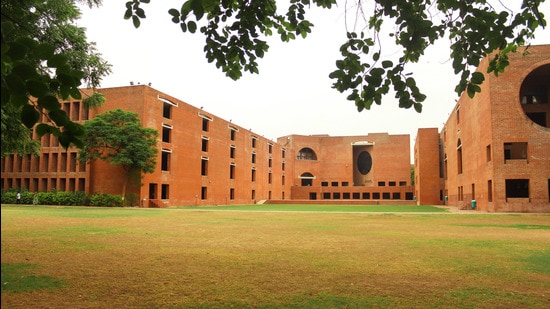
Many alumni, according to the panel report, are concerned over the demolition and reconstruction of the dorms on the IIMA old campus. “It did not help matters that the dorm demolition decision came on the heels of the decision to change the ‘IIMA logo’ without input from or communication with the alumni,” the committee said. “The dorms have enormous sentimental value to alums and great architectural significance historically. Their demolition with no communication or engagement from alumni has bred suspicions and mistrust, especially when joined with little to no communication about the new designs that will replace the old ones.”
Last year, the IIMA board decided to change the iconic logo —inspired by the latticework of the Sidi Saiyyed Mosque in Ahmedabad — following the institute director’s proposal, which faced opposition from a group of faculty and alumni. In 2020, a proposal to demolish the heritage structures at IIMA, starting with the iconic dorms designed by Louis Kahn, also sparked discontent among the faculty and alumni.
The review panel, without naming anyone, said the institute director should be first among equals rather than an all-powerful CEO. It added that the 10-year vision statement should include a commitment to “inspirational architecture” which should be emphasised along with all aspects of scholarship.
“While the successful placement record mitigates concerns about investment in an IIMA education, scholarships remain quite critical for students from underprivileged backgrounds,” the panel said, while recommending instituting a process for benchmarking fees against comparably ranked peers.
An IIMA official, when contacted, refused to comment on the expert panel’s recommendations.