E-Paper



PM Modi accuses Congress of neglecting tribal communities, unveils ₹9,700-cr projects in Gujarat
Prime Minister Narendra Modi criticised the Congress, saying the party that governed India for six decades had “left tribal communities to their fate.”

 Prefer HTon Google


Ahmedabad: Prime Minister Narendra Modi, speaking at a Janjatiya Gaurav Diwas event in Dediapada in Gujarat’s Narmada district on Friday, criticised the Congress, saying the party that governed India for six decades had “left tribal communities to their fate.”
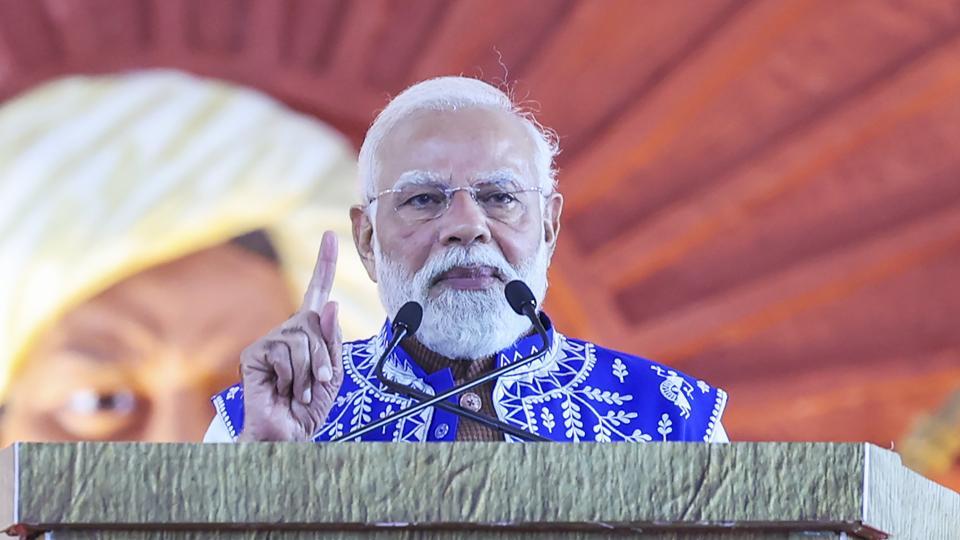
Addressing a gathering after inaugurating and laying the foundation stone of development projects worth over ₹9,700 crore in the tribal belt of south Gujarat, he said, “The occasion of Janjatiya Gaurav Diwas also reminds us of the injustice meted out to crores of our tribal brothers and sisters. The Congress, which ruled the country for six decades, left the tribal communities to their fate. Our tribal regions faced issues like malnutrition, lack of healthcare, inadequate education, and poor connectivity. These deficiencies in a way became the identity of the tribal regions, but the Congress did nothing about it.”
He added that tribal welfare has always been the highest priority for their party’s unwavering resolve to end the injustices faced by tribal communities and to ensure that the benefits of development reach them.
“Our country gained freedom way back in 1947 and the tribal community is also linked to Lord Ram. It is so old. But those who ruled for six decades did not realise that there is a need to work on the development of such a large community. For the first time when Atal Bihari Vajpayee became the Prime Minister in the BJP-led government, a separate ministry for tribal affairs was established. After his government, when Congress got an opportunity to serve the country for ten years, they neglected this ministry. It was completely forgotten,” he said.
He said that in 2013, the then government allocated only a few thousand crore for tribal welfare, but after their government came to power, the budget for the Ministry of Tribal Affairs has risen multifold.
Recalling his tenure as chief minister of Gujarat, he said he had launched the Kanya Kelavani Mahotsav from Dediapada. He said many children used to meet him, with some expressing their desire to become doctors, others aspiring to be engineers or scientists, and he used to encourage them to move forward and assured them that any obstacles in fulfilling their dreams would be removed.
“In the past five to six years alone, the central government has allocated over ₹18,000 crore for Eklavya Model Residential Schools across the country. Essential facilities have been provided in schools for girl students. As a result, there has been a 60% increase in the number of tribal children enrolling in these schools,” he said.
Emphasising that their government works with a vision of prioritizing the deprived, the Prime Minister cited Narmada district as a major example, which was once considered backward. He said the district was given priority, declared an aspirational district, and has since progressed significantly across various development parameters.
He said sickle cell disease has long posed a major threat to tribal communities, and to combat this, the number of dispensaries, medical centres, and hospitals in tribal regions has been increased. A nationwide campaign is underway to address sickle cell disease, and under this initiative, six crore tribal brothers and sisters across the country have already been screened, he added.
He highlighted that several projects related to national development and tribal welfare were inaugurated and foundation stones laid on Saturday. Under PM-JANMAN and other schemes, one lakh families in the region have been provided with permanent houses. A large number of Eklavya Model Schools and Ashram Schools have also been inaugurated and their foundation stones laid. The Prime Minister said the Shri Govind Guru Chair has been established at the Birsa Munda Tribal University, and several other projects related to health, roads, and transport have also been initiated.
Modi also emphasised the importance of passing on the tribal community’s contribution to the freedom movement to future generations.
“Several tribal museums are being established across the country. In Gujarat, a vast tribal museum is being constructed on 25 acres in Rajpipla. A few days ago, I visited Chhattisgarh and inaugurated the Shaheed Veer Narayan Singh Tribal Museum there,” the Prime Minister said, adding that the jail where Birsa Munda was imprisoned is being developed into a tribal museum in Ranchi.
Announcing the establishment of the Shri Govind Guru Chair for the Tribal Language Promotion Centre, Modi said the centre will study the dialects of tribal communities such as Bhil, Gamit, Vasava, Garasia, Konkani, Santhal, Rathwa, Nayak, Dabla, Chaudhary, Kokna, Kumbhi, Warli and Dodia.
“Stories and songs associated with these communities will be preserved. The tribal society possesses knowledge acquired through thousands of years of experience. Their way of life embodies science, their stories reflect philosophy, and their languages carry an understanding of the environment,” Modi said, affirming that the Shri Govind Guru Chair will help connect the new generation with this rich tradition.