
 E-Paper



Police await order to shut PFI offices in K’taka
An additional director general of police rank officer, who spoke on the condition of anonymity, said the deputy commissioners of respective districts will issue orders that will enable police to search and seize PFI property in the coming days.


With the banning of Popular Front of India (PFI), Karnataka police officers said police have the right to arrest members of the organisation, freeze their accounts and even confiscate its assets.
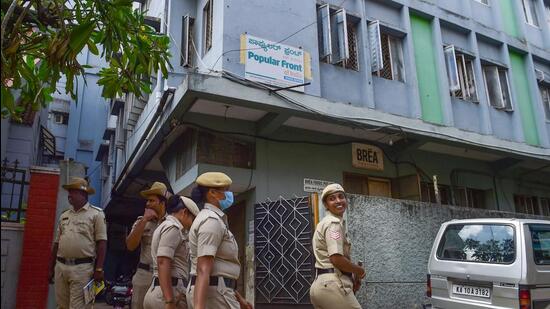
An additional director general of police (ADGP) rank officer, who spoke on the condition of anonymity, said the deputy commissioners (DCs) of respective districts will issue orders that will enable police to search and seize PFI property in the coming days.
“Once these orders are passed by the DCs, respective SPs (superintends of police) will conduct search, seizure and closure of all these PFI offices in the state. If there are any immovable assets, they will be intimated to ED (enforcement directorate) for attachment,” the officer said.
The officer said police will not allow any congregation at PFI offices. “Anyone gathering at these offices could be taken into custody. Section 10 of the UAPA criminalises membership of a banned organisation. It says that being a member of a banned organisation would be punishable by imprisonment of two years and may extend to life imprisonment and even the death sentence in certain circumstances.”
However, when asked how the members will be identified and what can an existing member do, the officer admitted that it was a grey area. “We understand that there is no membership documentation for PFI in Karnataka and also there aren’t any bylaws that allow a person to renounce his membership. We are looking into the further. At the same time, we currently have the powers to take anyone into custody, who we find is organising people under the name of PFI or even issues a statement under the organisation’s name,” he added.
According to the officer, the government is mandated to set up an Unlawful Activities Prevention Tribunal within 30 days under the UAPA’s Section 4. Once the tribunal is set up, it will issue a notice to the PFI asking it to reply in writing about why it should not be banned.
Based on submissions from both sides, the tribunal can hold an inquiry to decide whether there was sufficient evidence to declare PFI an unlawful association. PFI’s legal team will be given an opportunity to present its defence before the tribunal.
On Tuesday, Karnataka police, based on the inputs from central intelligence agencies, placed around 80 members of the PFI under preventive custody. Senior officers said statewide raids were conducted based on intelligence inputs that suspects in custody were planning to incite communal tensions in various parts of the state.
Police have placed these PFI leaders under custody under section 110 of the CrPC on charges of disturbing the peace of the society, said a senior officer. Raids and prevention custody were carried out in Shivamogga, Chitradurga, Mangaluru, Hassan, Bidar, Chikkaballapura, Raichur, and Ramanagara among other places.
Additional director general of police (ADGP) law and order Alok Kumar said raids were conducted based on inputs of a conspiracy hatching to create unrest in the state.
“Last week, National Investigation Agency conducted raids in Karnataka and arrested seven people and later Karnataka police arrested 13 people. While continuing this police action, we have received some information that some people were inciting communal violence and trying to create unrest in society. Based on this intelligence input, these preventive detentions have been made,” he said.
On Thursday, scores of PFI activists were detained or arrested as the NIA-led multi-agency raids on the premises of the organisation and people linked to it as part of a nationwide crackdown across 10 states for allegedly supporting terror activities.


