
 E-Paper



Prez Kovind lauds Covid fight in ‘modern India’ pitch
In his address to a joint session of Lok Sabha and Rajya Sabha at the start of Parliament’s budget session, Kovind began by paying tribute to the nation’s freedom fighters on the 75th anniversary of India’s Independence.

 Prefer HTon Google


President Ram Nath Kovind on Monday listed the government’s achievements amid the Covid-19 crisis, especially the steps to fight the pandemic and to aid farmers and women, and called for more hard work to build a modern India by the centenary of Independence in 2047.
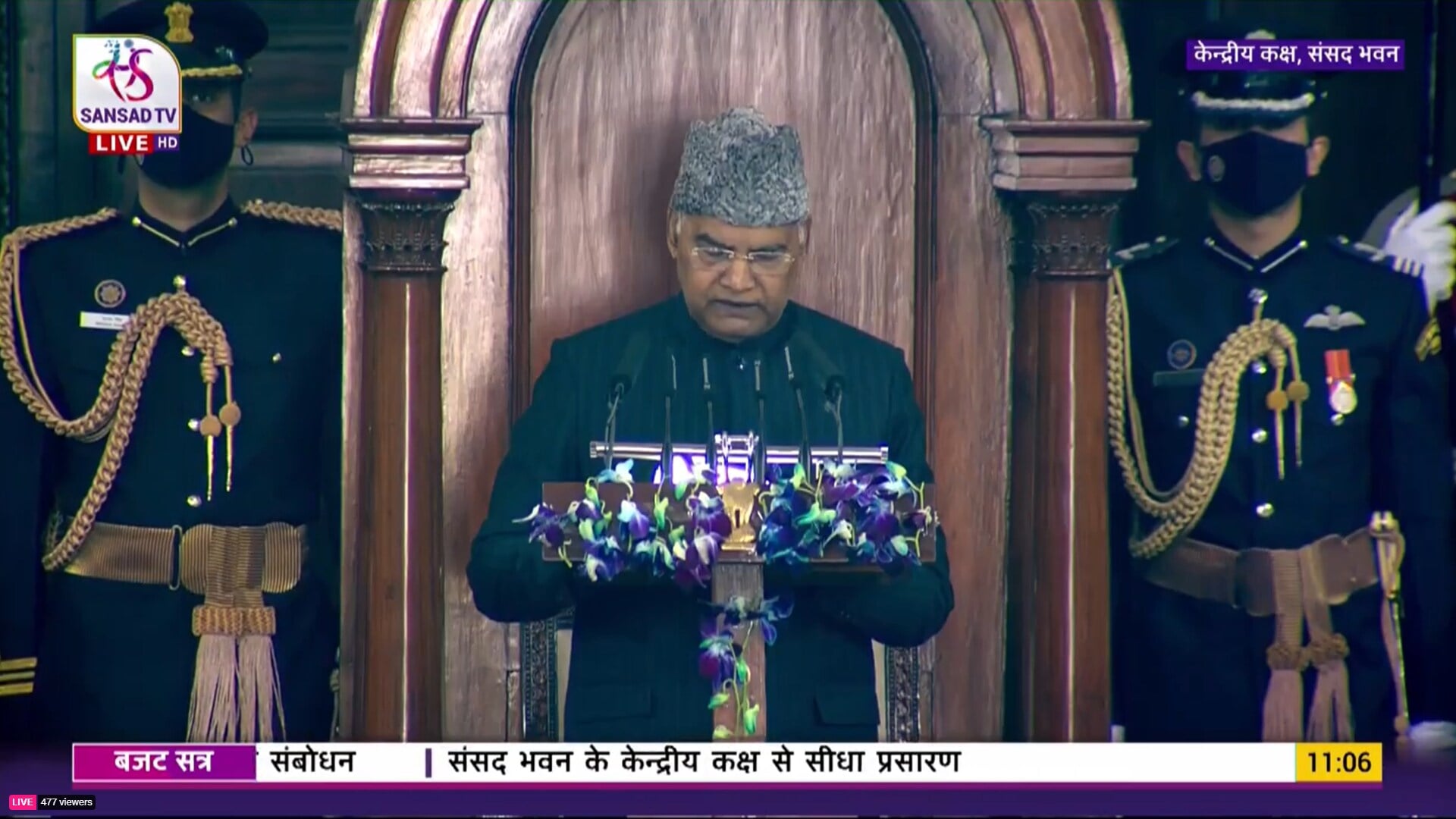
In his address to a joint session of Lok Sabha and Rajya Sabha at the start of Parliament’s budget session, Kovind began by paying tribute to the nation’s freedom fighters on the 75th anniversary of India’s Independence and said the government is laying the foundation for the next 25 years with the mantra of Sabka Saath, Sabka Vikas, Sabka Vishwas, Aur Sabka Prayas to make the country more self-reliant.
“Today, the country’s achievements and successes are as limitless as the country’s potential and possibilities. These achievements are not of one institution or establishment, these are the collective achievements of more than a billion citizens of our country. These are the fruits of the labour and sweat of billion-plus people,” he said, speaking in Hindi.
“These achievements are milestones in the long journey to achieve our ambitious goals, and are our motivations to move forward. In 2047, the country will celebrate its centenary of independence. We have to work hard for building a grand, modern and developed India of that era...We all have a stake, and an equal stake in this journey,” he said.
The President’s speech at the start of the budget session usually highlights the government’s achievements over the past year and outlines targets and plans for the future.
Noting that this is the third successive year that India and the world have been affected by Covid-19, Kovind lauded the central and state governments, front line workers, nurses, doctors, scientists and entrepreneurs for working as a team to help the country cope with the pandemic.
The government’s commitment to fight the coronavirus is reflected in the country’s massive vaccination programme, where over 1.5 billion doses of vaccines had been administered in less than a year, he said.
Reacting to the President’s speech on Monday, Congress leader Manish Tewari said there was no mention of the deaths in the second wave of Covid-19 among other things. “Not a word on CHINA/PAK/Two Front situation. No regret on massacre of Civilians in Nagaland. No announcement on restoring statehood of J&K.Taliban take over of Afghanistan its terror implications on India obfuscated. No apology for Deaths in second COVID wave,” Tewari tweeted.
India is now among the countries with the most vaccine doses administered and this has increased morale and protection among citizens. Some 90% of adult citizens had been given one dose of vaccine, and 75% of those eligible had received both doses. Teenagers aged 15-18 years have been included in the vaccination programme and front line workers and senior citizens with co-morbidities are being given a precautionary third dose, the president said.
Eight Covid-19 vaccines had been authorised for emergency use by the government, and three made in India jabs had been approved by the World Health Organization (WHO), helping the country to play a role around the world in overcoming the pandemic, Kovind said.
While the government has taken on the immediate challenges in the fight against Covid-19, it is also developing solutions for the future, such as the Pradhan Mantri Ayushman Bharat Health Infrastructure Mission with an outlay of ₹64,000 crore that will prepare India for future crises.
More than 80,000 health and wellness centres and hundreds of thousands of Ayushman Bharat cards have helped the medical treatment of the poor, and affordable medicines are being supplied through more than 8,000 Jan Aushadhi Kendras. Products of Indian pharmaceutical firms are reaching more than 180 countries and the production-linked incentive (PLI) scheme for this sector will expand opportunities and boost research, Kovind said.
While several countries saw a scarcity of food grains during the during the worst pandemic in 100 years, the Indian government provided free rations to poor households every month under the Pradhan Mantri Garib Kalyan Anna Yojana, the world’s largest food distribution programme with an outlay of ₹2,60,000 crore, reaching 800 million beneficiaries for 19 months. This scheme has now been extended till March 2022.
The government also operates the PM-Sva-Nidhi scheme for protecting the livelihood of the poor amid the pandemic and has provided more than ₹2,900 crore to 2.8 million street vendors under this programme.
Kovind noted that farmers produced more than 300 million tonnes of food grains and 330 million tonnes of horticulture produce during 2020-21 despite the pandemic, and said the government is working to “empower the farmers and the rural economy”. The government made “record procurement to match the record production”, and procured 4,330,000 tonnes of wheat during the Rabi or winter season, benefiting about five million farmers.
“Our agriculture exports have reached a record level due to the efforts of the government. Agricultural exports registered a growth of more than 25% in 2020-21, and reached nearly ₹3 lakh crore,” Kovind said.
“In order to ensure remunerative prices to farmers for their crops, it is necessary that their products reach the right market. In this direction, the government has endeavoured to open new avenues of prosperity for the farmers by launching Kisan Rail Seva,” he said.
The Indian Railways operated more 1,900 Kisan Rail trains on more than 150 routes to transport about 600,000 tonnes of perishable agricultural produce amid the pandemic.
The interests of small farmers, who make up 80% of the farming community, are “central to our government”, and ₹1,80,000 crore has been provided to more than 110 million farmer families under the PM-Kisan Samman Nidhi, Kovind said. Small farmers have benefited from changes in the crop insurance scheme, and more than ₹100,000 crore has been given as compensation to about eight crore farmers.
Kovind noted the role played by women in giving an impetus to the rural economy, and said banks had lent ₹65,000 crore to more than 2.8 million women’s self-help groups during 2021-22, a fourfold increase from the amount extended during 2014-15. The government has trained thousands of members of self-help groups and made them partners for delivering banking services to rural homes.
“Women’s empowerment is one of the top priorities of my government...Entrepreneurship and skills of the mothers and sisters of our country have been promoted through the Mudra scheme. The Beti Bachao, Beti Padhao initiative has yielded many positive results, and there has been an encouraging improvement in the number of girls enrolled in schools,” he said, adding that the government has introduced a draft legislation to increase the minimum age of marriage for women from 18 to 21 years.
“The government has made a beginning to liberate the society from the manifestly arbitrary practice of triple talaq by making it a criminal offence. Restrictions on Muslim women from performing the Haj only with mehram (male guardian) have been removed. While about 30 million students from minority communities were provided scholarships prior to 2014, my government has provided scholarships to 45 million such students since 2014. This has led to a significant reduction in the school dropout rate of Muslim girls and an increase in their enrolment,” he said.
Kovind quoted the words of BR Ambedkar, the chief architect of the Constitution – “My ideal would be a society based on liberty, equality, and fraternity...Democracy is not merely a form of government…It is essentially an attitude of respect and reverence towards one’s fellow men” – and said the government considers these ideals as its motto.
“My government believes in the mantra of Antyodaya, which encompasses social justice, equality, respect and equal opportunities. Therefore, in the policies of the government, top priority is being given to villages, the poor, scheduled castes and scheduled tribes and backward communities,” he said.
He also quoted the words of the Tamil saint Thiruvalluvar – “Karkka kasaddar karpawai katrapin, Nirkka adarkka taga (What a person has learnt is reflected in his conduct)” – and said the government is implementing a new national education policy to “give shape to the resolve and potential of Atmanirbhar Bharat”.
Local languages are being promoted through this policy and emphasis is being laid on conducting important entrance examinations for undergraduate courses in Indian languages. This year, 19 engineering colleges in 10 states will start teaching in six Indian languages, he said.


