
 E-Paper



Priyanka Gandhi Vadra set to win Wayanad seat as ruling parties dominate by-polls
Priyanka Gandhi Vadra was leading in Kerala’s Wayanad Lok Sabha seat by a margin of 410,931 votes and to register a bigger win than Rahul Gandhi this summer


Congress leader Priyanka Gandhi Vadra, who is making her poll debut, was leading in Kerala’s Wayanad Lok Sabha seat by a margin of 410,931 votes while the Bharatiya Janata Party (BJP) was ahead in Maharashtra’s Nanded, the other paramilitary constituency where by-polls were held this month, even as ruling parties dominated the assembly by-polls across the country.
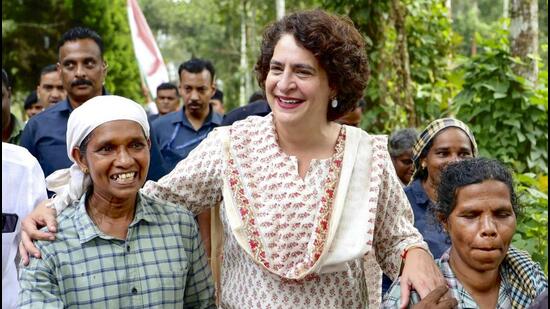
The Wayanad seat was left vacant when Congress leader Rahul Gandhi left it and chose to retain Rae Bareli in Uttar Pradesh, the second Lok Sabha seat he contested this summer. Priyanka Gandhi Vadra polled 622,338 votes while her closest opponent Communist Party of India’s Sathyan Mokeri was a distant second (211,407). She is all set to register a bigger win than Rahul Gandhi, who won the seat by a margin of 364,000 votes this summer. In 2019, he bagged the seat by a margin of 4,31,770 votes.
In Nanded, BJP’s Santukrao Marotrao Hambarde was leading with 287,149 seats followed by Congress’s Chavan Ravindra Vasantrao 276,013.
The parliamentary by-polls were held along with those to nine assembly seats in Uttar Pradesh, seven in Rajasthan, six in West Bengal, five in Assam, four each in Punjab and Bihar, three in Karnataka, two each in Madhya Pradesh and Kerala, and one seat each in Chhattisgarh, Gujarat, Uttarakhand and Meghalaya.
In Uttar Pradesh, the BJP won Ghaziabad, Khair, and Phulpur while it was leading in Kundarki, Majhawan, and Katehari. Ally Rashtriya Lok Dal (RLD) was leading in Meerapur while the Opposition Samajwadi Party won Karhal and Sishamau.
The by-polls in Uttar Pradesh were held months after the BJP’s poor Lok Sabha poll performance in the state. The BJP’s Lok Sabha tally in the state fell from 62 to 33. It lost erstwhile strongholds such as Faizabad (Ayodhya) despite the Ram Temple’s consecration in the run-up to the polls. The SP emerged as the single largest party with 37 out of 80 seats. The BJP’s underwhelming Lok Sabha performance in Uttar Pradesh triggered rumblings within the party’s state unit as the party fell short of the halfway mark of 272 seats in the 543-member Lok Sabha for the first time since 2014, making it dependent on allies.
The BJP-led government in Uttar Pradesh had a comfortable majority of 283 seats in the 403-member House. The SP and its allies had just 107 seats. In 2022, SP won four of the nine seats, where by-polls were held, BJP three, Nishad Party, and RLD one each.
The by-elections were seen as a test of chief minister Yogi Adityanath’s brand of politics, reflected in his controversial slogan, “Batoge to Katoge (divide and get chopped)”. The slogan was seen as a ploy to unite the Hindus even as it has faced criticism for lack of civility. The BJP has been alarmed over the division in the Hindu vote bank in the 2024 national polls, especially in Uttar Pradesh. The SP countered the BJP’s “Batoge to Katoge” with “Judoge to Jeetoge (unite and win).”
Former chief minister Akhilesh Yadav was banking on his “PDA formula” or social coalition of Other Backward Classes (OBCs), Dalits, and minorities, which helped the SP to emerge as the single largest party in Lok Sabha polls. He hoped to sustain the momentum of the Lok Sabha elections until the 2027 assembly elections and retain the status as a strong opposition party.
Yadav’s PDA formula is seen to have derailed the BJP’s ambition of forming a majority government at the Centre.
The SP fielded Yadav family members on six of the nine by-poll seats despite facing criticism over dynastic politics. In Karhal, the BJP nominated Anujesh Yadav, son-in-law of SP founder Mulayam Singh Yadav’s brother, Abhay Ram. SP fielded Tej Pratap Yadav, grandson of SP founder’s brother, Ratan Singh, and son-in-law of former Bihar chief minister Lalu Yadav, in Karhal, where the party has held sway since the mid-1980s.
In Bihar, the ruling National Democratic Alliance (NDA) won all four seats, which fell vacant when the lawmakers representing them were elected to Lok Sabha, ahead of the assembly polls next year. The BJP won Tarari, Ramgarh, and Belaganj while ally Hindustani Awam Morcha (Secular) Imamganj.
In Assam, the ruling BJP won Behali and was leading in Dholai and Samaguri. Allies United People’s Party, Liberal won Sidli while Asom Gana Parishad was leading in Bongaigaon.
The ruling BJP was leading in Chhattisgarh’s Raipur City South and Gujarat’s Vav. In Karnataka, the ruling Congress won all three seats—Shiggaon, Sandur, and Channapatna. Congress won Kerala’s Palakkad while the ruling Communist Party of India (Marxist) bagged Chelakkara.
The Opposition Congress won Madhya Pradesh’s Vijaypur seat while BJP was leading in Budhni. The National People’s Party bagged Meghalaya’s Gambegre. The ruling Aam Aadmi Party won Punjab’s Dera Baba Nanak, Chabbewal, Gidderbaha, and the Opposition Congress Barnala.
The BJP won Rajasthan’s Deoli-Uniara and Salumber while the governing party was leading in Khinwsar, Jhunjhunu, Ramgarh. The Opposition Congress was leading in Dausa and Bharat Adivasi Party won Chorasi.
In Uttarakhand ruling BJP won Kedarnath while the governing Trinamool Congress (TMC) strengthened its position further in West Bengal by winning five seats. TMC was leading on the remaining seat.


