
 E-Paper



Protect EWS students’ right to e-learning, SC tells states
The bench was dealing with an appeal by a group of private unaided schools against a Delhi high court order that directed these schools in the national capital to provide free gadgets and internet connections to poor students for online classes and claim reimbursement from the Delhi government.


The digital divide due to online teaching has produced stark consequences with underprivileged children forced to discontinue their studies or, worse, drop out, the Supreme Court lamented on Friday as it urged the Centre and states to put together a “realistic and lasting solution” for protecting the right to receive online education of children belonging to economically weaker sections (EWS).
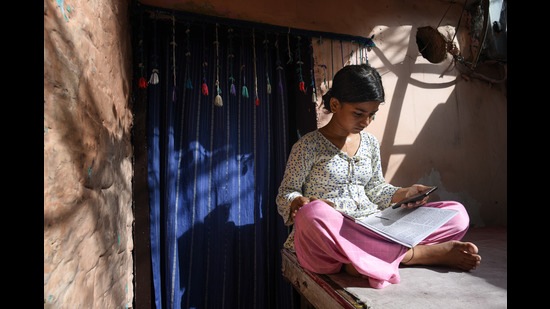
“The states must come out with a plan, otherwise there will be massive dropouts and as a result, there will be dangers of child marriage, child labour and child trafficking. Threat is so grave that the State has to act quickly and take this with utmost seriousness, and come out with some kind of policy to make sure children continue in schools,” observed a bench of justices Dhananjaya Y Chandrachud and BV Nagarathna.
“It is heart-rending that on one hand we are merging children belonging to EWS and DG with other children in good schools but on the other, how do we get the laptops and tablets for their parents who could be drivers or house maids. There is a real and grave threat of dropout of children because of lack of resources like devices and connectivity,” added the bench.
“If Article 21A (right to free and compulsory education between the age and 6 and 14) is to become a reality, the needs of children from the underprivileged section to receive online education cannot be denied,” asserted the court.
The bench was dealing with an appeal by a group of private unaided schools against a Delhi high court order that directed these schools in the national capital to provide free gadgets and internet connections to poor students for online classes and claim reimbursement from the Delhi government.
The Delhi government and the Centre have also filed appeals against this judgment.
The concerns of the top court have come two days after a report released by the Union education ministry said that 29.6 million school students do not have access to digital devices, as per data collected from 24 states and Union territories (UTs) until June. The numbers could be higher. Seven states and UTs, including the densely populated Uttar Pradesh and Maharashtra, have not submitted the data.
Representing NGO Justice For All, advocate Khagesh B Jha cited before the bench the government’s report, containing startling numbers that highlighted the extent to which students have been disadvantaged over the past year and a half when almost all education has been online in the shadow of the Covid pandemic. The high court order on September 18 had come on a petition by the NGO.
Agreeing with Jha, the bench said that it is a “crucial issue involving young citizens of India who could be deprived of their right to free and compulsory education under the RTE Act due to a lack of resources”.
Senior advocate Shyam Divan, who appeared for the private schools, said that the issue is complex as they cannot go on burdening parents of general category children if the Centre and states throw their hands in the air.
The court found merit in Divan’s submissions. “Mr Divan is right that we can’t burden private schools with everything. They will cross-subsidise it with other parents. But it is not like parents not belonging to EWS can pay for everything. What is the Delhi government doing? They should have a plan of action,” it said. On his part, the Delhi government counsel replied that financing the devices and internet are the chief issues.
At this, the court said that it will record its concerns in the order and would request the Chief Justice of India to list all the petitions on these issues as soon as possible so that “a practical solution can be found” while it expects “the central government and state governments to take up the matter in close coordination on an immediate basis and come out with a realistic and practical solution.”
Asking the Delhi government to come out with a plan to achieve the salutary purpose of the RTE Act, the court said in its order that “the need to provide adequate computer-based equipment together with access to online facilities for the EWS/DG children is of utmost importance”.
The education ministry’s data, which was released on Wednesday and is a part of a report titled “Initiatives by school education sector in 2020-21 for continuing teaching and learning”, is the first set of official statistics on the digital divide.
As reported by HT on October 7, of the 29 million, 14 million are from Bihar, with the number translating into 58% of total students in the state. This is followed by 3.2 million from Jharkhand, which is 43% of total student strength in the state; 3.1 million from Karnataka, 27% of the total strength of students in the state; 3.1 million from Assam, 44% of students in the state; and 1.75 million from Tamil Nadu, which is 14.5% of total student strength in the state.


